
Vladslo German Cemetery: Käthe Kollwitz's Grieving Parents
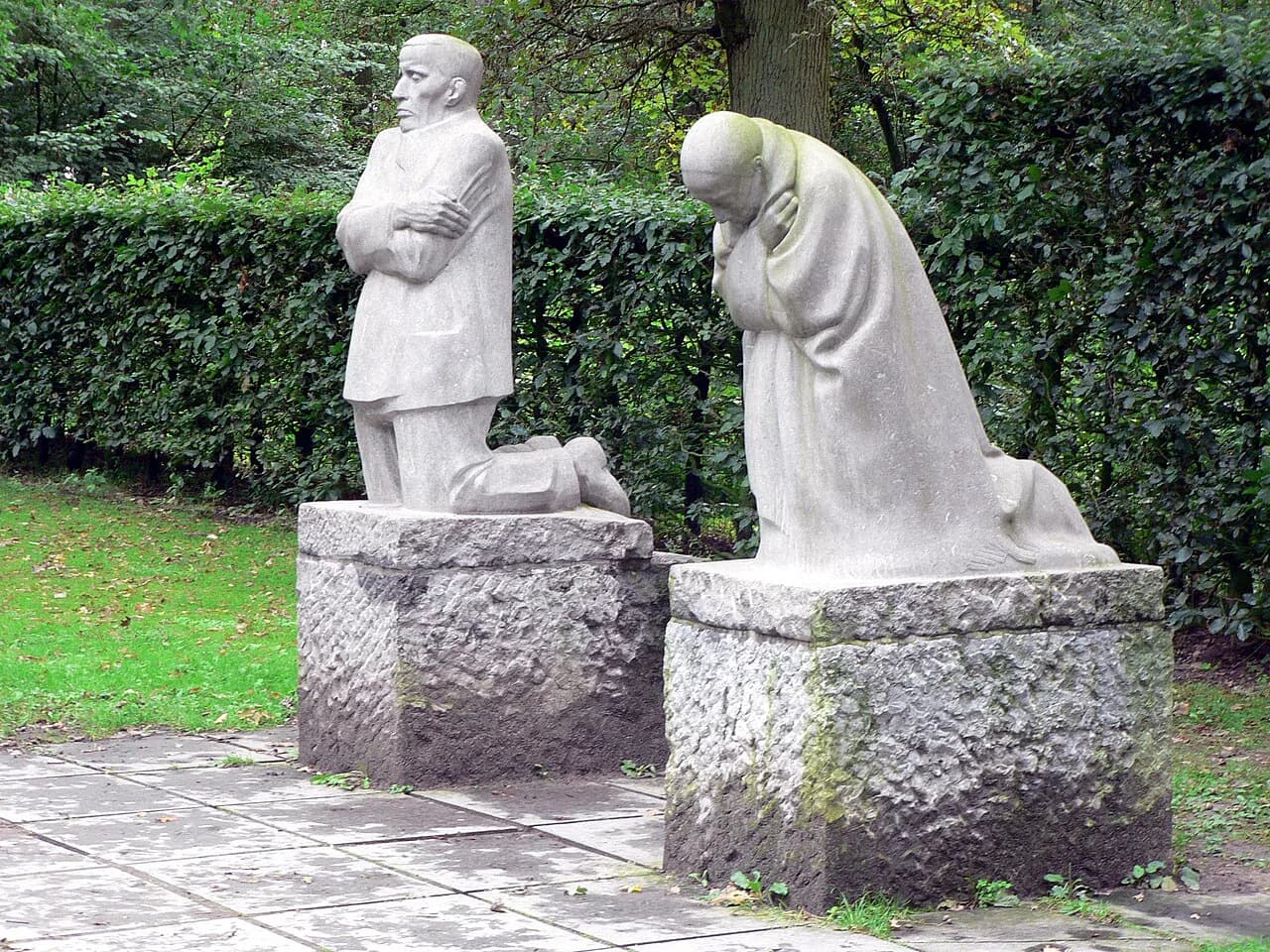
Vladslo German Military Cemetery near Diksmuide holds about 25,600 German war dead and Käthe Kollwitz's Grieving Parents, made in response to her son Peter's death.
On this page
Vladslo German Military Cemetery is a compact, wooded burial ground near Diksmuide in West Flanders, and its single unmissable sight is Käthe Kollwitz's sculpture The Grieving Parents, kneeling before the grave of her son Peter. Allow roughly half an hour on site: the cemetery is small, the sculpture is close to the entrance area, and the visit is about looking rather than touring. This guide covers who is buried here, why the sculpture faces the way it does, how the cemetery was laid out, and how it fits into a day built around the wider WW1 sites in Belgium.
Where Vladslo German Cemetery lies
The cemetery sits at Vladslo, a village in the Diksmuide municipality of West Flanders, in the flat polder country behind the Yser river. The surrounding landscape is the battlefield ground of the First World War, which began here in 1914 when German forces pushed west and the Belgian army held the line along the river. It is a rural, quiet setting rather than a town sight, so you come for the graves and the sculpture rather than for anything else nearby.
It makes a natural half-day addition to a stay in Ypres (Ieper) or Diksmuide, both of which have their own war museums and memorials. If you are working through the larger Commonwealth grounds first, Tyne Cot near Passchendaele gives you the opposite end of the scale, with its vast wall of names and its sea of Portland stone headstones.
The soldiers buried at Vladslo
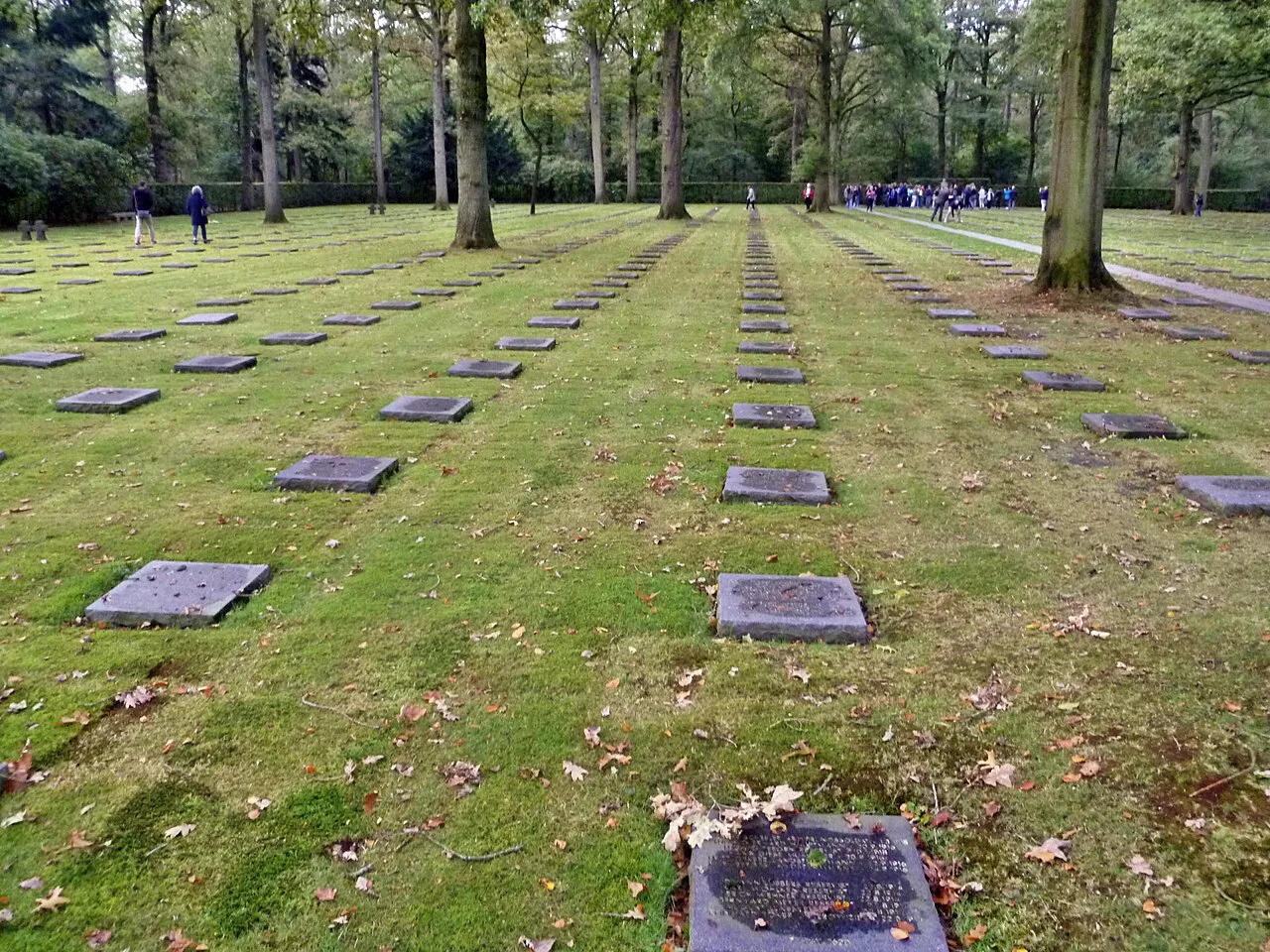
Vladslo holds about 25,600 German soldiers, according to a detailed account of the site and its history. The cemetery was first laid out by German soldiers in 1914 for those killed in the battle of the Yser, and after the war burials were brought in from across Belgium, making it a concentration cemetery rather than a ground where men fell and were buried where they lay.
Today the German War Graves Commission, the Volksbund, looks after the site on behalf of the German government. When the war ended in 1918 there were 134,000 German dead in Belgium alone, of whom about 16,500 were young volunteers killed in the first autumn battles of 1914. The Volksbund believes that some 90,000 soldiers are still unidentified or missing and thought to be buried in Flanders, which brings the German military dead in the region to around 210,000.
Peter Kollwitz and the making of the Grieving Parents
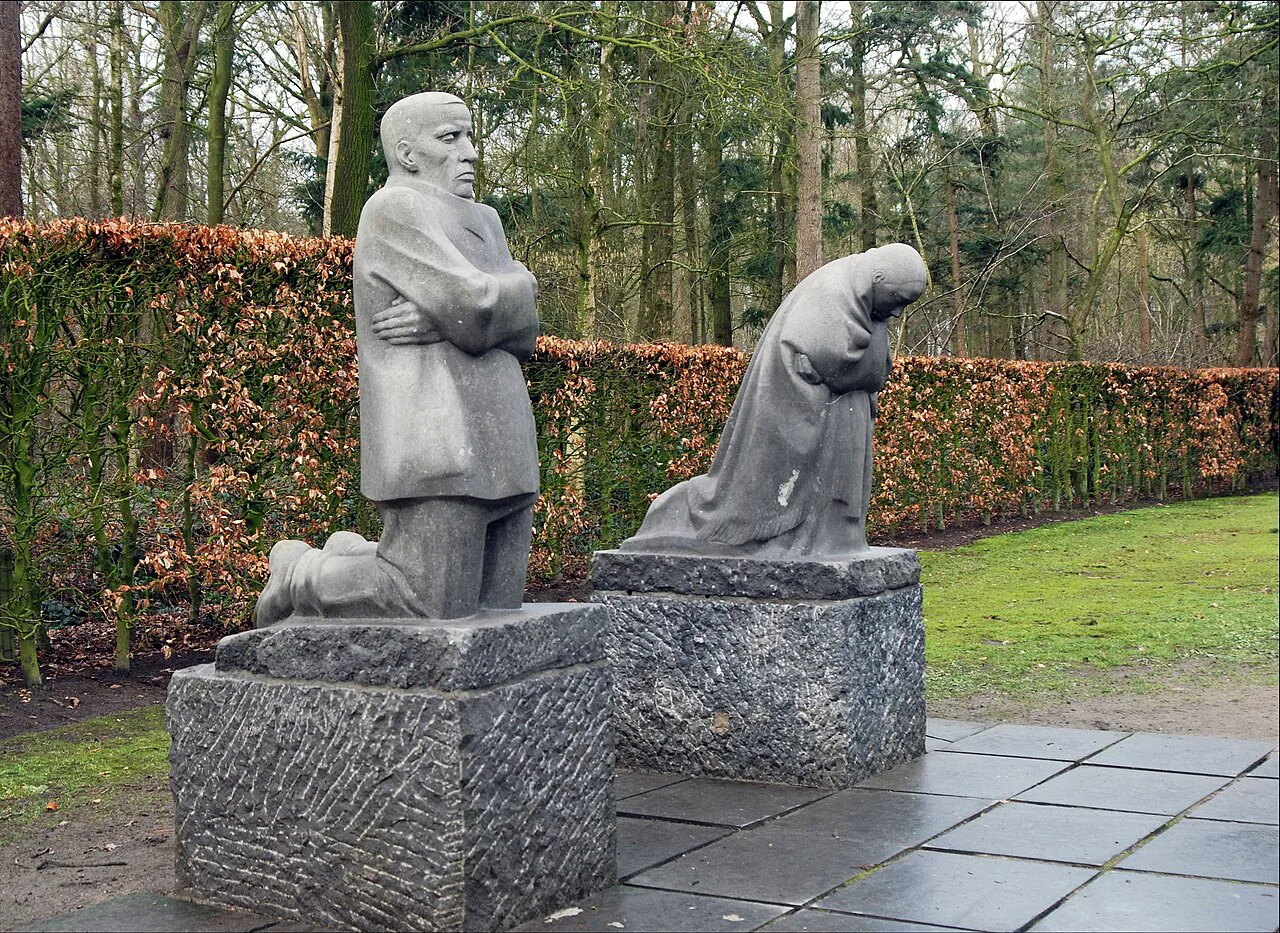
Peter Kollwitz was a student volunteer, just 17 years old, killed near Esen in October 1914, and he is buried at Vladslo. His mother, Käthe Kollwitz, was an Expressionist artist from Berlin, and she spent years working on the sculpture that became The Grieving Parents in response to his death. The work was only displayed for the first time in 1932, at the Roggeveld military cemetery at Esen, with a grave marker reading Peter Kollwitz Musketier and the date 23 October 1914.
Kollwitz's own later history sharpens the visit. In 1933 the Nazis removed her from the Prussian Academy of Art, classed her work as degenerate, and stripped it from most museums and public buildings; her grandson Peter was killed on the Eastern Front in 1942. The sculpture itself survived the German occupation of Belgium during the Second World War. Knowing this makes the two kneeling figures read less as civic sculpture and more as a private act of grief that outlasted the regime that rejected its maker.
What the sculpture looks like
The Grieving Parents shows two figures, a father and a mother, kneeling side by side on the ground. In front of them is the low grave marker of Peter Kollwitz; the parents' gaze focuses on the gravestone where their son is buried. Because the parents face the stone rather than the visitor, the group reads as an act of watching over a grave rather than a monument to be admired.
The figures were moved here with the cemetery in 1957, so the arrangement you see is complete and deliberate rather than a sculpture later dropped onto an existing plot. Walk round the group to see the faces, then stand where the parents' gaze falls to see the grave as they do.
Why the cemetery moved from Esen in 1957
Both the cemetery and the sculpture came to their present site in 1957. The burials were collected from all over Belgium and reburied here, and the Kollwitz figures came with them from the Roggeveld military cemetery at Esen. This explains one of the most striking things about Vladslo: it does not mark where a battle line ran, it marks where a Nation chose to gather its dead.
That distinction matters when you compare it with grounds such as Essex Farm cemetery, where the dressing station and the writing of In Flanders Fields belong to the exact spot. Vladslo asks a different kind of attention: it is a place of assembly, and the single family grave at its centre carries the weight of all the others.
The layout: shared graves and ground-level tablets
German cemeteries are not laid out like Commonwealth ones, and German practice varies: some grounds use tablets set flat into the ground, some use white headstones, and some use black iron crosses. At Vladslo it is usual for German soldiers to be buried several to a grave, and each grave here holds the bodies of eight soldiers. That burial pattern is what gives Vladslo its low, horizontal, shared profile.
The planting is rugged and natural rather than manicured, with trees and rough ground among the stones. Look down as much as around: the names are underfoot, and the effect of so many tablets among the roots and grass is the point of the design.
How it differs from Commonwealth and French cemeteries
The contrast with Commonwealth practice is the thing most British and American visitors notice first. German cemeteries are less landscaped, have no flowers in the French manner, and lack the regular Portland stone headstone that marks a Commonwealth grave. Where a Commonwealth ground such as Lijssenthoek military cemetery reads as a garden of uniform stones, Vladslo reads as a rugged, natural ground of shared graves.
None of this is accidental. The flat tablet and the shared grave express a different attitude to commemoration, and understanding that before you arrive stops Vladslo feeling under-maintained. It is not: the Volksbund tends it, and its plainness is the design. If you are comparing grounds across the region, WW1 cemeteries in Belgium lays out the range, from the vast Commonwealth sites to the German concentration cemeteries.
Vladslo among the German concentration cemeteries
Vladslo is one of the four great German concentration cemeteries, the reburial grounds where Germany gathered its scattered dead after the war. That status explains both its size and its mood: it is a national cemetery on Belgian soil, holding men from every part of the Flanders front rather than one sector of it.
The Volksbund also brings young people from across Europe to international youth camps, where they help maintain these sites and build understanding between the countries that fought. If you are tracing the war across the region, Flanders Fields is the natural frame for these grounds, and the In Flanders Fields Museum in Ypres gives the wider narrative before or after you visit the graves.
How to reach Vladslo and how long it takes
Vladslo is a short drive from Diksmuide, and the site sits outside the village in open country, so the car or bike is the practical way to combine it with the Yser battlefields and the IJzer tower area. Plan it as a stop of about half an hour rather than a destination in itself, and pair it with a longer stop in Diksmuide or Ypres.
If you are already visiting Poperinge, Vladslo is west of the Ypres salient and fits a loop that takes in Talbot House, Poperinge and the dressing-station ground at Essex Farm on the way back. Build the day around two or three grounds rather than racing between all of them, because the impression comes from standing still, not from the driving.
Visiting respectfully
This is a war grave, so treat it as a cemetery rather than a sight: keep your voice low, stay on the paths and grass margins between tablets, and do not step on the grave markers. Photography is normal at memorials, but photograph the sculpture and the setting rather than individual graves as trophies.
Bring what you would take to any outdoor site in the polders: sturdy shoes for uneven ground and a waterproof layer, since the ground here is flat and exposed. Check the Volksbund pages or the local tourist office for current access arrangements before you go; visiting conditions can change with maintenance work.
Is Vladslo worth the detour?
Yes, if you are already in the Yser or Ypres area and want one place where the German experience of the war is visible on its own terms. The Grieving Parents alone justifies the stop, and the shared graves and ground-level tablets teach you something that a Commonwealth cemetery cannot.
If your time is short and you have not yet seen Tyne Cot or the In Flanders Fields Museum, do those first; Vladslo rewards the visitor who has already learned to read a cemetery. Make it the quiet middle stop of a driving day between Diksmuide and Ypres, and leave yourself a few minutes without a camera.
Sources
Useful notes for your next trip
Optional updates to our guides.
You might also like



Continue reading
More guides you'll find useful





