Belfries of Belgium: UNESCO Towers and Which Ones You Can Climb
Belgium's belfries are UNESCO World Heritage towers. See how the listing works and which towers anchor Bruges, Ghent, Antwerp and Mons city breaks.
On this page
Belgium's belfries are the towers that once stood for a town's own authority rather than a bishop's, which is why they sit over market squares instead of church naves. The UNESCO listing of the Belfries of Belgium and France has covered 56 surviving towers since 1999, and the Bruges Belfort is one of them. This guide explains what a belfry is, how the listing is organised, and which towers work best as fixed points on a short city break.
The practical consequence is that a belfry is usually minutes from the main square, so you can fold a climb or a close look into a morning rather than dedicating a day to it. Bruges, Ghent, Antwerp and Mons all put their tower within walking distance of the sights you came for.
What a Belgian belfry is, and why it is not a church spire
A belfry is a civic tower: it housed the town's bells, its clock and often its records, and its height advertised the independence of the commune rather than the glory of a parish. That is why Belgian belfries tend to rise from market squares and cloth halls, while church towers rise from nave and transept. When you look at a skyline, the belfry is the tower that belongs to the town rather than to a congregation.
The UNESCO documentation places the densest concentration of belfries in regions where feudal authority was tightest, notably the County of Flanders. Read that as context rather than a rule: the listing also includes towers well outside Flanders, and the architecture varies from brick to stone to baroque. Treat each tower as an individual building with its own reason for looking the way it does.
How the UNESCO Belfries of Belgium and France listing works
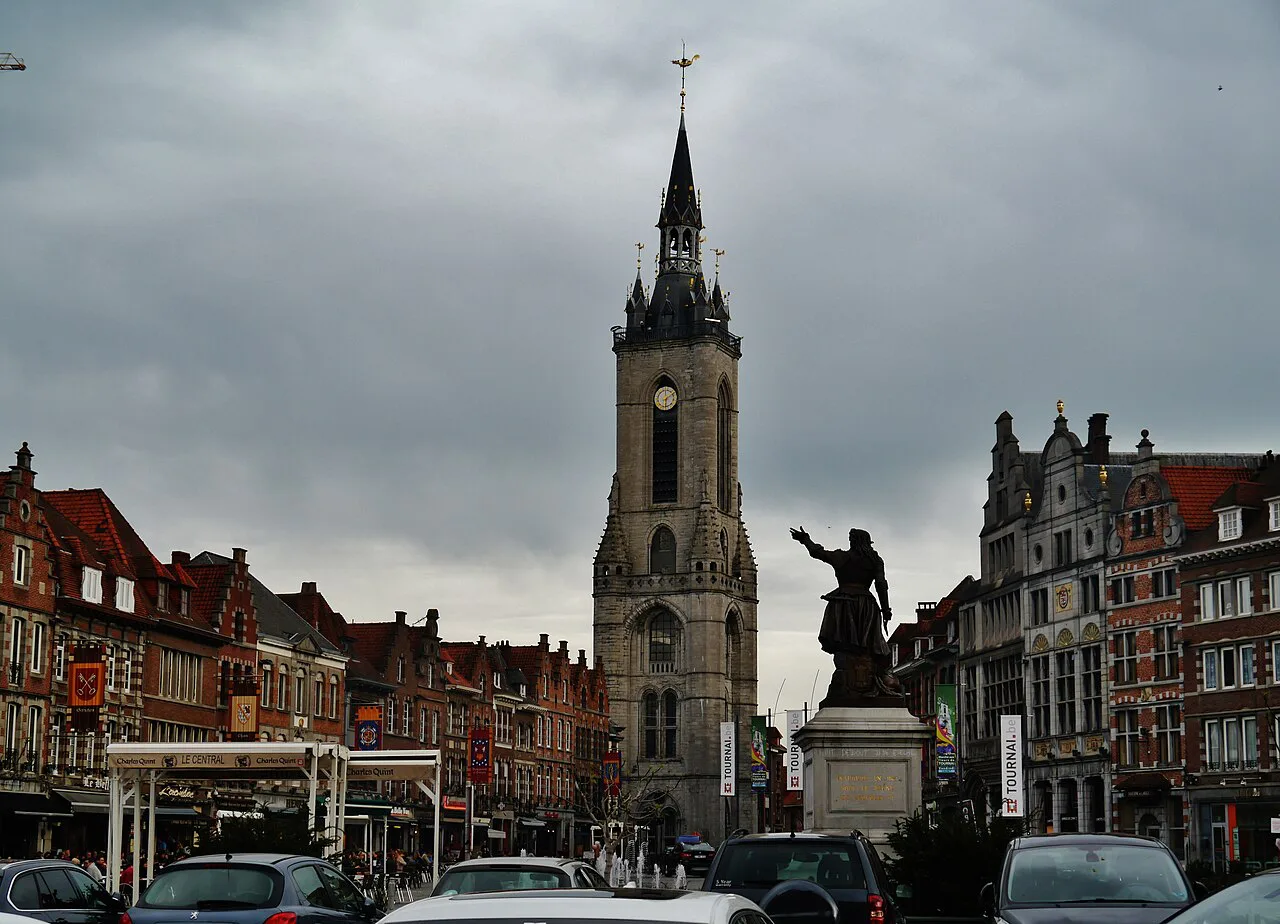
The listing is a single UNESCO World Heritage entry covering surviving belfries in Belgium and France, not a network of separately inscribed monuments. The Bruges Belfort is recognised within it alongside 55 other surviving belfries in the two countries. That shared status explains why towers of very different dates and styles appear under one name.
What a Belgian belfry is, and why it is not a church spire. A belfry is a civic tower: it housed the town's bells, its clock and often its records, and its height advertised the independence of the commune rather than the glory of a parish.
How the UNESCO Belfries of Belgium and France listing works. The listing is a single UNESCO World Heritage entry covering surviving belfries in Belgium and France, not a network of separately inscribed monuments.
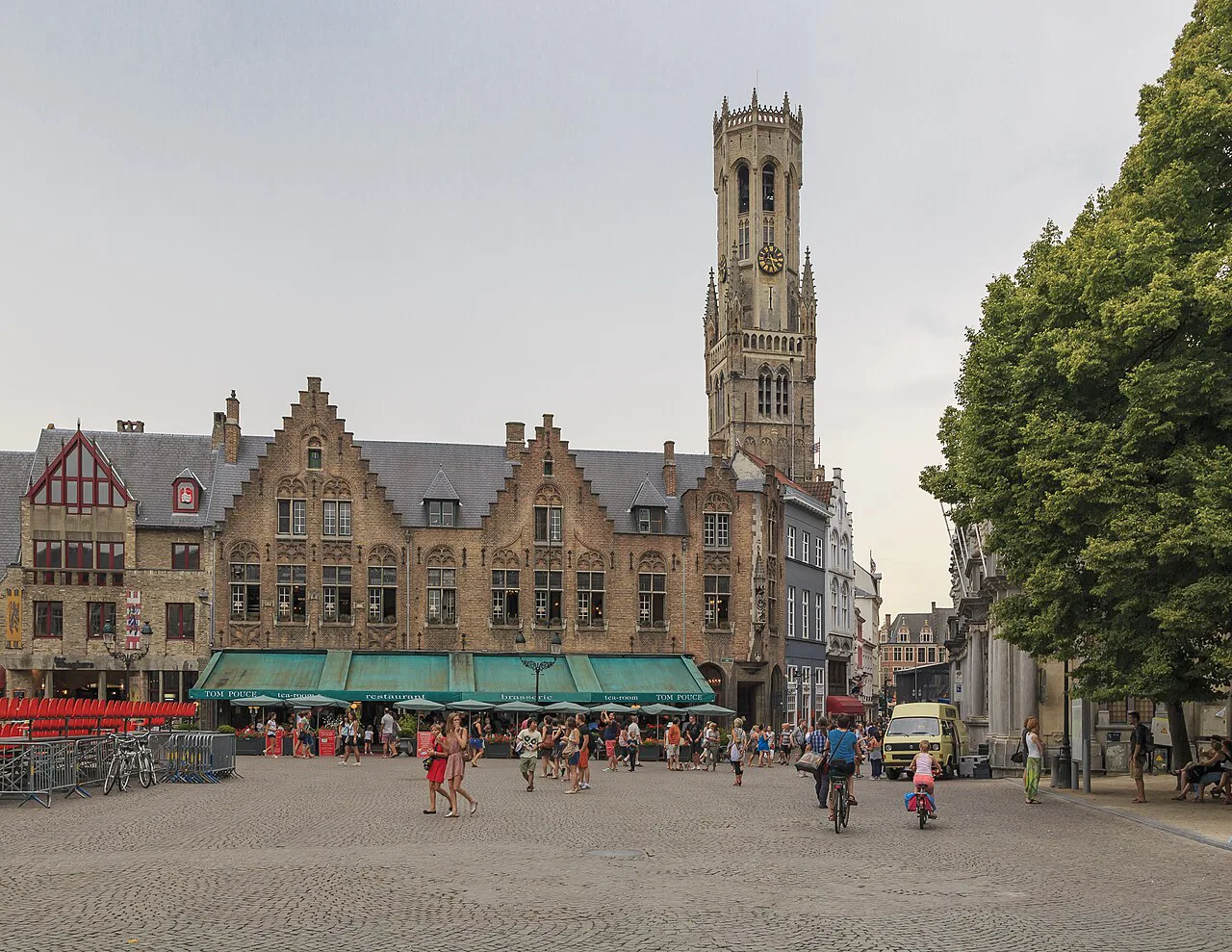
Bruges: the Belfort on the Markt. The Belfort rises directly off the Markt, the open square at the heart of Bruges, so it is the first tower most visitors see and the easiest to build a morning around.
For a traveller, the listing is a useful shortlist rather than a route. It tells you the tower in front of you belongs to a European tradition of civic building, but it says nothing about stairs, tickets or opening days, which are decided by whoever runs each tower. If UNESCO status is the thread running through your trip, the wider set of UNESCO Sites in Belgium works as a planning frame alongside the towers.
Bruges: the Belfort on the Markt
The Belfort rises directly off the Markt, the open square at the heart of Bruges, so it is the first tower most visitors see and the easiest to build a morning around. Because the square is a working hub of the old centre, the tower doubles as a meeting point and a compass: from the Markt you can walk to the Burg, the canals and the museum quarter without planning a route.
The tower carries a carillon, the set of tuned bells played from a keyboard, which is the feature to listen for as you cross the square. If tuned bells are a reason for your trip rather than a background detail, Carillon in Belgium explains how these instruments work and where the tradition sits in the Low Countries.
The view from the top is the point of climbing, but the climb is the trade-off: a medieval tower means a long ascent in a confined stairwell, which is slow going when the tower is busy. Decide before you queue whether you want the view or simply the building, because you can see the Belfort in detail from the Markt for nothing. Anyone who prefers a shorter day on foot can pair the square with the canals and leave the ascent for a clear, quiet morning.
Ghent: the Belfort on the Grote Markt
Ghent's Belfort stands on the Grote Markt beside Sint-Baafskathedraal and the Lakenhalle, the cloth hall, which makes the square a compact lesson in how a medieval trading city was laid out. The belfry and the cathedral are separate buildings serving separate purposes, so read them as two structures rather than one composite monument. Standing back across the square is the best way to see how the tower relates to the hall at its foot.
Ghent rewards a slow look at materials: brick, stone and ironwork change the character of the tower as the light moves. If you want to read the facades around the square with more confidence, Flemish architecture gives you the vocabulary for what you are seeing.
Antwerp and other Flemish towers to look for
Antwerp's historic centre gives you a skyline of towers to compare rather than a single climb, with the cathedral's spire and the civic buildings around the Grote Markt competing for attention. Walk the square once at street level and once from a distance, along the Scheldt quays, to see how the towers sit in the city rather than only above it.
If you are choosing between Flemish cities, the medieval towns of Belgium are the right comparison set, because each has a market square, a tower and a surviving street pattern within a short walk of the others. Build the shortlist around which square you want to stand in, then check the tower once you are there.
Mons: the baroque belfry in Hainaut
The Mons belfry is the counterweight to the Flemish brick towers: built in baroque style, it reaches 87 metres and dominates a city that is itself built on a hill. Louis Ledoux designed it and led the works from 1662 until his death in 1667, and Vincent Anthony continued the building to 1669. It has been a World Heritage Site since 1999, and it also served practical purposes, warning of fire and, during the Second World War, of bombardments. The Belfry of Mons (Beffroi de Mons) is the place to start for the tower itself.
The tower stands on Rue des Gades, with Saint Waltrude Collegiate Church about 200 metres away, so you can see two very different religious and civic buildings in one short walk. Because the belfry lacks some of the features typical of Flemish towers, such as a jail, it is a good reminder that the listing covers variety rather than a single template. Plan the Mons belfry as the anchor of a half-day in the upper town rather than a quick photo stop.
How a belfry climb works
Climbing a belfry is a stair workout in a stone shaft, usually with limited space at the top and a one-way flow of people. That makes timing matter more than fitness: go early or late, and accept that a busy tower will slow the ascent and the descent. The view is the reward, so factor in a few minutes at the top rather than treating the climb as a quick errand.
Treat the climb as a half-day anchor rather than a full-day plan: pair it with the square below, a church or a museum nearby, and a walk along the canals or quays. Bruges and Ghent both let you do this without public transport, which keeps the day flexible if the tower is crowded.
Reading a belfry from street level
You do not need to climb to read a belfry. Look first at the base, where the tower meets the market square or cloth hall, then follow the shaft upward to the clock stage and the bell stage; the transitions tell you which parts were built or rebuilt when. Brick towers and stone towers weather differently, and a baroque belfry like Mons reads as a single designed composition rather than an accumulation of stages.
The clock face and the carillon are the details worth seeking out at close range, since they are the working parts of a civic tower. If bells are the reason you are here, hear one before planning around a performance: Carillon in Belgium explains how these instruments work and where the tradition sits in the Low Countries.
Belfries and the city around them
The advantage of belfries as route markers is that they sit where cities were busiest, so the squares, halls and quays you want are already around them. In Bruges, the Markt leads to the Burg and the canals; in Ghent, the Grote Markt opens onto the streets of the old centre; in Mons, the tower sits in the upper town near Saint Waltrude. Use the tower to orient yourself at the start of each day, then walk outward.
A short break of one to three days rarely needs more than one belfry climb, and a tower seen from the square often does more for your sense of a city than a hurried ascent. Chocolate and Belgian beer are the other two tasting threads worth planning around, and both are best done in the streets below the towers rather than as a separate excursion.
Which belfries to choose on a one-, two- or three-day trip
On a one-day trip, pick one city and one tower: Bruges if you want the Markt and the canals in a single walk, Ghent if you want the Grote Markt with Sint-Baafskathedraal and the Lakenhalle in the same view. On two days, add the other Flemish city and see the towers as a pair, comparing a brick tower with Ghent's ensemble on the square.
On three days, Mons earns its place as the contrast: a baroque belfry in Hainaut, with Saint Waltrude Collegiate Church nearby, shows that the listing is not solely a Flemish story. The trade-off is travel time, so keep the Flemish days compact and give Mons a clear half-day rather than squeezing it between two squares.
Which belfry should you build your trip around?
Start with Bruges if you want the classic belfry-over-market-square experience, choose Ghent if you want the tower in company with a cathedral and a cloth hall, and choose Mons if you want the baroque exception in Wallonia. One climb is usually enough for a short break, so pick the tower whose square you most want to stand in.
Check the operator's page for the tower you choose before you travel, since stairs, tickets and access are managed building by building rather than by UNESCO. Then plan the rest of the day around the square below, which is where the belfry's civic purpose is easiest to see.
Explore more Belgium guides
Sources
Useful notes for your next trip
Optional updates to our guides.
You might also like



Continue reading
More guides you'll find useful