
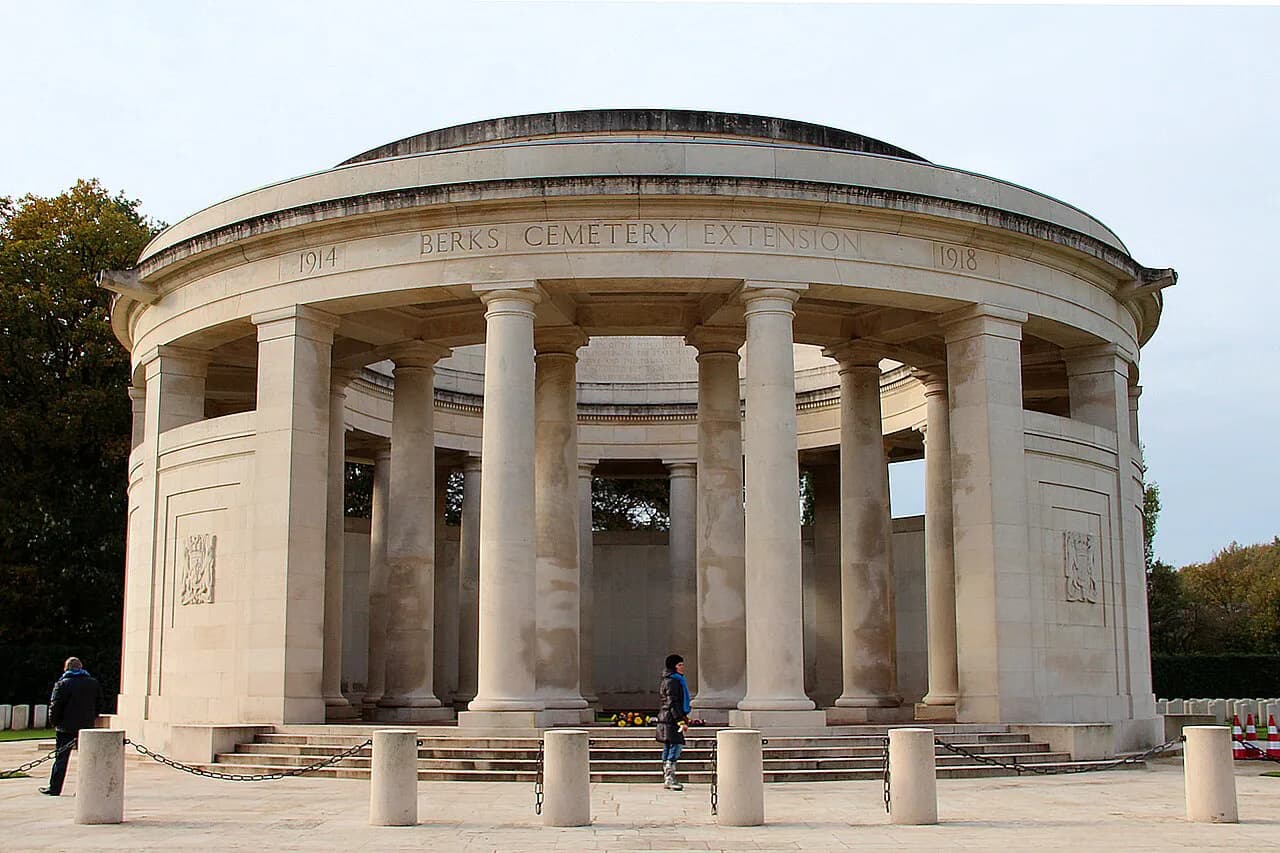
Ploegsteert: The Memorial, the Wood and the Truce Ground
Ploegsteert holds the Ploegsteert Memorial at Berks Cemetery Extension, remembering over 11,000 Commonwealth soldiers with no known grave.
On this page
Ploegsteert is worth a half-day from Ypres: a quiet Walloon village whose surrounding fields hold the Ploegsteert Memorial to more than 11,000 Commonwealth servicemen with no known grave, two adjoining cemeteries at Hyde Park Corner, and the wood that gave the sector its name. It rewards travellers who want the memorial landscape without the crowds of the Menin Gate.
This guide separates the memorial from the cemeteries it stands on, explains why this ground commemorates everyday trench losses rather than one great offensive, and sets out the walk from the village, the truce ground nearby and the nature reserve at the edge of Ploegsteert Wood.
What Ploegsteert is and where it sits
Ploegsteert lies in the municipality of Comines-Warneton in Hainaut, on the Walloon side of the Franco-Belgian border, a short drive west of Ypres (Ieper) and within reach of Armentières in France. The village is francophone, so signs and place names are in French, but the battlefield history here is bound up with British and Commonwealth units who knew the place as Plugstreet.
For travellers based in Ypres, Ploegsteert works as a western extension of the Ypres salient: the same war, a different national administration and a much emptier landscape. It sits between Ypres and Armentières, which makes it a natural stop on a loop that also takes in Messines Ridge to the north-east.
The Ploegsteert Memorial
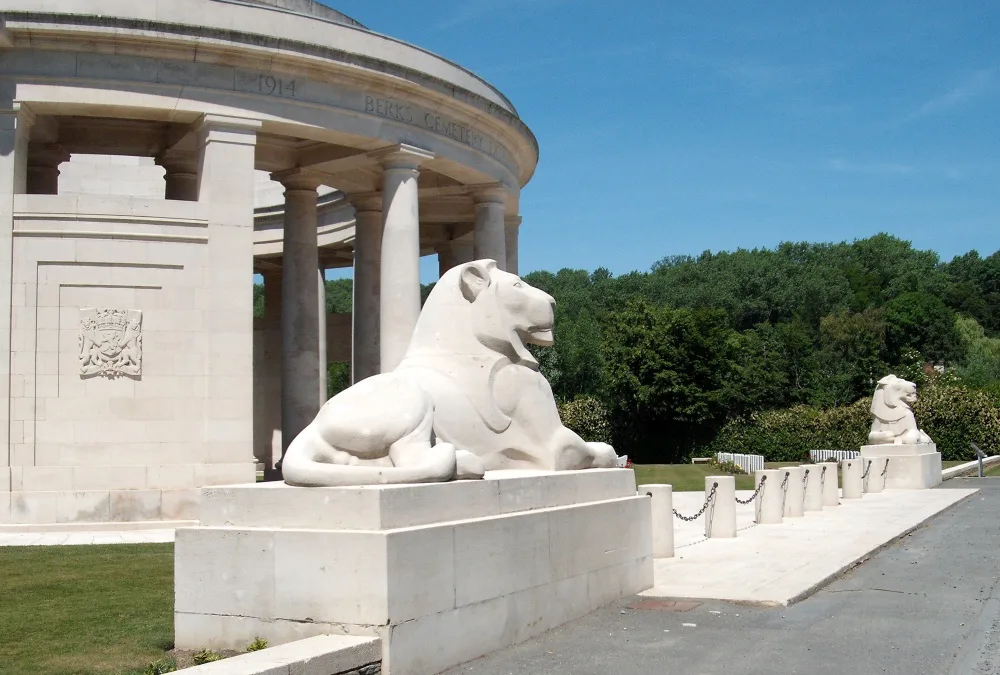
The Ploegsteert Memorial remembers more than 11,000 Commonwealth servicemen who died in this sector and have no known grave. It stands on Berks Cemetery Extension on the Mesenstraat, on the left heading towards Mesen, about 1,200 metres from Ploegsteert village. The designer of the memorial and both cemeteries was H Chalton Bradshaw.
What makes this memorial unusual is who it commemorates. The sector it covers runs from the Caestre–Dranouter–Waasten line in the north to the Haverskerque–Estaires–Fournes line in the south, taking in Hazebrouck, Merville, Bailleul, Armentières, the Nieppe forest and Ploegsteert Wood. The men named here mostly died in the daily trench skirmishes typical of this quieter sector, or in smaller attacks mounted to support big actions elsewhere, rather than in set-piece offensives like those at Ypres or Loos.
There is no visitor centre at the memorial, and the ground is a cemetery: read the panels, walk the names and keep noise low. Check the Commonwealth War Graves Commission records for a specific name before you travel if you are tracing a relative.
The cemeteries at Hyde Park Corner
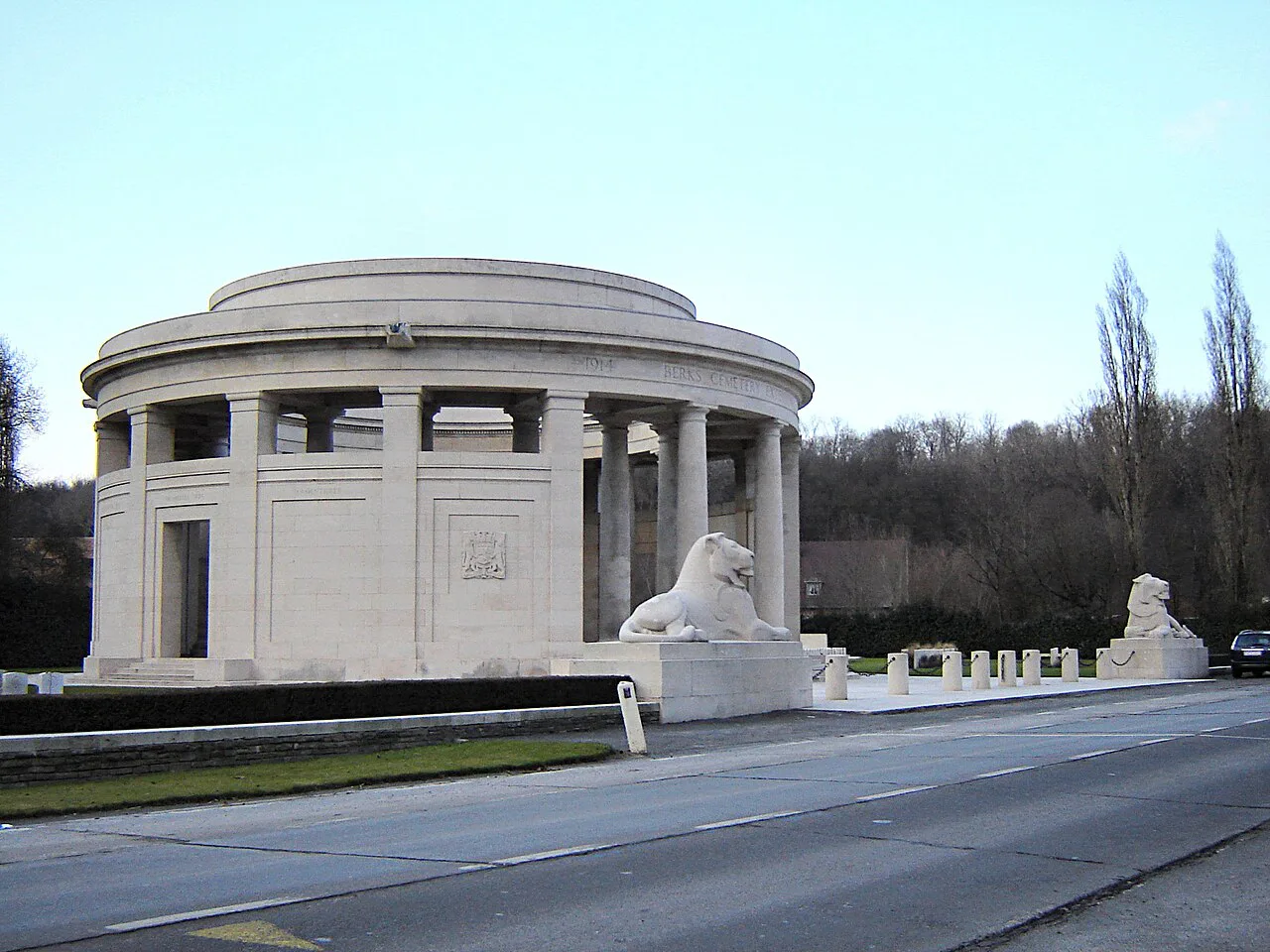
The memorial sits within a cluster of burial grounds that visitors routinely confuse. Hyde Park Corner (Royal Berks) Cemetery was begun in April 1915 by the 1st/4th Royal Berkshire Regiment and used, with gaps, until November 1917; it now holds 83 Commonwealth graves and four German graves. Berks Cemetery Extension, separated from it by the road, was started in June 1916 and expanded continuously until September 1917, and in 1930 Plots II and III were added by bringing in graves from Rosenberg Chateau Military Cemetery and its extension about a kilometre to the north-west. Berks Cemetery Extension now holds 876 graves.
Hyde Park Corner itself was a road junction north of Ploegsteert Wood, with Hill 63 to the north-west and the deep shelters known as the Catacombs, which could house two battalions, close by and in use from November 1916. Knowing that geography helps: you are walking ground that was a rear position and a burial plot at different moments of the war.
Ploegsteert Wood and its cemeteries
Ploegsteert Wood gave the sector its name and still shapes the visit: the lanes around it lead to a scatter of small cemeteries, including Ploegsteert Wood Military Cemetery, Lancashire Cottage Cemetery, Toronto Avenue Cemetery and Strand Military Cemetery. These are intimate plots in fields and at woodland edges rather than formal sites, and each repays five minutes rather than a guided stop.
Markers in the area also include craters left by mine explosions, such as Crater 17 and Crater 18 along Trench 127 and Crater 19 and Crater 20 along Trench 122, plus a wooden cross associated with the Khaki Chums Christmas Truce. Treat them as memorial ground: stay on paths, leave anything you find in place, and do not climb on craters or headstones.
The Christmas Truce ground
The Christmas Truce of 1914 is part of this sector's story, and the marker for it here is the wooden cross linked to the Khaki Chums, the group who erected a truce cross near Ploegsteert. It is a modest marker in a field rather than an interpretive site.
For the wider picture of how the truce is marked across the Salient, from the unofficial crosses to later commemorations, read the guide to the Christmas truce memorial before you set out so you know which ground you are looking at.
Getting there and around
The memorial is on the Mesenstraat, 1,200 metres from Ploegsteert village, which is a walk of roughly fifteen minutes along a country road with no footway for parts of it. Parking beside the cemetery is the practical option for most visitors, and the lanes between the memorial, the wood and the village cemeteries are best covered by car or bicycle.
Ploegsteert is reached from Ypres by road westward through Mesen, and it also sits within easy reach of Armentières across the French border. A Ypres battlefield tour that covers the southern sector will usually include the memorial and Messines Ridge in the same half-day; a self-drive version gives you the freedom to stop at the small woodland cemeteries.
To place Ploegsteert in the wider story of the Salient, from the first gas attacks at Gravenstafel to the Passchendaele mud, read the Battles of Ypres before you go. It makes the quiet graves here read very differently.
The nature reserve at Ploegsteert
The nature reserve at Ploegsteert covers part of the old wood and heath. Part of the reserve, reached by a municipal road, can be visited every day, and the first Sunday of each month brings a free visit starting at 9.30.
The reserve is a good way to see the wood as landscape rather than cemetery: quiet tracks, birdsong and the sense of how close the front lines sat inside a wood. Combine it with the woodland cemeteries for a walk of an hour or two, and leave time for the memorial on the way out.
What else is nearby
Beyond Ploegsteert, the Yser Front to the north around Diksmuide offers a different memorial landscape, with the Yser Tower (IJzertoren) commemorating the Flemish dead and the preserved trenches of the Dodengang, the Trench of Death, beside the river. Both are a longer drive from Ploegsteert but make sense in a multi-day Salient itinerary.
Half a day or a full day in Ploegsteert?
For most travellers a half-day covers the essentials: the Ploegsteert Memorial and Berks Cemetery Extension, Hyde Park Corner (Royal Berks) Cemetery across the road, and the woodland cemeteries around Ploegsteert Wood. Add the truce cross and the nature reserve if you have a full day, and allow an hour's driving each way from Ypres.
A well-planned battlefield tour from Ypres slots Ploegsteert into a southern loop with Messines Ridge; a self-drive visit lets you linger at the names on the memorial and find the small plots in the fields around the wood.
Frequently Asked Questions
Is Ploegsteert French-speaking?
Yes. Ploegsteert is part of Comines-Warneton in Hainaut, in Wallonia, so the village is francophone and signs are in French. The battlefield history is bound up with British and Commonwealth units, who knew the place as Plugstreet.
What are good walking routes in Ploegsteert?
The most rewarding walking is between the memorial on the Mesenstraat, the cemeteries at Hyde Park Corner and the woodland cemeteries around Ploegsteert Wood. Paths in the nature reserve, part of which is open daily, add an hour or two. Country lanes have limited footways, so wear visible clothing.
What is the beer of Ploegsteert?
There is no widely known Ploegsteert beer that this guide can point you to. Belgian beer is best explored in the towns, and Ypres is the natural base for beer cafés after a day in the Salient.
Sources
Useful notes for your next trip
Optional updates to our guides.
You might also like



Continue reading
More guides you'll find useful





