
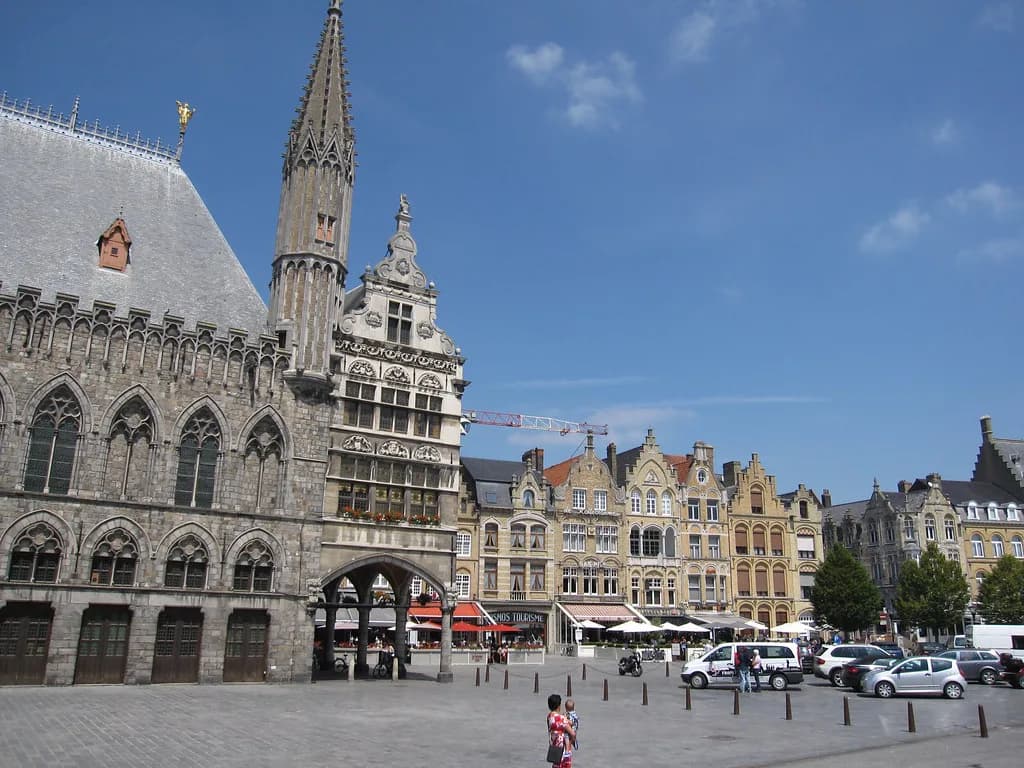
Ypres Battlefield Tours: How to Choose One and What You'll See
Compare guided Ypres battlefield tours with independent routes across the Salient, from the Menin Gate to Passchendaele and the In Flanders Fields Museum.
On this page
A guided Ypres battlefield tour is the quickest way to see the Salient properly if you have one day: a small-group tour from Ypres or a private van from Bruges will carry you from the Menin Gate out to the craters, cemeteries and museums around Passchendaele. Doing it yourself by car gives you more time at each stop and costs less, but the landscape reads as ordinary farmland without the context a guide supplies. This guide sets out what the tours cover, what is included, the published prices and how to shape an independent route around the same places.
The ground in question is compact. The Ypres salient, the bulge in the Allied line around the town, runs only a short drive from Ypres (Ieper) north-east to Passchendaele, so a well-planned day can take in a museum, two or three cemeteries and a memorial or two without rushing.
What a battlefield tour covers: the Salient from Ypres to Passchendaele
Every credible tour works the same rough geography. You start in Ypres, where the Menin Gate (Menenpoort) marks the road east, then follow the old front line north-east through the villages and ridges toward Passchendaele, stopping at cemeteries, bunkers and preserved trenches along the way. The best tours tie each stop to a date and a unit, so the fields stop looking like fields.
Aim for a tour that includes at least one museum and one of the large Commonwealth cemeteries. The In Flanders Fields Museum in Ypres supplies the overview, the Memorial Museum Passchendaele 1917 supplies the dugout and trench experience, and the cemeteries supply the human scale. If a tour only drives past these, it is a sightseeing trip rather than a battlefield tour.
The wider story of the four battles fought around the town, from the first German advance in 1914 to the Passchendaele offensive of 1917, is worth reading before you go so that the stops on the ground fall into sequence.
Guided small-group tours from Ypres: what is included and how the day runs
Ypres Battlefield Tours, which has guided in the Salient since 2010, publishes an In Flanders Fields and Passchendaele tour at €55 per person, a useful benchmark when you compare operators. That figure belongs to that tour alone, so treat it as a starting point rather than a market rate.
Ask what the fee covers before you book. Some tours bundle museum admissions, insurance and a vehicle; others quote guiding only and expect you to pay entry at each site. It is also worth asking about the route and whether the tour returns in time for the evening ceremony at the Menin Gate; the 55-euro Ypres Battlefield Tours listing gives only a headline price, so check the inclusions directly with the operator.
Since the guide does the navigating, this is the sensible option for anyone arriving by train without a car, and for travellers who want the dates and the units explained rather than a scenic drive.
Guided day tours from Bruges: private van, hotel pick-up and admissions included
Bruges (Brugge) works as a base for the Salient, though the transfer eats into the day. Flanders Fields Battlefields Daytours by Nathan runs private trips from Bruges in an air-conditioned van, with pick-up and drop-off at your hotel or B&B, admission to museums such as the In Flanders Fields Museum and the Passchendaele Museum included, and insurance covered. The itinerary is built around your interests and can take in the evening Last Post ceremony.
The private format suits a couple or a small group who want specific ground covered: a particular cemetery, a family name on a panel, or a wider loop that reaches the Somme, Vimy or Waterloo. The trade-off is that you travel from Bruges rather than waking up in Ypres, so the day is longer and you see less of the town itself.
Self-drive and independent routes: Menin Gate, the Salient and the memorial landscape
With a car you can follow the same circuit at your own pace and stay as long as you like at each stop. Start at the Menin Gate (Menenpoort) for orientation, then take the road toward Zonnebeke and Passchendaele, stopping at the Memorial Museum Passchendaele 1917 and at least one of the large cemeteries such as Tyne Cot. A short loop of this kind fills a day comfortably.
The harder part is interpretation. Without a guide, the visitor centre at each site carries the story, and the In Flanders Fields Museum gives the necessary grounding; plan the museum first, then drive out. Signage across the Salient is good enough to link the main sites, but a paper map or a downloaded route saves a lot of turning around on narrow farm lanes.
War graves and memorials: respectful visiting at Commonwealth cemeteries
The cemeteries and memorials of the Salient are Commonwealth war graves, and the Commonwealth War Graves Commission was established by Royal Charter in 1917 to honour the 1,700,000 men and women of the Commonwealth forces who died in the two world wars; its online records list the dead and their graves. Treat these sites as burial grounds: keep voices low, keep to the paths between headstones, and do not sit or stand on the grave markers. School groups and coach parties often arrive together, so an early or late stop is usually quieter.
Individual headstones and memorial panels carry names, regiments and dates, and many visitors come to find a particular one. The commission's online records make it possible to look up a name and its cemetery before you travel, which turns a general tour into a specific pilgrimage.
The Last Post ceremony at the Menin Gate: planning an evening around it
The Last Post, the traditional final salute to the fallen, is played by the buglers of the Last Post Association in honour of the soldiers of the former British Empire and its allies who died in the Ypres Salient during the First World War. The association intends to maintain this daily act of homage in perpetuity, which makes the evening ceremony a natural end to a tour day.
Build the day backwards from the ceremony: return to Ypres with time to eat and walk to the gate, and book a tour that explicitly finishes in town rather than heading back to Bruges at speed. Crowds gather well before the buglers appear, so arriving early is the practical move.
Museums to build a tour around: In Flanders Fields and Passchendaele 1917
The In Flanders Fields Museum, in Ypres, is the place to start. It sets out life in and behind the trenches, with detailed historical context and statistics, and it gives the landscape outside the town its meaning. Opening hours vary by season.
The Memorial Museum Passchendaele 1917 at Zonnebeke tells the story of the 1917 offensive and includes a dugout experience that reconstructs the underground quarters troops lived in. Together with the museum in Ypres it covers both the overview and the ground, which is why good tours include both.
On the northern edge of the story, the Yser Tower (IJzertoren) at Diksmuide is a museum with a political as well as a military dimension, explaining the symbolism of the tower and the crypt beneath the earlier structure.
Talbot House in Poperinge and the wider Flanders Fields museums
Poperinge, west of Ypres, holds Talbot House, a soldiers' house opened by Chaplain Philip Clayton in December 1915, where all ranks were welcome. It works as a complement to the battlefields because it shows the men at rest rather than in the line.
Further out, the preserved trenches at the Trench of Death and the flat polder country of the Yser Front give a different war from the ridges east of Ypres, and they can be paired with the Memorial Museum Passchendaele 1917 for a longer stay.
Costs: what guided tours charge and what self-driving saves
The published price of €55 per person for the In Flanders Fields and Passchendaele tour with Ypres Battlefield Tours is the clearest figure available for a small-group day. Museum admissions and vehicle costs vary by operator, so compare what is bundled rather than the headline number alone.
Self-driving usually works out cheaper for two or more people, since you pay for fuel and parking rather than per head, but you carry the navigating and you lose the commentary. A private van from Bruges includes admissions and pick-up, so the higher price reflects that convenience.
How many hours or days you need in the Salient
One full day is enough for the essential circuit: the In Flanders Fields Museum in the morning, a drive out to Passchendaele with two or three cemetery stops, and the Last Post in the evening. Two days lets you add Talbot House, the Yser Front and a walk along a preserved trench without hurrying any of them.
If your interest is a single ridge or a single name, half a day can be enough; if you are following a relative's unit through several actions, allow two days and plan the sequence in advance on a map. Tours fill the day by design, so an independent driver with narrow aims may see more by booking less.
Which tour suits you: small group, private or independent
Choose a small-group tour from Ypres if you are travelling alone or as a couple, want the ground explained, and prefer to leave the driving to someone else. Choose a private tour from Bruges if you have specific ground to cover, a family connection to follow, or a group with mixed interests, and are willing to pay for the flexibility and the hotel pick-up.
Drive yourself if you value time at individual sites above commentary, and use the museums and the commission's records to supply the context. Whichever you pick, build the day around the Menin Gate ceremony in the evening, because it is the one fixed point that gives the rest of the itinerary its shape.
Which Ypres tour to book
For most first-time visitors with a single day, a small-group tour from Ypres is the best value: it covers the Menin Gate, the salient and a Passchendaele stop with the dates explained, and it leaves you in town for the Last Post. If you are based in Bruges with a group or a specific purpose, the private van with admissions included is worth the extra.
Whoever you book with, ask for the museum admissions, the vehicle and the return time in writing before you commit, and keep one day free so the Salient does not have to be rushed.
Explore more Belgium guides
Frequently Asked Questions
What are the best World War 1 battlefields to visit from Ypres?
The Ypres Salient itself holds the tightest cluster: the Menin Gate, the In Flanders Fields Museum, the Memorial Museum Passchendaele 1917 and the big Commonwealth cemeteries around Passchendaele. Further afield, Messines Ridge and the Yser Front around Diksmuide broaden the picture, and operators from Bruges can extend to the Somme and Vimy.
What is Ypres called now?
The town is Ieper in Dutch, which is the name used on Belgian maps and signs. Ypres is the French and English form, and both refer to the same place in West Flanders; the surrounding battlefield area is known as the Ypres Salient.
Can you visit the site of the Battle of the Bulge from Ypres?
The Battle of the Bulge was fought in the Ardennes, around Bastogne, well south-east of Ypres. Operators list it as a possible extension rather than part of a Salient day, so treat it as a separate trip rather than a stop on a Ypres battlefield tour.
Sources
Useful notes for your next trip
Optional updates to our guides.
You might also like



Continue reading
More guides you'll find useful



