
The Battles of Ypres: What Happened and Where They Are Remembered
Four battles shaped the Ypres salient between 1914 and 1918. Here is what happened in each, and the memorials and museums where they are remembered.
On this page
The battles of Ypres were four separate campaigns fought around Ypres (Ieper) between 1914 and 1918, and together they made the Ypres salient one of the most contested stretches of the Western Front. You can see the whole story in a day or two because the city sits at its centre: the Lakenhalle (Cloth Hall) on the Grote Markt holds the In Flanders Fields Museum, the Menin Gate (Menenpoort) stands at the eastern exit, and the former battlefields lie a short ride away. This guide takes the four battles in turn and matches each to the memorial that remembers it.
The practical shape of a visit is simple. The museum, the gate and the main square sit within minutes of each other, while Tyne Cot Cemetery and the Passchendaele ridge lie out in the countryside. Plan one block for the city centre and another for the memorial landscape east and north-east of it.
What the battles of Ypres were and why the salient mattered
The salient was the pocket of Allied-held ground that curved around Ypres and pushed east into German-held territory. It was held for position rather than for the city itself: the line covered the approaches to the Channel ports, and the higher ground on several sides let the Germans observe and shell it. That is why the same few square miles were fought over repeatedly.
For a visitor, that geography explains the layout of the memorials. The town was rebuilt after the war, so the medieval-looking Lakenhalle and the streets around the Grote Markt are reconstruction, while the cemeteries and concrete remnants in the fields are original ground. Reading town first and countryside second makes the distances between the sites much easier to grasp.
First Ypres, 1914: the race to the sea and the end of the old army
The First Battle of Ypres opened in October 1914, as the German advance pushed westwards to break the Allied line and reach the ports of Dunkirk and Calais. The fighting ran into November that year, closing the mobile phase of the war on this front and leaving the trench lines that would define the salient for four years. It was fought largely by the old regular armies on both sides, which is why it is remembered as the end of an era as much as a battle.
It also fixed the shape of what followed: the Allies held the town and the ground immediately around it, but the ridges to the east and south stayed in German hands. Every later battle was an attempt to change that arrangement, and the memorial landscape you walk today is laid out along it.
Second Ypres, 1915: the first large gas attack on the Western Front
The Second Battle of Ypres, fought in spring 1915, is remembered above all as the first large-scale use of poison gas on the Western Front. The attack fell on ground held by French and colonial troops north of the city, and Canadian units fought hard to close the gap that opened. The front line was pushed back closer to Ypres, narrowing the salient further.
It is not marked by a single great monument in the way Passchendaele is. Its ground lies north and north-east of the town, along villages and low ridges that now hold smaller cemeteries and roadside memorials. If you are following the battles in order, drive or cycle this section rather than walking it.
Third Ypres, 1917: Passchendaele, the mud and the cost
The Third Battle of Ypres, better known as the Battle of Passchendaele, began in the summer of 1917 and ground on into the autumn. The aim was to break out of the salient and reach the ridges beyond, and the fighting is remembered for the state of the ground: heavy shelling destroyed the drainage of the low-lying polder, and men fought across a churned, waterlogged landscape. The village of Passchendaele was taken late in the campaign, at a cost that made the name a byword for attrition.
This is the battle most visitors come to see on the ground, because the ridge east of Ypres is where its memorials cluster. If you would rather have the history narrated as you move between the sites, a Ypres battlefield tour removes the navigation problem of narrow lanes and scattered cemeteries. Otherwise, a bike gives you the reach to cover the ridge and the town in a day.
The 1918 battles: the German spring offensive and the final advance
In 1918 the fighting reversed direction. The German spring offensive drove the Allied line back towards Ypres in April, and the salient was reduced to a shallow bridgehead for a time. Later in the year the Allied advance swept eastwards again, and by the Armistice the front had moved well beyond the ridges fought over since 1914.
For a visitor, the 1918 battles explain why the memorial landscape is not tidy: cemeteries of different dates sit beside one another. Some of the most evocative ground lies outside the classic Passchendaele circuit, towards Messines to the south, where mines were fired in 1917 and the craters remain part of the memorial landscape.
Menin Gate (Menenpoort): the missing of the salient
The Menin Gate stands on the road east out of Ypres, where soldiers left the city for the front line, and it carries the names of the missing of the salient who have no known grave. It is a memorial arch rather than a cemetery, and standing under it is about reading names. Treat it as a place to be quiet in, and leave the photography for the surrounding ramparts.
The gate is a short walk from the Grote Markt and the museum, which makes it the natural close to a day in the city. It is also the starting point for the routes east towards Tyne Cot and Passchendaele, so pass through it on your way out rather than making a separate trip.
Tyne Cot Cemetery and the Passchendaele memorials
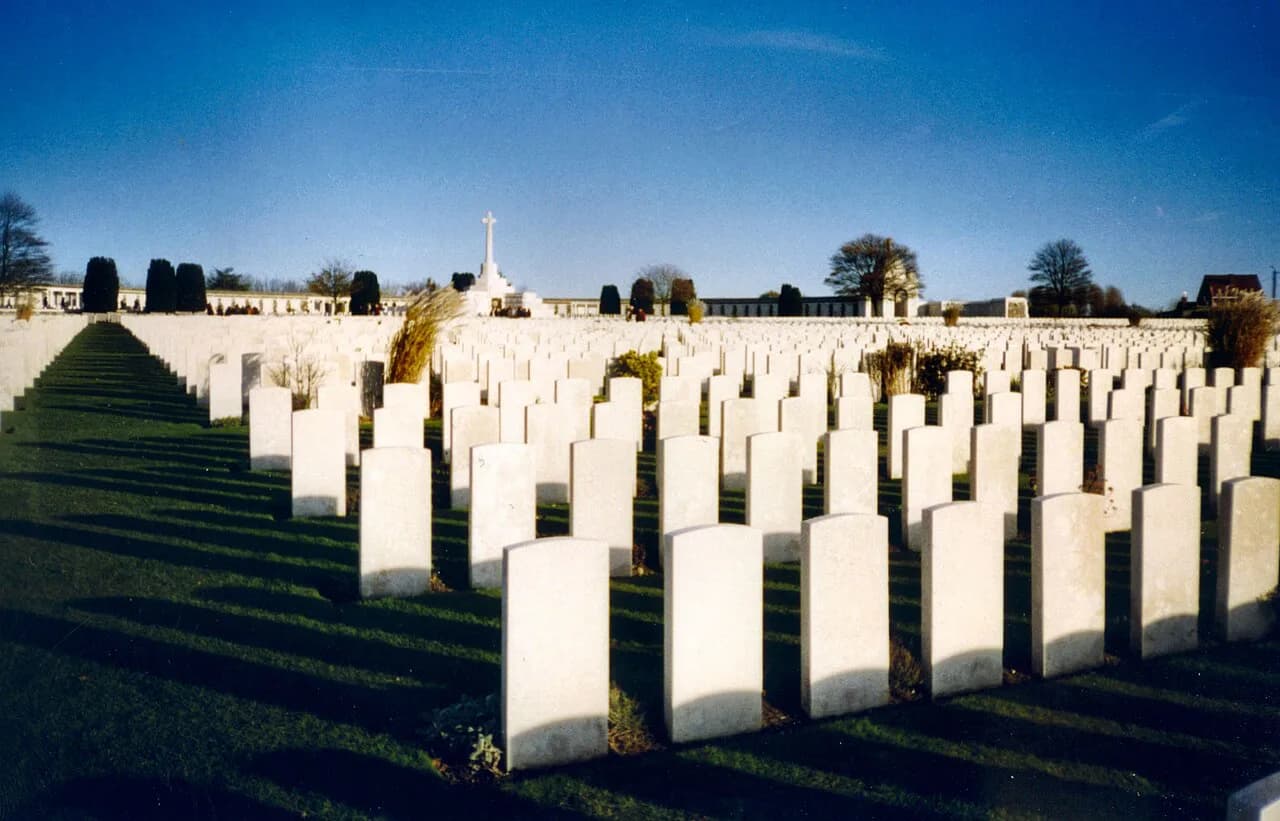
Tyne Cot Cemetery lies on the ridge beyond Passchendaele, on ground fought over in the Third Battle of Ypres, and it is where the scale of that campaign becomes clear. The headstones and the memorial wall behind them interpret the fighting on this ridge specifically, not the salient as a whole. Walking the perimeter takes time, so allow half an hour even on a short visit.
The surrounding countryside holds the smaller sites, and they repay a slower pace. The preserved trenches and dugouts near Diksmuide, on the Yser front to the north, show what a front-line position of this war looked like, with the Trench of Death the most direct example in the area.
In Flanders Fields Museum: the story in the Cloth Hall
In Flanders Fields Museum occupies the Lakenhalle (Cloth Hall) on the Grote Markt, the rebuilt medieval hall that dominates the square. It interprets the war in and around Ypres, including the civilian experience of occupation and the destruction of the city, which makes it the natural single primer before you head out to the cemeteries. Allow a couple of hours and go before the battlefield circuit, not after it.
The museum sits close enough to the gate and the square to combine all three comfortably in half a day, leaving the rest of your time for the memorial landscape.
Walking and cycling the salient: distances between the sites
Ypres itself is small enough to cross on foot, but the memorials outside the town do not make a single walking loop. The Menin Gate is a short walk from the Grote Markt, and the town ramparts give an easy circuit back. The ride out to Tyne Cot and Passchendaele is a separate journey into open country, so budget for transport rather than assuming you can walk from town to ridge.
A bike is the most flexible way to link the sites, because the battlefield roads are flat and the gaps between cemeteries are modest once you leave town. For a fuller picture of what the salient contains beyond Ypres, start with an overview of the Ypres salient and then pick the sections that match your interests.
How long you need, and which sites to choose in a day or two
With one day, do the museum and the Menin Gate in the morning and early afternoon, then take a short trip out to Tyne Cot before returning to town for the evening. With two days, add the Passchendaele ridge and one of the smaller cemeteries on the northern or southern flank, and give the museum a proper half-day.
Ypres is easy to reach by train from Brussels, and UK visitors arriving by Eurostar often pair a battlefield visit with a stop in Bruges, where the Groeninge Museum holds Flemish Primitives whose work long predates the First World War. Either way, one base makes the trip simpler.
Where the salient extends: Ploegsteert and the southern flats
The salient is usually imagined around Ypres itself, but the line continued south towards the French border at Ploegsteert, where the ground is flatter and the memorials quieter. The Ploegsteert Memorial and the Berkshire Cemetery Extension sit at the edge of the village and are worth a detour on a longer visit.
This southern end also holds one of the war's best-known episodes, and the Christmas truce memorial near Ploegsteert marks the ground where the 1914 informal truces took place. It is a modest site rather than a grand monument, so allow time to find it rather than expecting it on the main road.
Is a battlefield tour worth it for a short visit?
For a one- or two-day visit, a guided tour is worth considering if you want the 1918 fighting and the Passchendaele ridge explained in sequence without spending your time on navigation. If you prefer to move at your own pace, the museum and gate plus a bike out to Tyne Cot cover the essentials well.
Whichever you choose, treat the cemeteries and memorials as memorials first and sights second. Quiet, unhurried time on the ridge, with the museum behind you, gives the four battles of Ypres a coherence that a rushed circuit cannot match.
Explore more Belgium guides
Frequently Asked Questions
What happened in the Ypres war?
Four separate campaigns were fought around Ypres (Ieper) between 1914 and 1918: First Ypres in autumn 1914, Second Ypres in spring 1915 with the first large gas attack on the Western Front, Third Ypres or Passchendaele in 1917, and the German spring offensive and Allied advance of 1918. The city and its surrounding salient were contested for the whole period, and the rebuilt town and the memorial landscape in the fields both reflect that history.
What is Ypres called today?
The city is still called Ypres in French and Ieper in Dutch, and both names appear on signs, maps and station boards. English-language material often uses the French form, which is why the battlefield sites are described as the Ypres salient rather than the Ieper salient.
Who was in the Second Battle of Ypres?
The Second Battle of Ypres was fought by French, colonial and Canadian units alongside other Allied forces in spring 1915, against the German army that released the gas. Canadian troops in particular are closely associated with holding the line after the gas cloud opened a gap. The ground lies north and north-east of the city, away from the main Passchendaele memorials.
Was Passchendaele the worst battle of WW1?
Passchendaele is remembered for the waterlogged ground and the grinding attrition of the autumn 1917 fighting, and its name is often used as shorthand for the worst conditions on the Western Front. It was one of several campaigns with very heavy losses, and the memorials on the ridge are the place to understand what the fighting there involved. No single battle can be reduced to a ranking.
Sources
Useful notes for your next trip
Optional updates to our guides.
You might also like



Continue reading
More guides you'll find useful





