
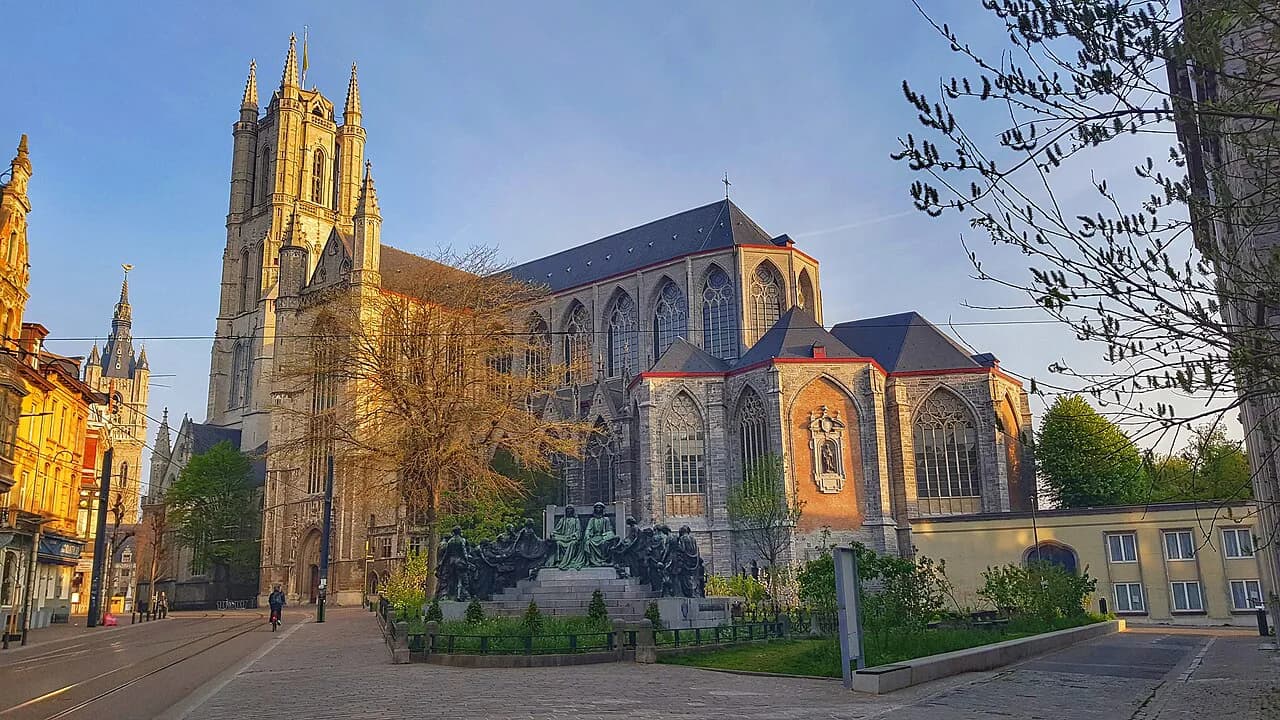
Ghent Altarpiece: Van Eyck's Mystic Lamb at St Bavo's
See the Ghent Altarpiece by Hubert and Jan van Eyck in St Bavo's Cathedral: what the panels show and what makes the Adoration of the Mystic Lamb remarkable.
On this page
The famous painting in Ghent is the Adoration of the Mystic Lamb, a hinged polyptych of oak panels completed by Hubert and Jan van Eyck in 1432 and still in St Bavo's Cathedral (Sint-Baafskathedraal). It is a painting you read rather than simply look at, because the outer and inner faces show entirely different scenes. This guide explains both views, the figures worth finding, the panels that are gone, and how the work survived war and theft to be seen complete in the city again.
What the Ghent Altarpiece actually is
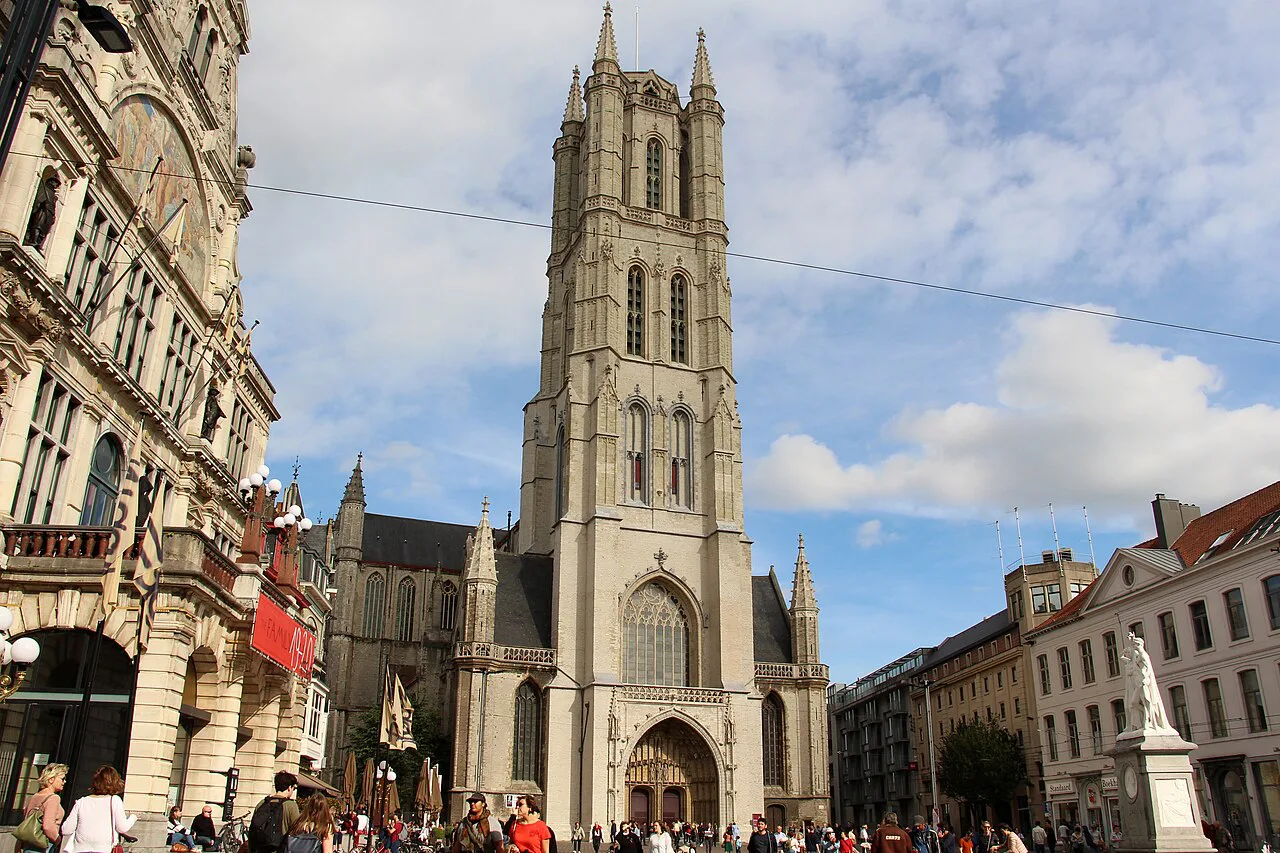
The altarpiece is a polyptych: a set of separate oak panels, framed and hinged so it can be folded and reconfigured, which is why its appearance changes depending on whether it stands open or shut. According to the frame inscription, the work was begun by Hubert van Eyck and finished by his brother Jan, the painter most closely associated with the masterpiece. The altarpiece was made for St Bavo's Cathedral in Ghent, and its scale is why the cathedral has to give it real space.
Unlike earlier egg tempera or water-based fresco, the oil medium the Van Eycks exploited gives the surface a depth of colour and luminosity that no flat photograph conveys. That technical point matters to a visitor: the dark blues, the golds and the fabric textures are the reason to stand close and then step back. If you want the wider picture of painters working in this period, the guide to the Flemish primitives sets Van Eyck beside Memling and their contemporaries.
The closed view and the open view
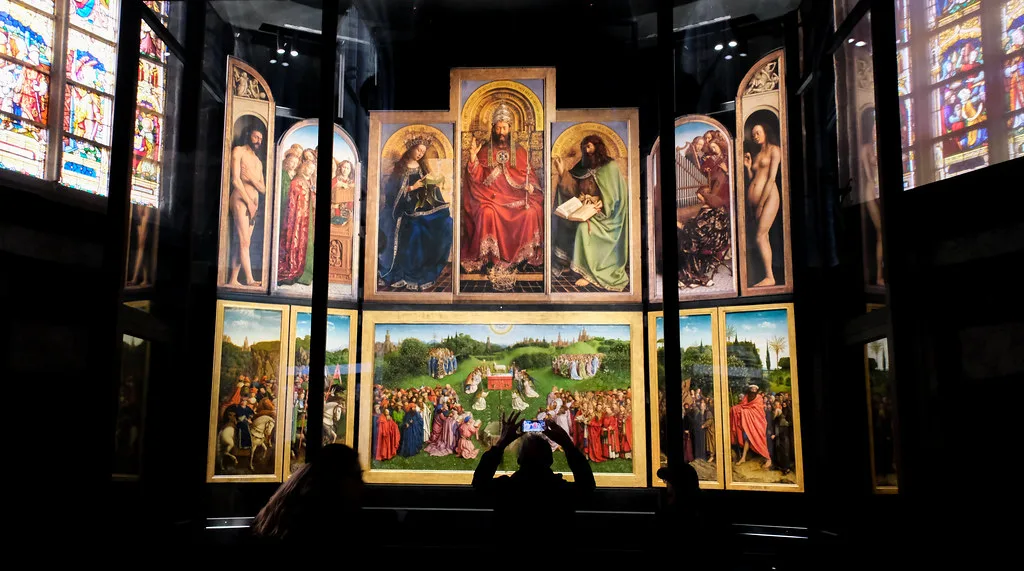
When the wings are closed, the outside shows the Annunciation, with the angel and the Virgin painted in near-monochrome so they read almost like sculpture. That is the view most visitors see first, and it repays a few minutes before you move round. The inner panels are what earn the altarpiece its reputation, and they are best approached from left to right rather than in one sweep.
In the typical open configuration the composition divides into two registers. Adam and Eve flank the upper register, downcast, standing at the edges of the composition; nearby sit small Genesis scenes, the sacrifices of Cain and Abel and the murder of Abel. Reading those first gives the lower register its meaning, because the whole work is arranged as a narrative of fall and restoration rather than a single scene.
Panel by panel: the lower register
The lower register carries the painting's other name. Crowds of figures converge on the Lamb on the altar, the subject that gives the Adoration of the Mystic Lamb its title, and the sheer number of faces is what rewards slow looking. Stand back far enough to see the whole register, then move closer for the individual groups; the panels are famous for detail that only resolves at short range. More of this period, from Van Eyck to Rogier van der Weyden, is covered in the guide to Flemish painters.
Why the painting matters
The altarpiece sits at the start of a tradition. The Van Eycks' handling of oil paint gave later Netherlandish painters a model for depth of colour, and the work's complexity made it one of the most copied and studied images in art history. That reputation has a practical consequence for visitors: it draws a steady stream of people even when the rest of the cathedral is quiet. If your trip continues across Belgium, the guide to the best museums in Belgium shows where to find the next stages of the same story.
The missing Just Judges and the lost predella
Two parts of the original scheme are not there to admire. In 1934 the panels of John the Baptist and the Just Judges were stolen; John the Baptist was recovered, but the Just Judges is still missing, and its absence is a fact of the altarpiece as much as any panel in it. Do not look for a substitute among the painted crowd.
The predella, a painted band along the bottom of the frame, is a different kind of loss. A drawing showing the polyptych with a predella was reported in 1915 and caused excitement because the predella had vanished without trace in the sixteenth century, but the drawing turned out to be a fraud. Recent historical research suggests the predella was lost during a restoration around 1550, which is worth knowing before you study the frame.
War, dispersal and return to St Bavo's
The altarpiece was already scattered before the First World War. The two side panels of Adam and Eve were at the Royal Museum for Fine Arts in Brussels, while most of the other panels had been sold decades earlier and were in the possession of the King of Prussia in Berlin; only the four central panels, including the Adoration of the Mystic Lamb, remained in Ghent's cathedral.
During the German occupation, the canon Gabriël Van den Geyn hid the four Ghent panels in three places in the city and told the governor they had been sent to England. The lie held, the panels stayed in Ghent, and after the war the Berlin panels were returned, with Adam and Eve following from Brussels; the work was complete in its original cathedral.
That return is the context for what you see now: a survival as well as a painting. Many Flemish pictures that left Belgium in that era never came back, so the altarpiece's completeness at St Bavo's is unusual. For a sense of how other Belgian collections were assembled and what they hold, the Rubens in Antwerp guide is a useful companion if your trip takes in Antwerp.
Reading the Van Eyck altarpiece in detail
Closer to Van Eyck gives high-resolution views of the panels and technical imaging from different stages of conservation treatment, including photographs taken before, during and after work. That is more than a substitute for standing in front of the painting: it lets you trace details the glass and the distance from the rail will not give you.
The altarpiece is only one stop in Ghent's art offer. For Van Eyck's own dispersed works across Belgium, the Van Eyck in Belgium guide picks up the trail; for another great Flemish painter of the following generation, the Memling in Bruges guide is a natural counterpart. Ghent's own churches and belfry fill the rest of the day.
Seeing the painting at St Bavo's Cathedral
The altarpiece hangs in St Bavo's Cathedral, where the work remained through the war and where it is displayed today. The cathedral's own information covers access to the work and any separate display arrangements. In Ghent, one full day is enough to combine the altarpiece with the historic centre; if your trip stretches to two or three, give the painting a quieter morning slot.
Is the Ghent Altarpiece worth a trip to Ghent?
Yes, and it changes how you see the rest of the city. The Adoration of the Mystic Lamb is the single strongest reason to build a trip around Ghent rather than Brussels, and it takes longer than most visitors plan for, so give it a dedicated morning. Check the cathedral's own information before you travel for the current arrangements for viewing it and for how St Bavo's is set up on the day.
If this is part of a wider art trip, the guide to the Flemish primitives places the altarpiece at the start of the story, and the guide to the best museums in Belgium picks up the rest.
Explore more Belgium guides
Sources
Useful notes for your next trip
Optional updates to our guides.
You might also like



Continue reading
More guides you'll find useful




