Flemish Painters: Where to See Van Eyck, Rubens and Ensor in Belgium
A practical guide to the great Flemish painters and where to see their work in Belgium, from Van Eyck and Memling in Bruges to Rubens in Antwerp.
On this page
Flemish painters fall into three broad groups that map neatly onto three Belgian cities: the early masters around Bruges, the Baroque giants of Antwerp, and the late nineteenth-century rebels of Ostend. Build a trip around those cities and you can see the whole sweep in three or four days, with Ghent supplying the single most famous altarpiece of them all. This guide names the painters, says where their work hangs, and explains what to look for once you are standing in front of it.
What Flemish painting actually means
Flemish painting describes work made in the Burgundian and Habsburg Netherlands, a territory far larger than modern Flanders and covering much of present-day Belgium as well as parts of northern France and the Netherlands. That is why the label takes in artists born in places that are now Dutch or French. Think of it as a historical school rather than a regional craft.
The distinction from Dutch painting matters when you plan a trip. The Dutch Golden Age, with Rembrandt, Vermeer and Hals, belongs to the northern republic and its museums in Amsterdam and The Hague. The Flemish tradition runs through Bruges, Ghent and Antwerp, and its characteristic products are devotional panels, civic group portraits and vast church altarpieces rather than domestic genre scenes.
The early masters: Van Eyck, Van der Weyden and Memling
The Flemish primitives, as the fifteenth-century masters are known, worked for dukes, guilds and merchant donors in the wealthy cloth cities of Bruges and Ghent. Their innovation was oil painting on prepared wooden panel, built up in thin translucent layers so that light passes through the paint and bounces back off the ground. That technique is the reason the colour in these panels still reads as luminous five centuries on, and why they look so different from fresco or tempera.
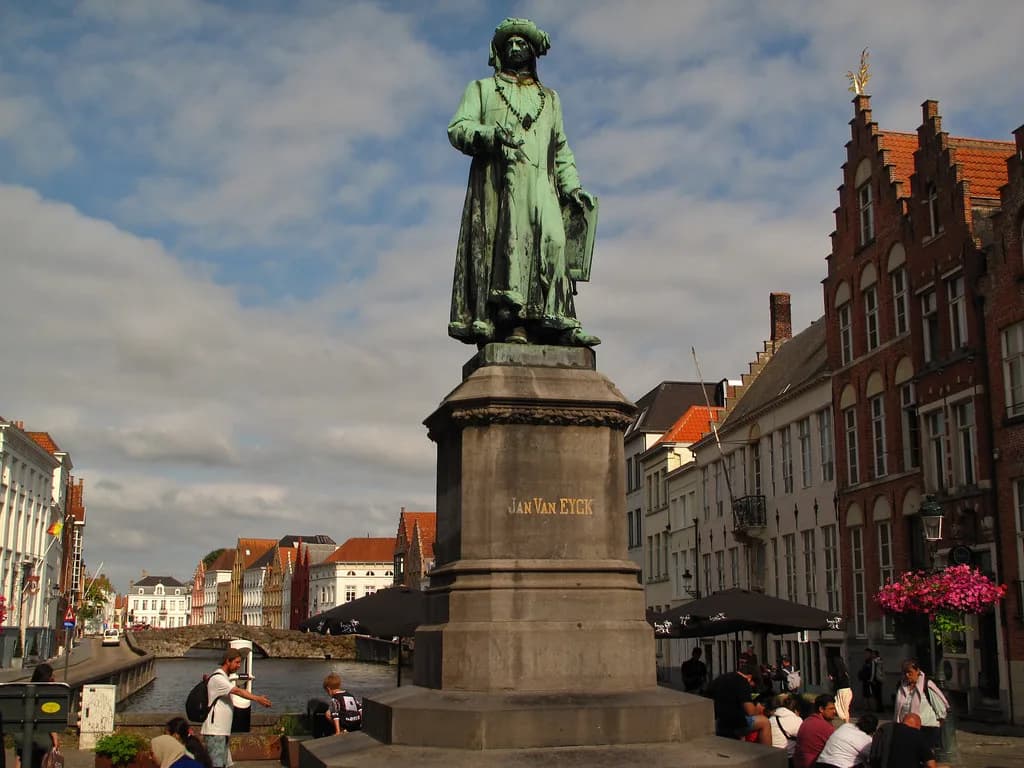
Jan van Eyck is the name to know first, the court painter whose close observation of fabric, stone and skin set the standard for the century that followed. Rogier van der Weyden specialised in emotional religious scenes, while Hans Memling settled in Bruges and painted portraits and shrines for the city's international merchants and religious houses. Van Eyck's workshop practice and the surviving panels attributed to him are set out in more detail in the guide to Van Eyck in Belgium.
For a visitor, the practical consequence is that you should look at these panels up close and from an angle. Glare and reflection change what you see, and many museums light small panels quite dimly to protect them. Give each one several minutes rather than working through a room at speed.
Bruegel, Rubens, Van Dyck and Jordaens: the sixteenth- and seventeenth-century peak
Pieter Bruegel the Elder shifted Flemish painting towards peasant life, landscapes and moralising crowd scenes, and his compositions reward slow reading because the main action is often buried in a corner. A century later, Peter Paul Rubens turned Antwerp into the busiest studio in Europe, producing altarpieces, mythological cycles and portraits on an industrial scale. Rubens was born in June 1577 in Siegen, in Germany, where his exiled family had settled.
Anthony van Dyck trained in Rubens's circle before making his name as a portraitist of aristocratic sitters, and Jacob Jordaens carried the Antwerp Baroque on after Rubens's death. Between them these three defined what a seventeenth-century Flemish painting looks like: warm flesh tones, sweeping drapery and bodies that seem to move. In Antwerp you meet them above all in the city's churches, where the altarpieces were made to sit.
A useful measure of Rubens's range is his portraiture. The Portrait of Isabella Brandt in the Uffizi Gallery in Florence, painted around 1625, shows his first wife in a half-length composition against a dark background of red curtain and column.
Ensor and the painters who broke with tradition
James Ensor spent most of his life in Ostend and used masks, skeletons and crowds to satirise bourgeois society, which makes him the natural end point of a chronological Flemish trail. His palette is bright and his subjects deliberately awkward, a clear rupture with the smooth religious painting of the previous centuries. Ostend is small enough to combine with a coast stop on the way to or from Bruges.
Where to see Flemish paintings in Bruges
Bruges is the densest city for early panels, and the Groeningemuseum is the obvious first stop for the Flemish primitives, whose work is closely associated with the city. Allow a half day there rather than an hour, because the rooms are small and the labels repay reading. Pair it with the surrounding streets, which still follow the medieval cloth-trade layout that paid for this art.
Memling's output was closely tied to Bruges's religious institutions, and several of his most important works remain in the city rather than in national collections. The wider guide to the Flemish primitives sets out which panels sit where and how the workshops were organised.
Where to see Flemish paintings in Ghent: the Van Eyck altarpiece
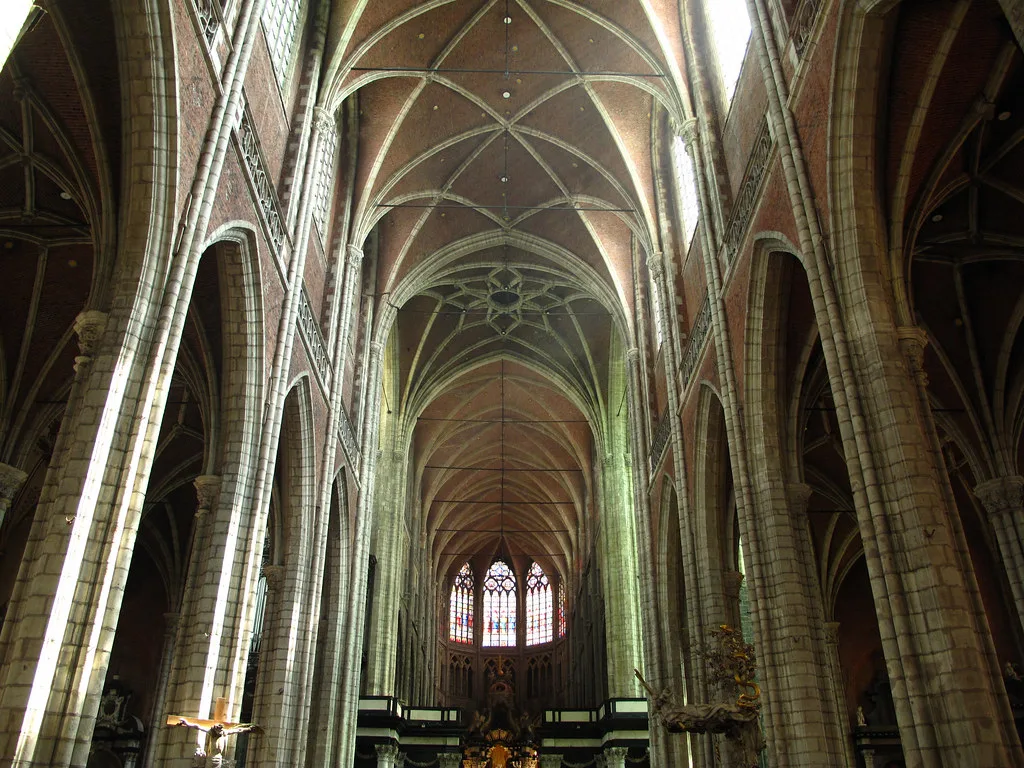
The Adoration of the Mystic Lamb, painted for Sint-Baafskathedraal, is the reason many travellers put Ghent on an art itinerary at all. It is a winged polyptych, which means the panels were designed to be folded shut on ordinary days and opened for feast days, so the closed exterior is itself a complete composition rather than plain boards. The design rewards patient study of both the central panels and the outer wings.
The Ghent Altarpiece has been through fire, theft and wartime removal, and its conservation history is part of what you are looking at. The dedicated guide explains the panel structure and the donor figures on the outer wings.
Where to see Flemish paintings in Antwerp: Rubens in the churches and the museum
Antwerp is the Rubens city, and the most rewarding way to see him is in situ in the churches for which the altarpieces were commissioned. Triptychs above side altars show how scale and sightlines were calculated for a specific chapel, something a gallery wall cannot reproduce. The Royal Museum of Fine Arts Antwerp adds a wider collection of Flemish work alongside later painters.
If your time in Antwerp is short, prioritise the churches over the museum, because the Baroque altarpieces lose much of their point when moved away from the architecture they were made for. The guide to Rubens in Antwerp sets out the main sites and the order to visit them in.
Bruegel and Van der Weyden beyond the three cities
Brussels holds major Bruegel works in its museums, and further Flemish panels, including the Annunciation Triptych, are held in the Louvre in Paris. Both cities are worth adding if your trip extends beyond Belgium or if Brussels is your arrival point. They also serve as a reminder that the Flemish school was never confined to one country.
Oil on panel, glazes and why the colour lasts
Flemish painters worked mostly in oil on oak panel, priming the wood with chalk and glue before building up the image in translucent glazes over an opaque underlayer. Each glaze adds depth without hiding what lies beneath, which is how a red robe can read as both bright and shadowed. This layering is slow work, and it explains why a small panel could take longer than a large canvas painted in one pass.
The technique also explains condition. Panels warp, joints split and varnish yellows, so what you see has usually been conserved and sometimes retouched. Looking for the joins between planks, visible as faint vertical lines, is a reliable way to tell a panel from a canvas.
How to read a Flemish altarpiece
Most surviving Flemish altarpieces are triptychs or polyptychs with hinged wings, and the donor who paid for the work usually appears kneeling at the edges of the central scene or on the outer panels. Reading outwards from the centre, you move from the sacred event to the people who commissioned it, which was the point: the painting was a permanent record of piety and status. Check whether the wings in front of you are the original outer faces or a reconstruction before you read the iconography.
Notice also how many panels are open at once. A closed altarpiece presents a different set of figures and a different mood, often subdued and monochrome, and the contrast between the two states was part of the intended drama of feast days.
Planning a Flemish art trail over one to four days
With one day, pick a single city. Antwerp gives you Rubens in the churches plus a major museum, Bruges gives you the early masters concentrated in one place, and Ghent gives you the Van Eyck altarpiece. With two days, pair Bruges with Ghent, since the train between them is short and the two collections complement each other. With three days, add Antwerp for the Baroque, and with four, finish in Ostend with Ensor.
Group each day's visits by district rather than by chronology, so you spend your time looking rather than crossing the city. Keep one afternoon free for the walk between sites, because the medieval street plans of Bruges and Ghent are part of how this art was made and paid for.
Which painters to prioritise with one day in one city
If you only have a single day in Bruges, choose the early masters and skip everything later. In Ghent, the altarpiece is the whole day's anchor and you should build the rest of your visit around it rather than the reverse. In Antwerp, choose Rubens's church commissions over the museum, and in Ostend choose Ensor over any general collection.
Which Flemish city should you base yourself in?
Base yourself in Bruges if early panels are your priority, in Antwerp if you want Rubens where he was meant to be seen, and in Ghent if you have one must-see work in mind. A two-city trip of Bruges and Ghent covers the early masters thoroughly, while three cities add the Baroque and make the chronology legible. Whatever you choose, the works reward unhurried looking far more than a long tick-list of names.
Explore more Belgium guides
Frequently Asked Questions
What is Flemish painting technique?
Flemish painters generally worked in oil on primed wooden panel, building the image in thin translucent glazes over a solid underlayer. The layered approach gives depth and lasting colour, and it is why fifteenth-century panels still look so saturated compared with frescoes or tempera paintings.
Who were the Dutch master painters, and are they the same as the Flemish ones?
No. The Dutch masters, including Rembrandt, Vermeer and Frans Hals, worked in the northern republic after it separated from the southern Netherlands, and their paintings hang mainly in Dutch museums. The Flemish tradition runs through Bruges, Ghent and Antwerp and is strongest in devotional panels, altarpieces and portraits.
How long do I need for a Flemish art trip?
One city fills a day comfortably if you focus on the main collection or altarpiece. Two days let you pair Bruges and Ghent, and three or four days add Antwerp for Rubens and Ostend for Ensor, which is enough to see the tradition change across five centuries without rushing any single room.
Sources
Useful notes for your next trip
Optional updates to our guides.
You might also like
Continue reading
More guides you'll find useful