
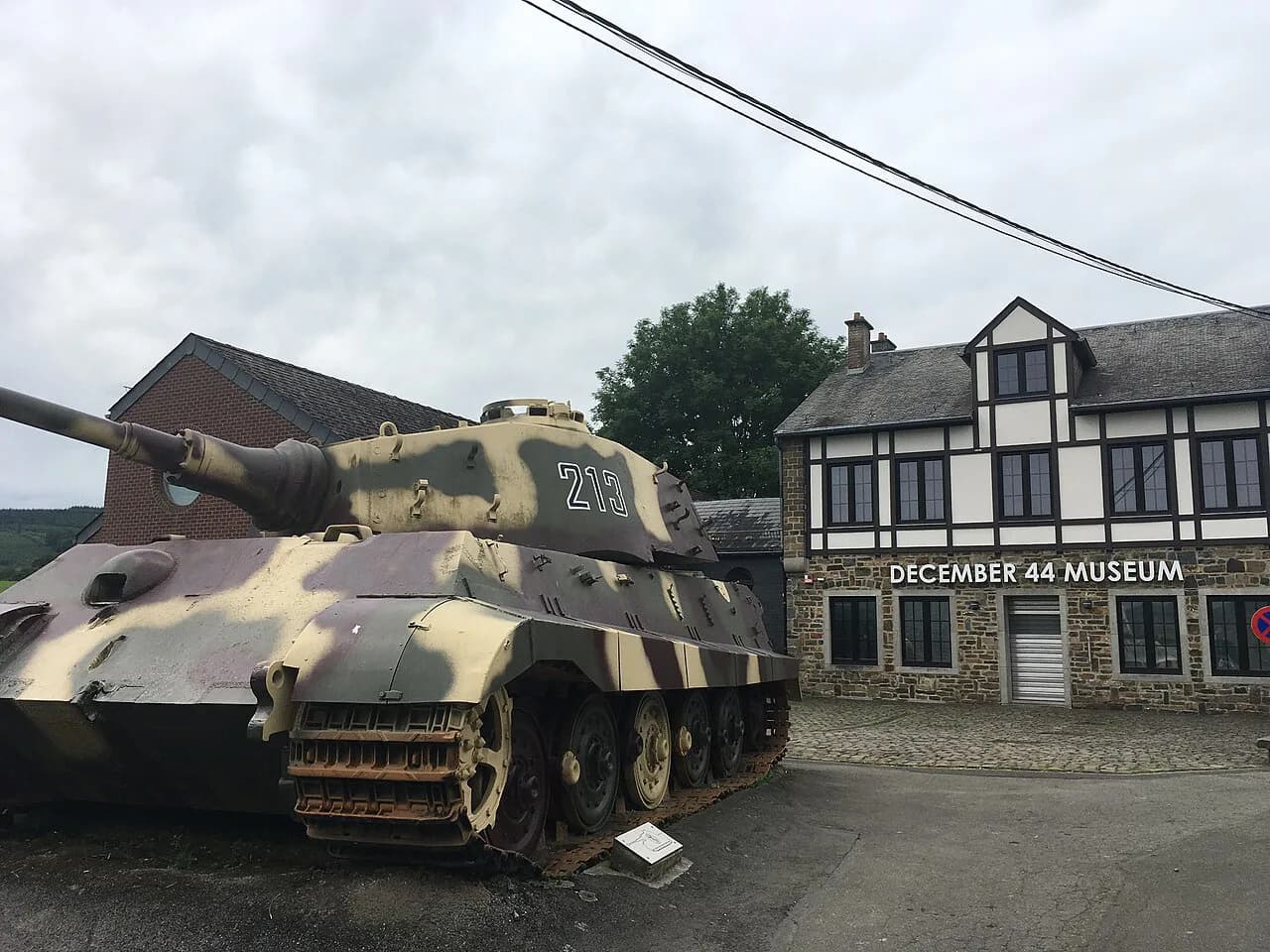
December 44 Museum, La Gleize: The King Tiger and the Collection
The December 44 Museum in La Gleize covers the Battle of the Bulge locally, with the King Tiger 213 outside and a collection found on the battlefield.
On this page
The December 44 Museum is the reason many travellers detour to La Gleize: a compact Battle of the Bulge museum in the Amblève valley, with a 69-tonne King Tiger 213 parked outside and a collection largely recovered from the surrounding battlefield. It is not a national museum and does not try to tell the whole Ardennes story; it tells the fight for this one village, where the German spearhead under Jochen Peiper was finally stopped. This guide explains what you see, how the village fits the battle, and how to slot the visit into a one- to four-day trip.
What the December 44 Museum is and where it sits in La Gleize
The museum occupies the former presbytery in La Gleize, a village in the commune of Stoumont in Liège province, and its address is Rue de l'église 7B, B-4987 La Gleize. The presbytery served as an aid station for Peiper's panzergrenadiers during the fighting, so the building itself is part of the story rather than a neutral shell around the exhibits. A 500 m² museum opened beside it in 1989; a reconstruction in 2013 doubled the space by bringing the presbytery into the museum, and further items from a private collection were added in 2019. That layered history explains why the museum feels domestic in scale, with rooms arranged around the old house rather than a purpose-built hall.
La Gleize sits on the hills of the Amblève valley, one of the more mountainous corners of the Ardennes, and the roads in and out are small and winding. That upland setting shapes a visit: you are not stopping at a motorway service station but driving into a village where the church, the town hall and the museum face each other across a small square. If you are building a route around ww2 sites Belgium, La Gleize works as a half-day stop rather than a full day in itself.
Why La Gleize matters in the Battle of the Bulge
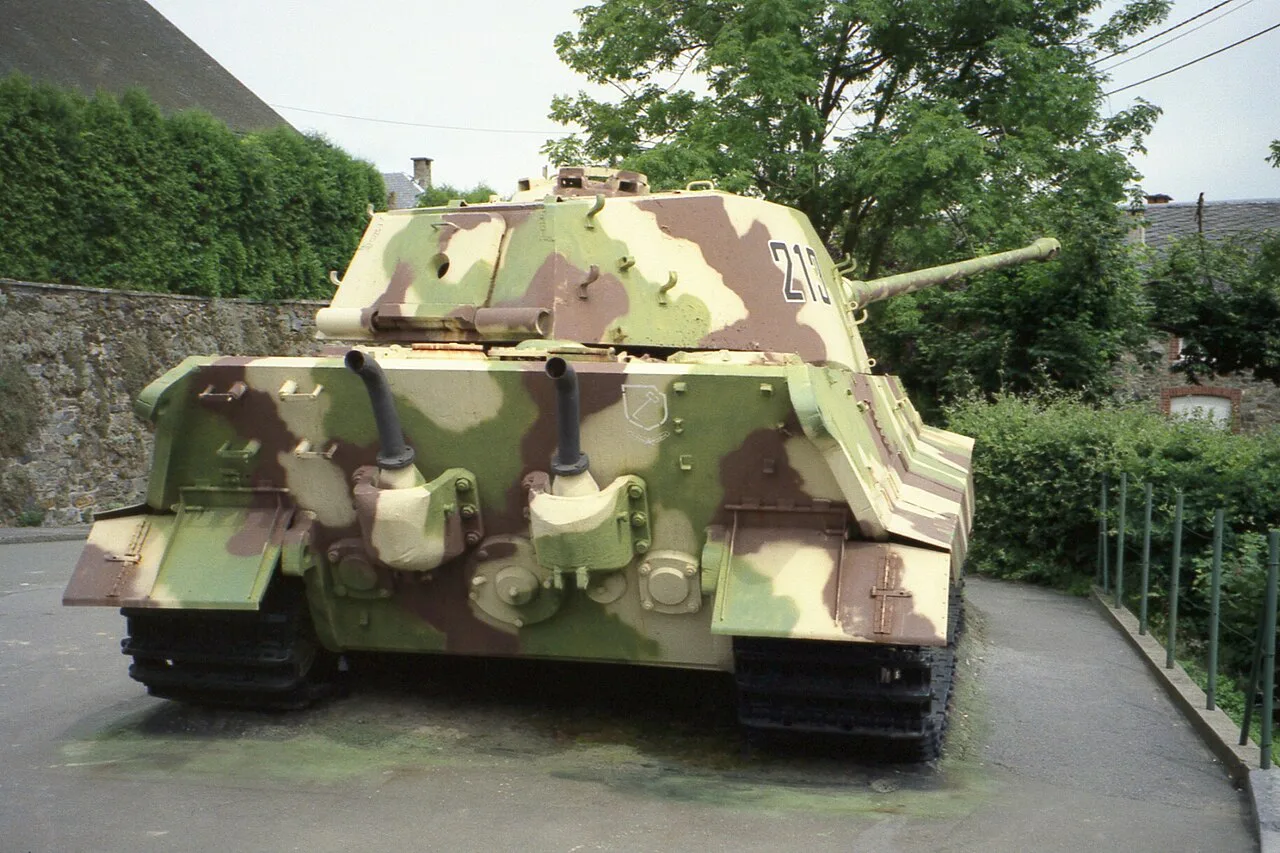
Most British and American readers know the Battle of the Bulge through Bastogne, the siege that held the southern shoulder. The museum argues the northern story just as strongly: the weight of the German offensive fell on the 1st SS Panzer Division Leibstandarte, led by Jochen Peiper, and La Gleize was the last bastion of his Kampfgruppe. Encircled by American forces, some 800 survivors slipped away on Christmas night in 1944, leaving 135 armoured vehicles behind, including the 69-tonne Royal Tiger now displayed at the museum. The village's own claim is blunt: if the Americans won the battle at Bastogne, the Germans lost it at La Gleize.
That framing is what makes the museum worth the detour for anyone following the campaign across the Ardennes. It deals with the northern spearhead, the units, the vehicles and the failure of the drive towards the Meuse, rather than repeating the Bastogne siege narrative. If you have already visited the Bastogne museums, La Gleize adds the other half of the pincer. For the broader geography of the campaign, the Battle of the Bulge Sites in Belgium page sets out the main towns and what each one covers.
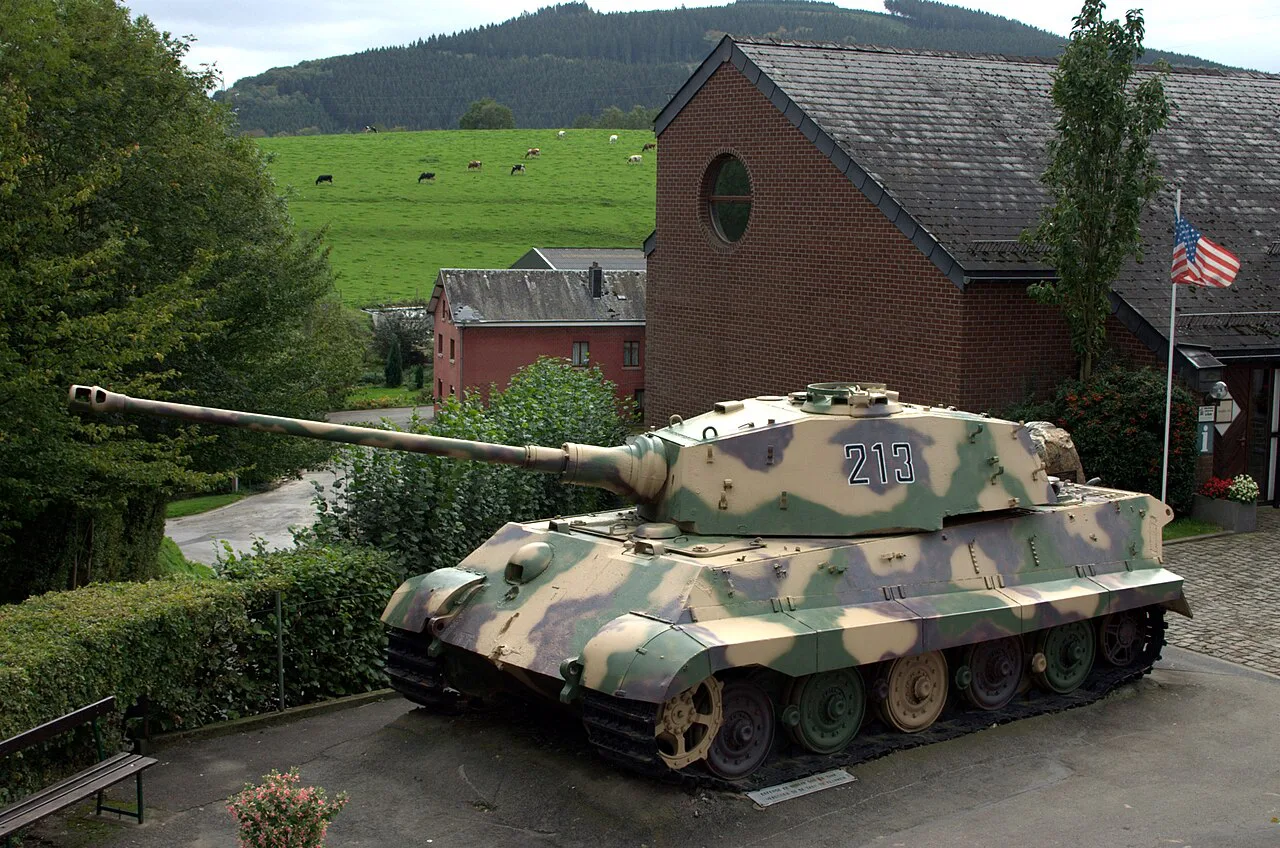
The King Tiger 213 outside the museum
The first thing you see is the tank. King Tiger 213 stands in front of the museum, a 69-tonne machine abandoned in the village when the German force withdrew. You do not need a ticket to look at it: it is outdoors, beside the building, and visible from the square. Treat it as a memorial object rather than a piece of equipment to climb on, and give it a few minutes before going inside. The tank is the museum's outdoor anchor, and for many visitors it is the image that stays.
What's inside: the collection and the presbytery building
Inside, the collection is one of the larger assemblies of Battle of the Bulge material in Europe, most of it recovered from the local battlefield. Uniforms, equipment and vehicles are displayed in historically accurate settings, and the 2013 reconstruction roughly doubled the exhibition space to over 1,000 m². The museum's own account of its purpose is remembrance: to make future generations aware of the consequences of war and to keep the memory of those who died. Expect a dense, object-led display rather than a heavily interactive one, and allow time to read the panels rather than pass through quickly.
Because the presbytery is part of the museum, the visit moves between domestic rooms and purpose-built galleries, which gives the collection a more intimate feel than a large national museum. If you have visited Bastogne barracks or the Mardasson memorial, the contrast is useful: La Gleize is on a human scale, tied to one village and one failed thrust. The Battle of the Bulge museums in Belgium page helps you compare the main sites before you commit a day to any one of them.
The church and village square opposite the museum
Across the square from the museum stands the church of La Gleize, a Romanesque building of local stone that was virtually destroyed in the 1944 fighting and lost its bell tower, rebuilt in 1951. In 1944 its crypt sheltered civilians, and the village cellars held families, SS troops and American prisoners during the American bombardment. The church and the town hall frame the small square, so the museum, the tank and the memorial landscape are all within a couple of minutes' walk. This is not a site you rush through in the car; park once and walk the centre.
How long a visit takes and how it fits a one- to four-day trip
Allow roughly an hour and a half to two hours for the museum and the village square, plus time for the tank and the church. That is a suggestion rather than a measured figure, since the collection rewards slow reading. La Gleize fits best as a half-day stop on a driving day through the northern Ardennes, paired with other sites in the Amblève and Salm valleys rather than treated as a standalone destination. If you are basing yourself in a Belgian city for a long weekend, this is a detour for the second or third day.
For a broader view of Belgium's wartime sites, from the fort at Breendonk to the deportation museum in Mechelen, the ww2 sites Belgium overview shows how the Ardennes fits with the rest of the country. La Gleize is the northern Ardennes counterweight to the Bastogne cluster, and seeing both gives a fuller picture of December 1944 than either alone.
Getting to La Gleize and pairing it with other Ardennes sites
La Gleize is reached by road, on small routes through the Amblève valley, and the winding approach is part of the visit. There is no station in the village, so plan on driving or joining a tour; the nearest larger towns are in the Liège province and the route is slow going in poor weather. Check the museum's own site for current opening times and any seasonal closure before you set out, since the village has few alternatives if the museum is shut. The official museum site carries the address, telephone number and contact email.
Pair La Gleize with Bastogne if you want the full campaign: the Mardasson memorial and the Bastogne barracks cover the southern siege and the American defence, while La Gleize covers the northern spearhead. Allow a full day for the drive between them, or split the two across separate days. For travellers coming from a city break, the Ardennes is a two- to three-hour drive from Brussels or Liège, which makes it realistic as a day out only if you start early.
Is the December 44 Museum worth the detour?
Yes, if you are following the Battle of the Bulge and want the northern half of the story rather than another Bastogne retelling. The King Tiger 213 is visible without a ticket, the presbytery setting ties the building to the fighting, and the collection is substantial for a village museum. The trade-off is the drive: La Gleize is not on a main line and rewards travellers with a car and a day to spare.
If your time in Belgium is limited to city breaks, keep La Gleize for a longer Ardennes trip and use the ww2 sites Belgium guide to decide which sites justify the mileage.
Explore more Belgium guides
Frequently Asked Questions
Do I need a ticket to see the King Tiger tank?
No. The King Tiger 213 stands outside the museum, in front of the building, so you can see it from the village square without entering. The indoor collection requires a ticket, which you buy at the museum; check the museum's own site for current arrangements.
How does the December 44 Museum differ from the Bastogne War Museum?
The December 44 Museum focuses on the northern German spearhead under Jochen Peiper and the fighting around La Gleize, while the Bastogne museums cover the southern siege and the American defence. Visiting both gives a fuller picture of the Ardennes offensive.
Sources
Useful notes for your next trip
Optional updates to our guides.
You might also like



Continue reading
More guides you'll find useful





