
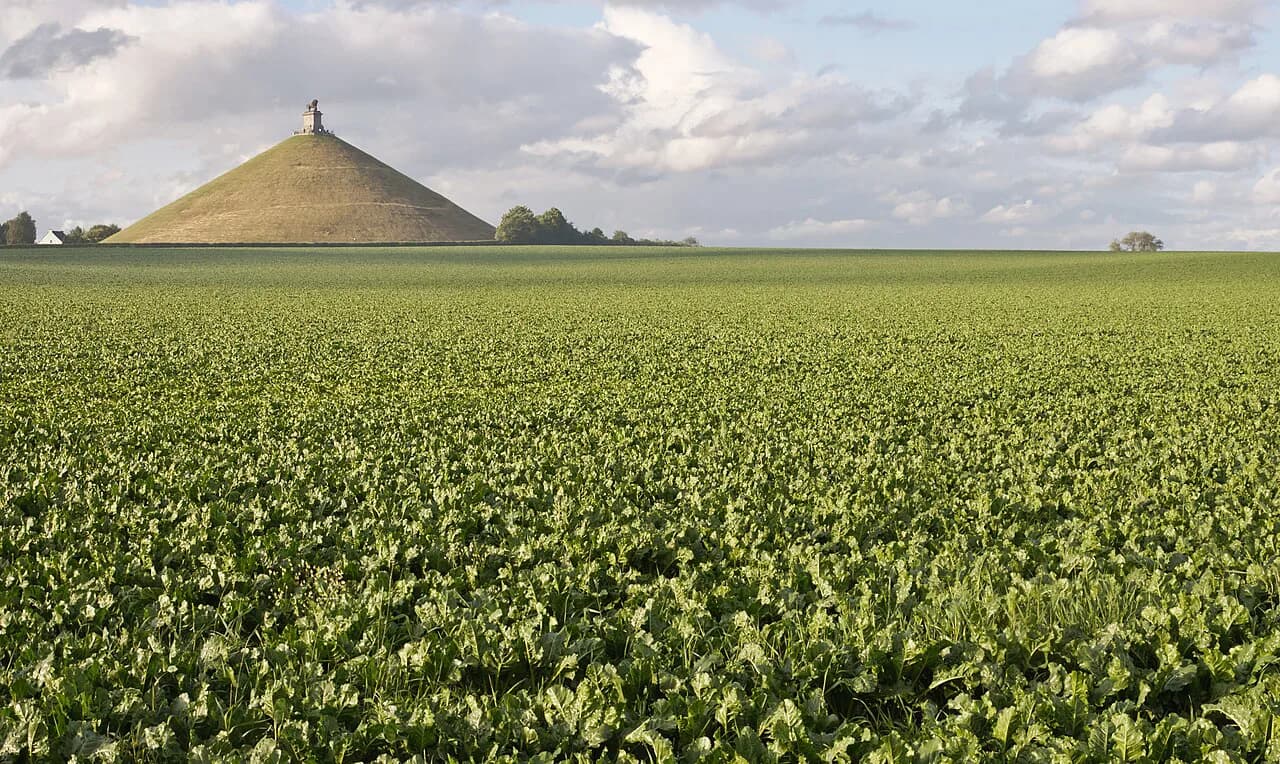
Waterloo Battlefield: What to See and How Long to Allow
Plan a visit to the Waterloo battlefield south of Brussels, taking in the Lion's Mound, Hougoumont farm, the visitor centre and the Wellington Museum.
On this page
A day is enough to see the core of the Waterloo battlefield if you concentrate on the Lion's Mound, the Memorial 1815 museum and Hougoumont farm, and add the two headquarters museums only if you start early. The sites are not one enclosed park: they lie in four clusters across the farmland and villages south of Brussels, so the order you visit them in matters more than the total distance. This guide groups them by location, explains what each one is, and sets out a realistic plan for a half day or a full one.
What the battlefield is and where it sits on the ground
The fighting of 18 June 1815 took place on a low ridge a short distance south of Brussels, near the villages of Waterloo, Plancenoit and Braine-l'Alleud. The battlefield is not a single walled attraction but open farmland crossed by roads, with monuments and museums scattered among working farms. The main memorial site, including the mound and visitor centre, has its address on the Route du Lion at Braine-l'Alleud rather than in Waterloo itself.
Thinking in four groups saves a lot of driving. The Lion's Mound and Memorial 1815 sit together at the centre; Hougoumont farm lies to the west; the town of Waterloo with the Wellington Museum and Saint Joseph's Church is to the north; and the Ferme du Caillou at Vieux-Genappe, plus the Plancenoit memorials, lie to the south. A sensible route works north to south or the reverse, rather than criss-crossing the ridge.
The battle in brief: 18 June 1815 and why it ended Napoleon's rule
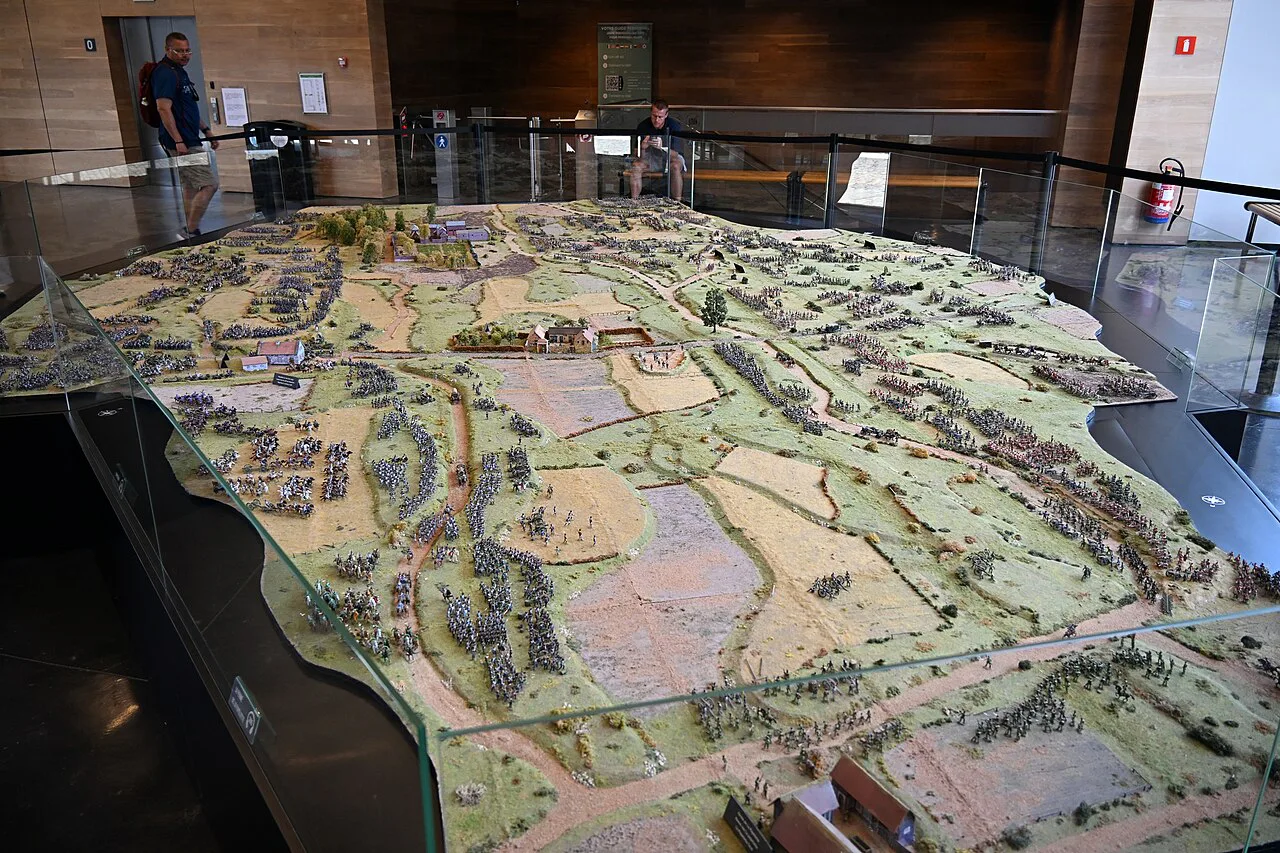
The battle of Waterloo was fought on 18 June 1815, when the French army under Napoleon Bonaparte attacked a defensive line held by Wellington's mixed force of British, Dutch, Belgian and German troops. Wellington held on through repeated French assaults until a Prussian army under Blücher arrived from the east, and their combined weight broke the French. It was the decisive engagement of the campaign, and it ended Napoleon's rule for good; he was sent to St Helena, where he died in 1821.
Two days earlier, on 16 June, the French had fought separate actions at Quatre Bras and Ligny, after which Wellington pulled back to the ridge at Waterloo and waited for the Prussians to return. The battlefield you walk today is that ridge: the farmhouses that anchored the allied line, the roads the attacks came down and the ground the Prussian advance crossed. Knowing this makes the scattered memorials easier to read as one event.
The Lion's Mound and the panorama at the visitor centre
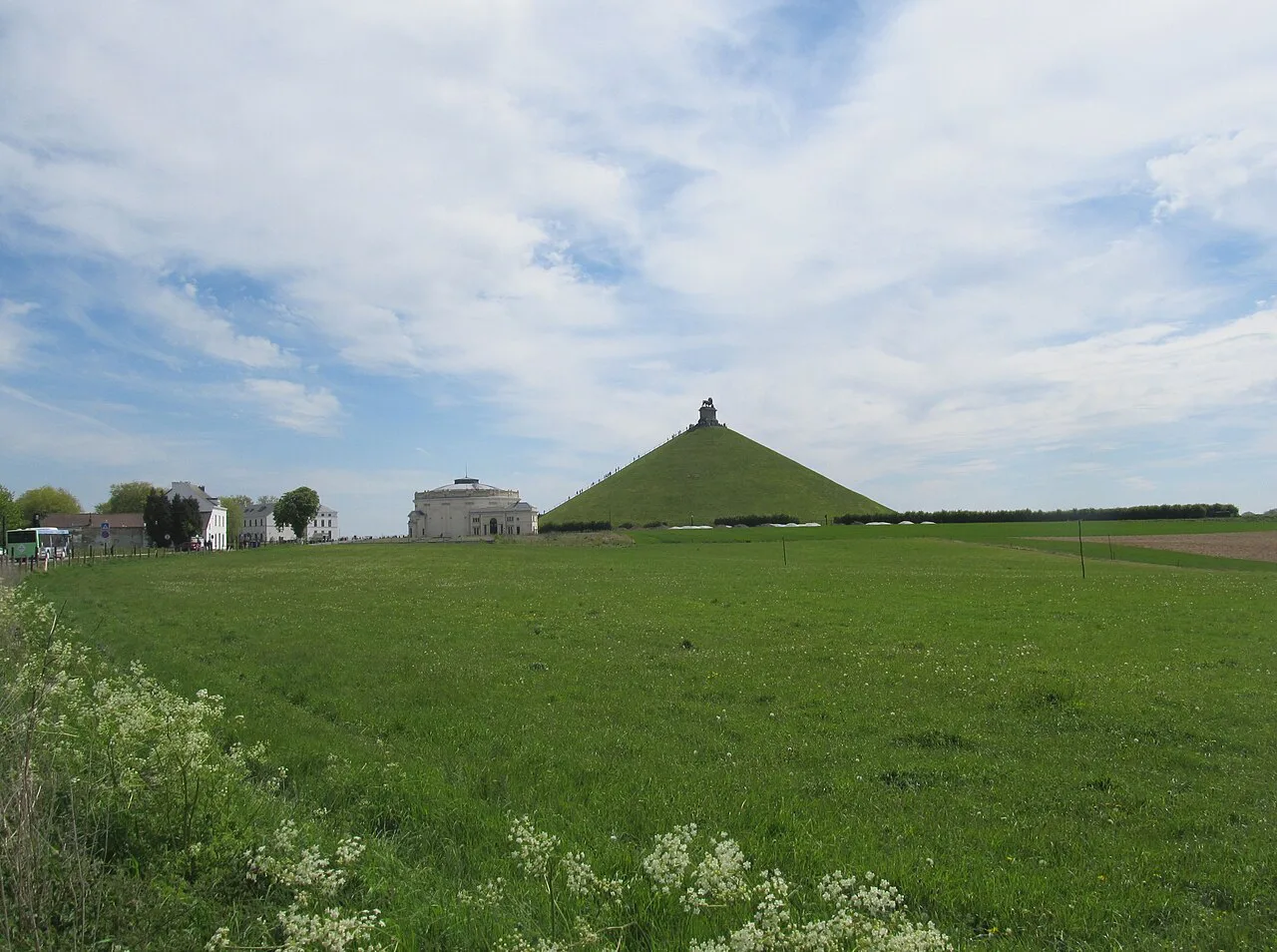
The Lion's Mound (Butte du Lion) is the landmark of the battlefield, an enormous artificial hill raised at the spot where the Prince of Orange was wounded, topped by a cast-iron lion. It gives a wide view over the ground, though the climb is steep and involves a long staircase. The memorial complex around it is the natural first stop, and you can read more about the Lion's Mound (Butte du Lion) before you go.
The mound is not original battlefield ground: it was raised in the nineteenth century and changed the shape of the ridge in the process. It stands about 40 metres high, and from the top the positions of the farms and the allied line become clearer. It is worth climbing before touring the museums, because everything afterwards makes more sense.
Beside the mound, the visitor centre holds the Panorama of the Battle of Waterloo, painted and built in 1912 and measuring about 110 metres long by 12 metres high. It is a painted panorama rather than a view of the real ground, and it works best after you have seen the terrain from the top. The same complex includes the Memorial 1815 museum and a film presentation, so allow time for all of it together.
The Memorial 1815 museum and the 4D film
The Memorial 1815 at Waterloo is the main museum of the battle, with a route through uniforms, weapons and displays that explain the campaign and the day itself. Part of the experience is a film shown with sensory effects, which some visitors find effective and others find dated; it is short, so it costs little to try. The museum is the place to spend the longest single stretch of indoor time.
If you are weighing whether the museum is worth it, think about how much context you want. The mounds and farms are memorials you read with your own knowledge; the museum supplies the narrative, the uniforms and the sequence of the attacks. For a first visit it is the most efficient way to understand the battle before walking the ground.
Hougoumont farm and its orchard memorials
Hougoumont Farm, Waterloo was one of the most important positions of the day, held by allied troops throughout the fighting, and it is the site most worth the detour from the mound. The farm buildings, chapel and courtyard survive, with commemorative plaques and a few tombs in the orchard, including the monument to the French soldiers killed there. Access is not continuous, so plan your day around whether it is open when you travel.
Hougoumont is a working farm and feels very different from a museum. You walk through farmyard walls and an orchard rather than along a display route, and the visit is about seeing how defensible the place actually was rather than following an exhibition.
Wellington's headquarters at Waterloo and Napoleon's last headquarters at the Ferme du Caillou
The Wellington Museum occupies the inn where the Duke spent the evenings of 17 and 18 June 1815, and where he wrote his victory bulletin. His room and that of his mortally wounded aide-de-camp Gordon are open to visitors, and exhibits tell the allied side of the story. In the same town, Saint Joseph's Church carries 27 commemorative plaques and a marble monument to the allied soldiers.
Napoleon's last headquarters sit at the Ferme du Caillou near Vieux-Genappe, on the Brussels road, where a museum was set up by the Belgian Society for Napoleonic Studies in 1950. Rooms are presented as the Emperor's room, a dining room and the aides-de-camp's common room, and a memorial to the Imperial Guard stands in the orchard. This is the French counterpart to the Wellington Museum and makes a natural pairing with the Plancenoit memorials nearby.
The Prussian and French memorials around Plancenoit
Plancenoit and its surroundings hold a concentration of smaller monuments, including the Prussian memorial unveiled on 18 June 1818 in the village. General Picton's stele, the Hanoverian and Belgian memorials and the French memorial of the Wounded Eagle sculpture, unveiled in 1904, stand along the roads near the mound. For anyone following the Prussian advance or the final attacks, these are the markers that make the last phase of the battle legible.
La Haye Sainte, the farmhouse at the centre of the allied line, is private property and battlefield tourists are discouraged from visiting it in the way they can Hougoumont. Papelotte farm, on the allied left, and Mont-Saint-Jean farm, used as a country hospital for the Anglo-Dutch army during the fighting, lie further out and are best seen by car or bicycle between main stops. Plan to see them from outside rather than expect an exhibition.
How much of the battlefield you can cover in a day
A half day covers the Lion's Mound, the Memorial 1815 museum and Hougoumont, which is enough for most first visits. A full day adds the Wellington Museum and Saint Joseph's Church in Waterloo town, the Ferme du Caillou and the Plancenoit memorials, but you will be moving at a brisk pace. Two days lets you walk the ridge slowly and still see the outlying farms without rushing.
The single biggest time cost is moving between the clusters, not the sites themselves. Hougoumont, for example, is a long walk from the visitor centre rather than a short hop, so a car, bicycle or taxi makes a full day far easier. If you are on foot, pick the central cluster and one outlying site rather than trying to do everything.
Marching orders apart, there is no need to see all four clusters. The mound, museum and Hougoumont give you the core story; the headquarters museums add the human detail and the Plancenoit markers add the Prussian and French side. Choose based on which part of the campaign interests you, and let the others go.
Getting there from Brussels and moving between the sites
The battlefield is about 12 miles south of Brussels on the main road, and the usual rail approach is to Braine-l'Alleud rather than Waterloo station. From the station to the memorial site is roughly a 2.5-kilometre walk, which explains why many visitors take a taxi for the last stretch. Check current train times and connections before setting out, as the journey and the walking route are the part of the day most likely to change.
Once you are on the ground, a car gives you the most flexibility across the four clusters; a bicycle is manageable in good weather because the roads are undulating but not severe. Public transport between the farms is not something to rely on, so build the day around one central base such as the mound complex and branch out from there. Brussels is the practical gateway, but allow for the journey each way eating into your sightseeing time.
Which Waterloo sites to pair with a half day
If you have only a half day, choose the Lion's Mound, the Memorial 1815 museum and Hougoumont farm in that order: they explain the battle and give you the ground to see it on. Add the Wellington Museum or the Ferme du Caillou only with a full day and a car. The butte du lion gives the overview, but the farm is where the fighting becomes real.
Pair the visit with a city base rather than trying to see Waterloo in a few hours on the way elsewhere. Waterloo rewards a slow half day on the ridge and a second stop at one headquarters museum, and Brussels and the towns of Walloon Brabant make practical bases for the rest of your trip. If your interests run more to medieval towers than to battlefields, the UNESCO-listed belfries of Belgium make an equally good day trip from the same base.
Explore more Belgium guides
Frequently Asked Questions
Who all fought at Waterloo?
Wellington commanded a mixed force of British, Dutch, Belgian and German troops; Napoleon led the French army; and Blücher's Prussian army arrived later in the day to support the allies. The battle is dated to 18 June 1815.
How did Waterloo get its name?
The battle is named after the village of Waterloo, north of the ridge where the fighting took place, because Wellington's headquarters were there and he wrote his victory bulletin from the inn now occupied by the Wellington Museum. The main memorial site is technically at Braine-l'Alleud, but the name stuck.
Was Waterloo a close battle?
It hung in the balance for much of the day, with repeated French assaults on the allied line before the Prussians arrived and tipped the result. It was decisive in ending Napoleon's rule rather than the largest or bloodiest battle of the Napoleonic Wars.
Sources
Useful notes for your next trip
Optional updates to our guides.
You might also like



Continue reading
More guides you'll find useful





