
Kortrijk, Belgium: What to See on a Short City Break
Kortrijk is a West Flanders city on the Leie, known for the Broel Towers, its beguinage, the Belfry and the Battle of the Golden Spurs museum.
On this page
Kortrijk deserves a day of your Flanders trip, and a half-day is enough if you are breaking the journey between Ghent and Lille. The compact centre puts the Leie riverfront, the Grote Markt, the beguinage and two strong museums within a short walk of each other. This guide sets out what each sight gives you, a sensible walking order and how many days the city actually earns.
Kortrijk (Courtrai in French) sits in West Flanders on the river Leie, 42 km southwest of Ghent and 25 km northeast of Lille. The city grew rich in the Middle Ages on the flax and wool trade with France and England, and that linen money still explains the waterfront you walk along today.
Why Kortrijk is worth a day
Kortrijk combines the scale of a working city with the walkability of a small town, which is why it suits a short break better than a checklist of sights. Almost everything described here sits inside the old centre, so you spend your time looking rather than travelling between stops. The reward is a city that has kept its medieval fragments and rebuilt confidently around them.
The city's identity runs through the Leie, the flax industry and one famous battle. One moment you are on a rebuilt market square, the next at a beguinage or a medieval bell tower. That mix is the argument for including Kortrijk in a wider run of Belgian towns rather than treating West Flanders as a single stop.
Be clear about what the centre is. Allied bombing in the Second World War destroyed much of medieval Kortrijk, so you are not walking through an intact old town as you would in Bruges. What survives is spectacular in places, and the 1999 remodelling of the Grote Markt deliberately sets the old belfry and St Martin's Church against modern paving and street lines.
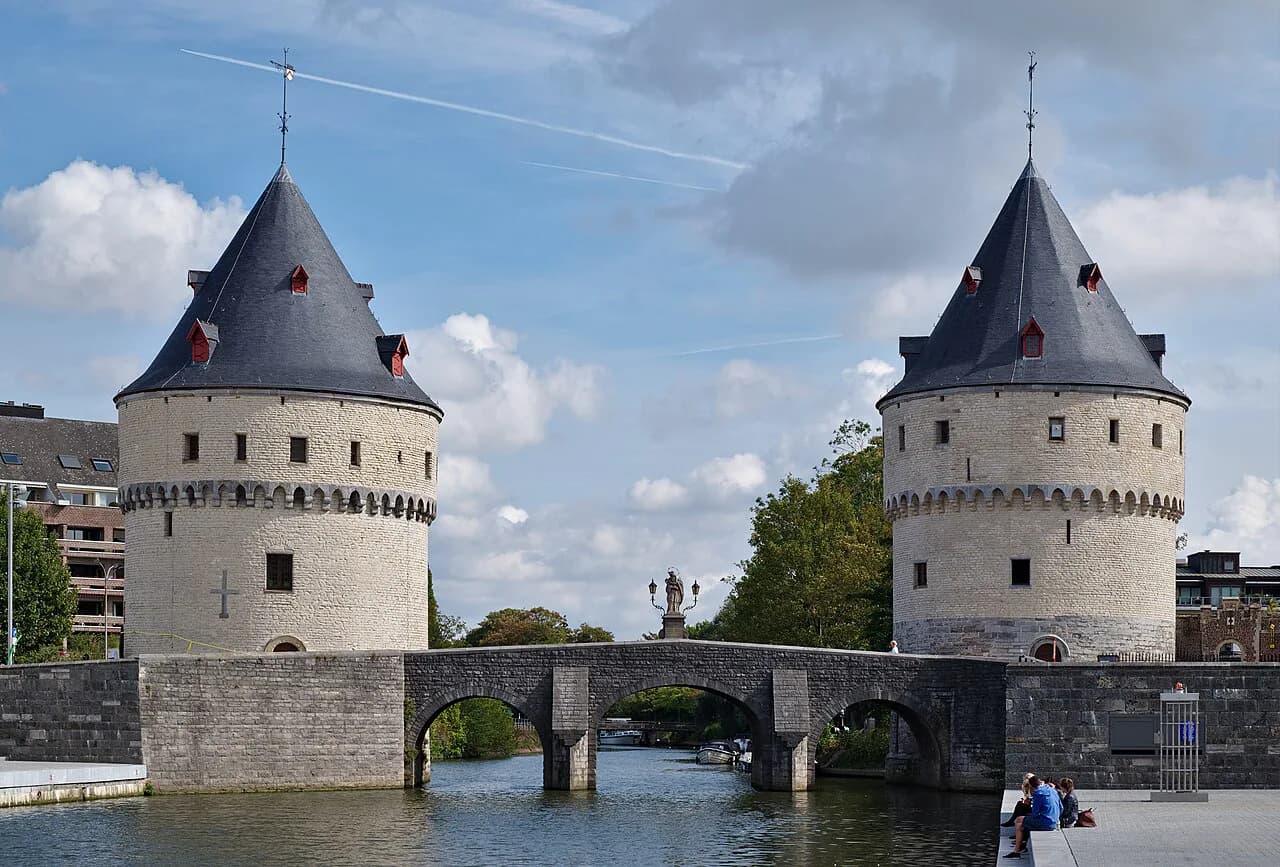
The Broel Towers and the banks of the Leie
Start at the river, not the market square. The banks of the Leie are the loveliest place in the city to spend time, and the twin Broel Towers stand over the water as the remnant of the medieval fortifications. Use the riverside as your base for exploring the downtown area, which mixes ancient heritage, modern architecture and a lively creative streak.
The flax trade explains the waterfront's shape. In its heyday the Leie was vital to the city's flax industry, with bleaching and processing tied to the river; these days it mostly adds picturesque appeal. Walking both banks takes perhaps twenty minutes at an unhurried pace and gives you the clearest sense of what made Kortrijk rich.
The Grote Markt and the UNESCO-listed Belfry
From the river, head inland to the Grote Markt, where the UNESCO-listed Belfry stands free of the buildings that once crowded it. In 1382 the invading army removed Manten, the mechanical bell-striker, and carried him off to Dijon; the current striker dates from the 1960s, when he was given a wife, Kalle. Look past the tower to St Martin's Church for the classic view of the square.
The square is remodelled in a pleasing mix of modern and old, and it has a market each Monday. That Monday market is the one fixed rhythm worth planning around if you like a city when it is out shopping rather than at its museums. On other days the square is simply a good place for a coffee and a slow look at the belfry.
Kortrijk 1302 and the Battle of the Golden Spurs
The Battle of the Golden Spurs was fought nearby on 11 July 1302, and it is the event that makes sense of the city's sights. The rebellious Flemish beat the French army of Philip IV, whose horsemen got stuck in the bog, and the victorious Flemings killed the captured French nobles rather than ransoming them, then hung their spurs as trophies in the Church of Our Lady. The Kortrijk 1302 multimedia museum explains the battle and its afterlife.
The battle's importance grew through the nineteenth century with the rise of Romanticism and Flemish nationalism, and it intensified after Belgian independence in 1830. Nicaise de Keyser painted it in 1836 and Hendrik Conscience put it at the centre of his 1838 novel The Lion of Flanders. 11 July remains a holiday for the Flemish community.
Budget an hour if you read everything and rather less if you skim. The museum gives you the story before or after you walk the streets, and doing it early means the belfry, the squares and the spurs narrative click into place for the rest of the day.
Texture, the textile museum, and the flax and wool story
Texture takes the city's linen and wool history as its subject and is the natural companion to the riverside walk. Kortrijk grew significantly in the Middle Ages thanks to that trade with France and England, becoming one of the biggest and richest cities in Flanders. Seeing the cloth and the tools makes the Broel Towers and the Leie feel less decorative and more like infrastructure.
Plan Texture and Kortrijk 1302 as your two museum stops and resist adding more. Two substantial collections in a day is ample, and they cover different ground: one is about the battle, the other about the trade that paid for the city. Between them you get the full arc of medieval Kortrijk without museum fatigue.
The Beguinage and the quiet convent quarter
The Kortrijk Beguinage is the third piece of the city's heritage trio alongside the Belfry and Kortrijk 1302. Beguinages were enclosed communities of lay religious women, and their low houses and courtyards offer a quiet counterweight to the busy market square. Walk through rather than past: the quarter rewards a slow ten minutes.
Tourism Kortrijk runs an info point at Begijnhofstraat 2 in the city, a practical address if you want a local map before setting out. It is the sort of stop that saves you a wrong turn later.
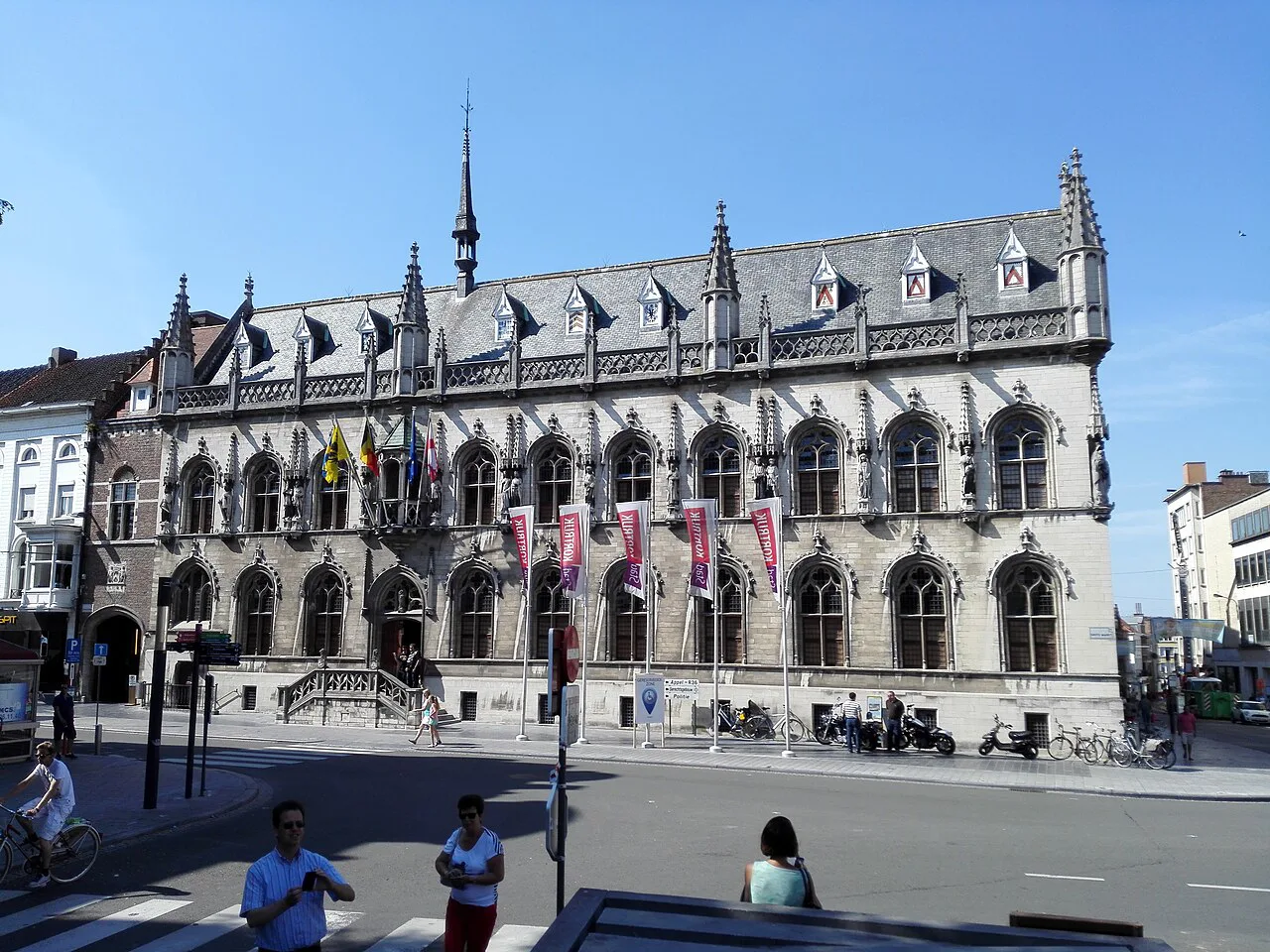
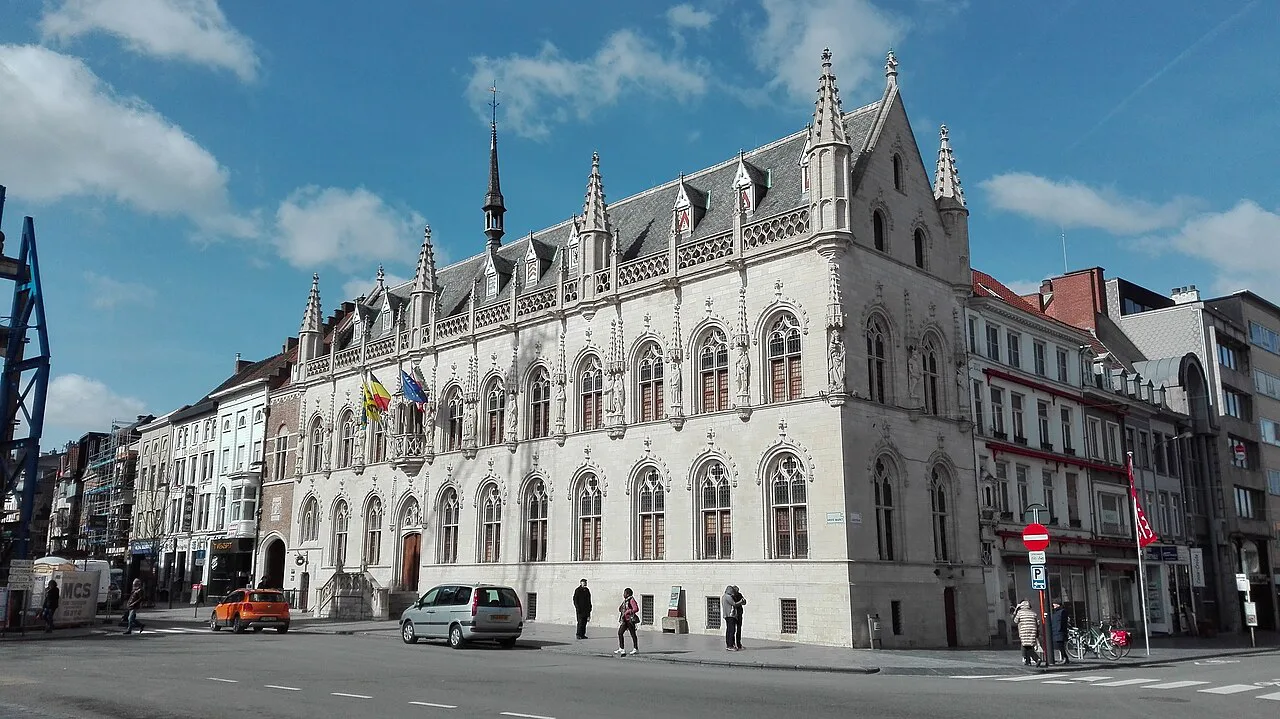
Kortrijk City Hall and its medieval interiors
Kortrijk City Hall anchors one end of the Grote Markt, and it is a sight in its own right rather than just a façade. The original wooden building burned down, but the current stone structure, renovated in 1959, looks much as it did in the seventeenth century, mixing Gothic and Renaissance work, with nineteenth-century statues of the counts and countesses of Flanders on the outside.
Inside, the Alderman's Room has a stone fireplace from between 1517 and 1527 carved with biblical scenes and coats of arms, surrounded by murals on the region's history. One shows Baldwin IX leaving on crusade in 1202; he was crowned Emperor of Constantinople, then captured by the Bulgarians in 1205 and vanished from the record. Upstairs, the Council Room fireplace carries Charles V at its centre.
How many days Kortrijk needs
Give Kortrijk a full day if you want both museums, the beguinage, the city hall interiors and a proper riverside walk with a long lunch in the middle. Give it a half-day if you are using it as a break in a journey between Ghent and Lille, focusing on the Broel Towers, the Grote Markt and one museum. Two days is generous unless you are using Kortrijk as a base for the wider Lys region.
The city makes most sense as a stop on the Ghent–Lille axis. Kortrijk is part of the cross-border Lille-Kortrijk-Tournai metropolitan area, which puts it naturally alongside Tournai if you are heading south into Wallonia. Treat it as a link in a chain of Belgian towns rather than a destination you fly in for.
Getting your bearings on foot
A sensible walking order runs from the Broel Towers up through the Grote Markt, into the city hall, on to the beguinage and finishing at Texture or Kortrijk 1302. Every leg is short and the route keeps the river in view at the start, which is where the city makes its best first impression. Wear shoes you can walk in on cobbles and paving.
If you want a comparison for how a Belgian belfry town organises itself around one square, Mechelen does it on a larger scale, with its own character and a different market square. Reading that alongside Kortrijk makes both cities easier to plan.
Where Kortrijk fits a Flanders itinerary
Use Kortrijk to break the run between Ghent and Lille, or to add a West Flanders day before heading towards Ypres. Its position 42 km southwest of Ghent means it slots neatly into a loop that also takes in Oudenaarde and the Flemish Ardennes. The Lys region between Kortrijk and Ghent rewards a slow route rather than a fast one.
For a longer run of belfry towns, Aalst sits between Ghent and Brussels and works well as a contrast to Kortrijk's river-led layout. Pairing the two gives you a sense of how differently the Low Countries' cloth towns developed.
Is Kortrijk worth the stop?
Yes, if you want a compact West Flanders city with a river at its centre and one of Belgium's most consequential battles behind it. The Broel Towers, the UNESCO-listed Belfry, the beguinage, the city hall interiors and the Kortrijk 1302 museum together earn a comfortable day. If you only have four hours between trains, take the riverside and the Grote Markt and leave the museums for another visit.
The Monday market on the Grote Markt is the one fixed date worth planning around if you want to see the square in use; on other days it is a good place to sit with a coffee within sight of the belfry.
Explore more Belgium guides
Frequently Asked Questions
Is Kortrijk in Belgium?
Yes. Kortrijk is a Belgian city and municipality in the Flemish province of West Flanders, on the river Leie, 42 km southwest of Ghent and 25 km northeast of Lille. Its French name is Courtrai.
What is the closest airport to Kortrijk?
The nearest major airport is Lille, just across the French border, since Kortrijk sits 25 km northeast of the city and is part of the cross-border Lille-Kortrijk-Tournai metropolitan area. Brussels and Ostend airports are further away. Check which routes and carriers serve each airport before you book.
How long does Kortrijk need?
A half-day covers the Broel Towers, the Grote Markt and one museum; a full day lets you add the beguinage, the city hall interiors and both Kortrijk 1302 and Texture. Two days is only worth it if you are using the city as a base for the Lys region.
When is the market in Kortrijk?
The Grote Markt hosts a market each Monday. It is the one weekly rhythm worth arranging your visit around if you want to see the square in use.
What is Kortrijk famous for?
Kortrijk is known for the Battle of the Golden Spurs, fought nearby on 11 July 1302, and for its medieval flax and wool trade. Those two stories sit behind the belfry, the beguinage, the Broel Towers and both of its main museums.
Sources
Useful notes for your next trip
Optional updates to our guides.
You might also like



Continue reading
More guides you'll find useful





