Ghent Markets: Which Market Is On Which Day and Where
Ghent holds a market every day of the week, with six on a Sunday morning. Here is which square hosts which market, what each one sells and when to go.
On this page
Ghent is a market city every day of the week, and Sunday morning is the busiest slot of all, with six markets running at the same time. If you have one morning to spend among the stalls, take Sunday and work west from the Kouter towards the Leie. This guide sets out which square or quay hosts which market, what is actually on the tables, and how to fold the stalls into a short city break.
The pattern is easy to hold in your head: Friday belongs to the Vrijdagmarkt and the Groentenmarkt, Saturday adds the flea market behind Sint-Jacobskerk, and Sunday multiplies everything. Most of these sit within a few minutes of each other on foot in the old town. That compactness is what makes Ghent unusually good for market browsing rather than a single big market day.
Which markets are on in Ghent, and on which days
Friday morning brings two markets a couple of minutes apart: the general street market on the Vrijdagmarkt and the Biomarkt on the Groentenmarkt. The flea and antiques market behind Sint-Jacobskerk then runs on Friday, Saturday and Sunday mornings, which means even a two-night stay catches it. Sunday is the big one, with six markets across the city.
That spread lets you choose a day rather than hunt for a single 'Ghent market'. A Friday trip gets you food shopping and fish; a weekend trip adds flowers, secondhand books and the flea trade. Plan the rest of your sightseeing around whichever morning your visit actually lands on, and read the market days as fixed points in the itinerary.
Friday markets: Vrijdagmarkt and the Biomarkt on Groentenmarkt
The Friday market on the Vrijdagmarkt is the practical, everyday one: fruit, cheese, shoes and stockings piled across the square, plus at least one food van selling Italian pasta. A large truck opens its side to display fresh sole, lobsters and herring, which makes this the stop for anyone self-catering or picnicking. It is a working street market rather than a souvenir set-piece.
The same morning, the Biomarkt on the Groentenmarkt is a modest farmers' market with a handful of stands selling organic fruit and vegetables from small, sustainable farms in East Flanders. The trade-off is scale against provenance: the Vrijdagmarkt is bigger and broader, the Biomarkt smaller and more focused on growers. With both a couple of minutes apart, you can browse one and shop at the other without losing the morning.
Saturday: the flea market at Bij Sint-Jacobs
Saturday is the quietest of the three flea-market mornings but the easiest to combine with a full day of sightseeing, since the stalls are gone by the time you want lunch. The cobbled square behind Sint-Jacobskerk fills with dealers selling old electrical appliances, crates of vinyl records, dusty vases and the occasional stuffed zebra. The mood is loud and local, with Ghent dialect shouted across the stalls and early customers eating breakfast on the café terraces.
Dealers set up around 8 am, so an early start pays off if you want first pick of the records and the better vases. Because the market runs again on Sunday, a Saturday visit leaves Sunday free for the flower and book stalls. If your break is short, remember this is the one market you can catch on any of three consecutive mornings.
Sunday morning: flowers on the Kouter, books on the Ajuinlei and the flea market again
Sunday is when Ghent's markets all fire at once. Start on the Kouter for flowers, walk south to the Ajuinlei for secondhand books along the Leie, then loop back up to Bij Sint-Jacobs for the flea market. Add the organic market at Maria-Hendrikaplein if you are near the main station. Six markets in one morning is realistic on foot because the distances between them are short.
The character changes street by street: the Kouter is colourful and orderly, the Leie quays are relaxed and slow, and Bij Sint-Jacobs is noisy and chaotic. That variety is the argument for giving Sunday morning to the markets rather than to a museum. Coffee and a terrace stop fit naturally between the three.
Sunday organic market at Maria-Hendrikaplein by the main station
A second organic market runs on Sundays on the Maria-Hendrikaplein, in front of the main station. It is the one market on this list that sits outside the old-town cluster, which makes it useful if you are arriving or leaving by train that morning. Expect the same small-producer, organic character as the Friday Biomarkt on the Groentenmarkt.
Treat it as a bonus rather than the main event: the old-town markets are where the atmosphere is. If your train leaves late morning, though, it is a sensible last stop before the platform. Otherwise, the Kouter and the Leie give you more to see in the same time.
The Prondelmarkt: what dealers sell and how the morning runs
The Prondelmarkt is Ghent's flea and antiques market, held on the cobbled square behind Sint-Jacobskerk on Friday, Saturday and Sunday mornings. The stock is genuinely mixed: ancient electrical appliances, crates of vinyl records, dusty vases and the occasional stuffed zebra. It rewards browsing and asking rather than working from a list.
Dealers set up around 8 am, and the atmosphere is lively, with customers grabbing an early breakfast on a café terrace and the smell of fried potatoes drifting over from Frituur Bij Sint-Jacobs. Come early for the best records and stay for the noise. It is the most characterful of the city's markets and the easiest to slot into any of three mornings.
The Bloemenmarkt on Kouter: azaleas, tulips and an 18th-century Sunday habit
Locals have bought flowers on the Kouter on Sunday mornings since the 18th century, and about 15 stallholders now set up colourful stands there. The stock runs from tulips to vivid Ghent azaleas grown in large greenhouses outside the city. The square itself is broad and open, which makes this the most photogenic of the Sunday markets.
It is a buying market rather than a browsing one, so come if you want flowers or simply want to see the square in use. Pair it with the book stalls along the Leie, a short walk south. Together they make a gentle, low-cost Sunday morning before the city's sights open up.
The Boekenmarkt on the Leie: secondhand books along the Ajuinlei
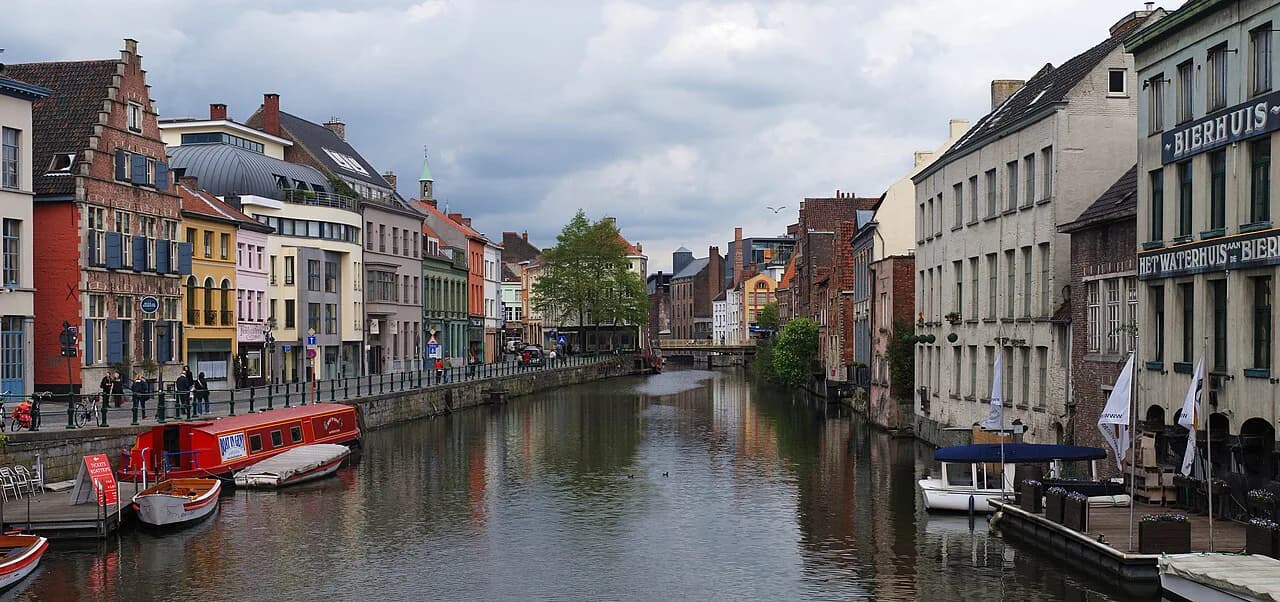
Secondhand book dealers set up along the Leie waterfront on the Ajuinlei on Sunday mornings. The mood is relaxed: locals browse piles of old books and magazines, and some stop for a glass of white wine at l'Apéro d'Oc. It is the quietest of the Sunday markets and the one that most rewards unhurried wandering.
The Ajuinlei is a short walk from the Kouter, so the two pair naturally in a single loop. Browsing is more rewarding here than buying to a plan, since stock is unpredictable and mostly secondhand. Bring cash for the smaller dealers and leave time to sit by the water.
Vrijdagmarkt market: fruit, cheese, shoes and a fish stall
Held every Friday morning on the Vrijdagmarkt, this street market is crammed with stalls selling fruit, cheese, shoes and stockings. You can count on at least one food van selling Italian pasta and a large truck with its side opened to reveal fresh sole, lobsters and herring. It is the most useful market for actual shopping.
The square is a natural base for the rest of the day: the old town, the Gravensteen and the Leie quays are all within easy walking distance. Shop in the morning while the stalls are up, then use the afternoon for the sights. It is the strongest reason to be in Ghent on a Friday.
Biomarkt: small East Flanders farms on the Groentenmarkt
The Biomarkt on the Groentenmarkt is a modest farmers' market held every Friday morning, with a few stands selling organic fruit and vegetables from small, sustainable farms in East Flanders. It suits anyone who wants to buy directly from growers rather than from a general street stall. The Groentenmarkt is close enough to the Vrijdagmarkt to visit both in one sweep.
Think of it as the quieter counterpart to the Vrijdagmarkt: fewer stands, narrower range, stronger provenance. If you are staying somewhere with a kitchen, this is where the better vegetables are. If you are just passing through, it is a two-minute detour from the main square.
Squares to build the rest of the day around after the stalls pack up
When the stalls come down, the squares take over as sightseeing. The Vrijdagmarkt and Groentenmarkt sit in the old town, close to the Gravensteen castle and the Leie quays, so you can move straight from market to afternoon. The Kouter is a short walk from the shopping streets and the main sights.
A Sunday that begins with flowers, books and the flea market can end on the water or up a tower. Boat trips leave from the Leie quays, and the city's viewpoints reward an afternoon climb. Pick one: a boat tour in the afternoon is the easiest way to see the city from below the street.
The city is compact enough to walk between all of this, and a walking route that starts at the markets and ends at the Graslei and Korenlei covers most of the old town in a day. Leave museum time for the following morning, when the market squares are quiet again.
How the markets fit a one-, two- or three-day Ghent trip
On a single day, pick the market that matches your date: Friday for the Vrijdagmarkt and Biomarkt, Saturday for the flea market behind Sint-Jacobskerk, Sunday for the flowers, books and everything else. Build the rest of the day around the old town, and use the afternoon for a castle or a boat. One day is enough to see the markets and the core sights.
With two days, give Sunday morning to the markets and keep the second morning for the museums and the Ghent Altarpiece. Three days lets you add the breweries and the chocolate shops, and still catch a market on whichever morning remains. The markets work as an anchor rather than a full itinerary, which is exactly their advantage in a short break.
Which Ghent market morning should you build your trip around?
Sunday morning gives the most choice: flowers on the Kouter, secondhand books on the Ajuinlei and the flea market at Bij Sint-Jacobs all run at once, within a short walk of each other. If your dates land on a Friday instead, the Vrijdagmarkt and the Biomarkt on the Groentenmarkt give you a morning of food shopping and fish.
Choose the day first, then plan the rest of the visit around it: a castle, a boat or a brewery in the afternoon. The markets reward an early start, comfortable shoes and cash for the smaller stalls.
Explore more Ghent guides
Frequently Asked Questions
What day is market day in Ghent?
There is a market every day of the week somewhere in Ghent. Friday brings the Vrijdagmarkt market and the Biomarkt on the Groentenmarkt, the flea market behind Sint-Jacobskerk runs on Friday, Saturday and Sunday mornings, and Sunday is the busiest, with six markets at once including the flowers on the Kouter and the books on the Ajuinlei.
Is there a Sunday market in Ghent?
Yes. Sunday morning is the big market slot, with the Bloemenmarkt on the Kouter, the Boekenmarkt along the Ajuinlei, the Prondelmarkt behind Sint-Jacobskerk and an organic market at Maria-Hendrikaplein among them. They sit close enough together to visit several on foot in one morning.
Where is the flea market in Ghent?
The Prondelmarkt is held on the cobbled square behind Sint-Jacobskerk on Friday, Saturday and Sunday mornings, with dealers setting up around 8 am. Expect old electrical goods, vinyl records, vases and general bric-a-brac rather than polished antiques.
Sources
Useful notes for your next trip
Optional updates to our guides.
You might also like
Continue reading
More guides you'll find useful