Dinant, Belgium: Citadel, Church and Saxophone Trail Guide
Plan a short break in Dinant, Belgium: the citadel above the Meuse, Notre-Dame's bulbous tower, Adolphe Sax's birthplace and a riverside walk through town.
On this page
Dinant needs one full day, and it works best as the second half of a two-centre trip with Namur. The town is a single row of houses pressed between the River Meuse and a limestone cliff, which is why its main sights sit on essentially two streets and why you can walk between them in minutes. This guide covers the citadel and the church, the saxophone trail, the Rocher Bayard, the cave on the left bank, river boats and the Lesse kayaks, plus how to get there and when to go.
What Dinant is and why it is worth a day of your trip
Dinant is a riverside town in southern Belgium with an ancient citadel, a Gothic cathedral and a museum dedicated to the creator of the saxophone. Adolphe Sax was born on a street here in 1814 and the town has never let anyone forget it: painted saxophones stand along the bridge, one for each country of the European Union. Most of the main attractions sit within a short walk of each other, which makes a single day realistic rather than rushed.
The payoff for a day here is variety in a small space: a cliff-top fortress with underground galleries, a church pressed against the rock, a cave of white calcite and a river running through the middle. You are not choosing between museums and landscape, because the two are stacked on top of each other. If you are touring the wider region, Dinant slots naturally into an Ardennes itinerary rather than demanding a trip of its own.
How Dinant is laid out: one row of houses between the Meuse and the cliff
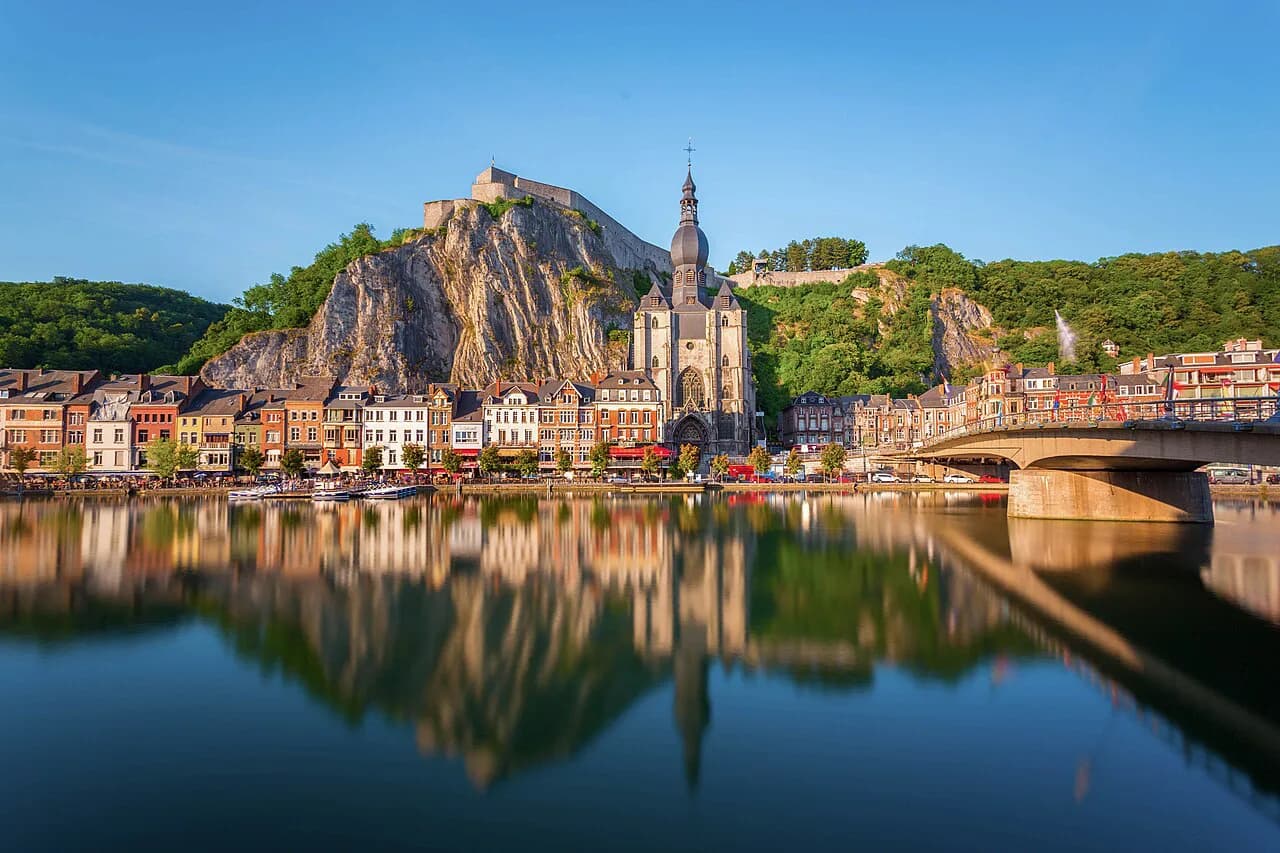
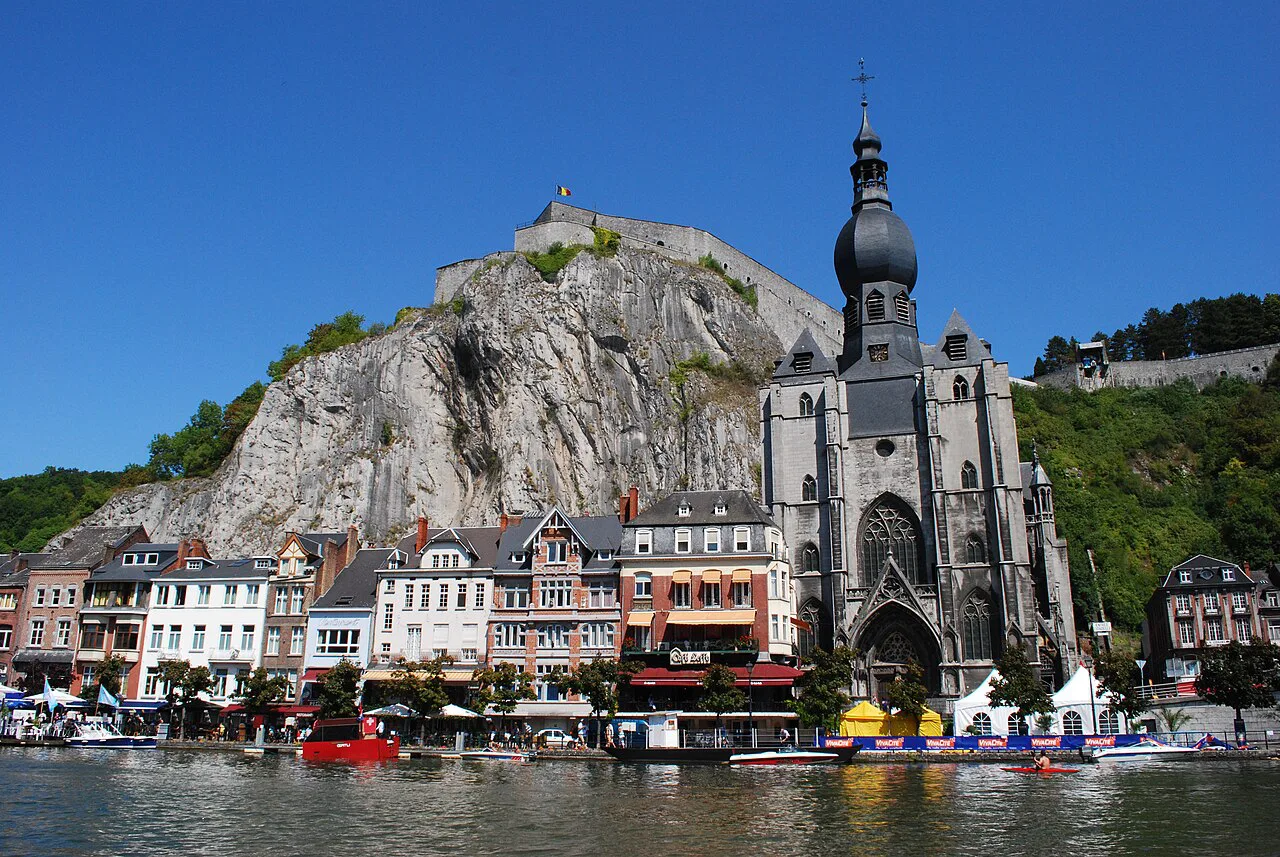
Behind the bridge, Dinant is a single row of houses pressed between the Meuse and a limestone cliff, with a bulbous church at the bottom and a citadel on top. That shape explains almost everything about visiting: the town centre is a strip along the right bank, the railway station sits close to the cave on the left bank, and the climb to the fortress starts beside the church. Plan your day as a short linear walk rather than a grid of streets.
Because everything sits on two streets, you can see the church, the Sax museum and the bridge in a couple of hours and still have the afternoon for the citadel, a boat or the cave. The Rocher Bayard stands beside the road south of town, which means it is easier to combine with a walk along the river than to reach mid-morning and then backtrack.
The Citadelle de Dinant: cable car or 408 steps
The citadel sits a hundred metres above the river, fortified since 1051 and rebuilt by the Dutch in 1818 after the French demolished the earlier work. The visit takes in underground galleries, a bakery and a 1914 trench. A cable car climbs from beside the church, or you can take the four hundred and eight steps if you prefer to earn the view.
Treat the climb as a real choice rather than a formality. The cable car saves your legs for the galleries and the terrace, where the view over the Meuse valley is the reason most people come up; the steps suit anyone who wants the cliff face at close quarters and has the knees for it. Either way, allow about two hours at the top once you are up there.
Collégiale Notre-Dame and its pear-shaped tower
The collegiate church is Gothic, built from 1227 after a rockfall crushed the Romanesque church that stood here, and given a bulbous pear-shaped bell tower in the sixteenth century that appears in every photograph of the town. It is pressed hard against the cliff with the citadel directly above, so the best view of the tower is from across the river or from the bridge. It was burnt in both world wars and restored after each.
Inside, half an hour covers it comfortably. Combine the visit with the cable-car base beside it, since the two sit at the same point of the town and there is no sense in walking the strip twice.
The saxophone trail: painted saxophones and the Maison de Monsieur Sax
The painted saxophones along the bridge are the town's most photographed sight and cost nothing to see; they stand in a line with the church and citadel behind them. Adolphe Sax was born on a street here in 1814, and the town has built its identity around the instrument ever since.
The Maison de Monsieur Sax is a small free exhibition on the site of the house where the inventor was born, covering the instrument's development and the patent fights that followed him. A bronze figure sits on a bench outside and is photographed constantly. Half an hour is enough, and the free entry makes it an easy addition rather than a decision to weigh up.
The Rocher Bayard and the legend of the four sons of Aymon
The Rocher Bayard is a limestone needle standing alone beside the road south of town, split from the cliff by Louis XIV's engineers in 1675 to let his army pass. Legend gives the gap to a magic horse escaping with the four sons of Aymon on its back, and the road now runs through the cleft. Allow about half an hour, most of it spent working out the angles for a photograph.
Grotte la Merveilleuse: white calcite draperies on the left bank
The cave was found during railway works in 1904 on the left bank, on three levels connected by stairs, and is known for white calcite draperies rather than for size. Guided visits run through the day and last about fifty minutes. The temperature underground holds near ten degrees whatever the month, so a warm layer is worth carrying even in July.
Its position close to the railway station makes it the natural first or last stop of the day rather than something to fit between the citadel and a boat. If caves are the reason you came to this part of Belgium, the caves of Han make a larger, separate outing further south.
Boat trips on the Meuse and kayaks on the Lesse from Anseremme
A boat cruise along the river is a good way to take in Dinant's architecture, history and scenery from the water, with boats docked along the quay in the town centre. It also gives you the view of the church and citadel stacked above the houses that you cannot get from the street.
In summer, kayaks come down the Lesse from Anseremme, which puts a short paddle on the edge of town alongside the river cruises. Choose the boat if you want the town from below without getting wet, and the kayak if you would rather spend the time on moving water.
Wartime Dinant: August 1914 and how the town remembers it
German troops shot six hundred and seventy-four civilians here in August 1914, an event that sits alongside the citadel's own 1914 trench in how the town presents its history. The figures are part of the record and worth knowing before you walk the streets they happened on.
Approach this as you would any memorial: read the plaques and the citadel displays, keep voices low, and let the numbers speak. It is the part of Dinant that stays with people longest, and it takes very little time to include.
Worth the detour: the Abbaye de Maredsous and the Château de Vêves
The Abbaye de Maredsous is a Benedictine house founded in 1872 and built in a neo-Gothic manner over eight years, with around thirty monks still in residence. A visitor centre, the church and the grounds are open; the monastery itself is not, so plan around the public parts. It makes a semi-soft cheese and licenses its name to a brewery elsewhere.
The Château de Vêves stands at Celles, ten minutes east of Dinant by car: five round towers on a rock, rebuilt in 1410 after being burnt and still owned by the family that has held it since. The interiors are eighteenth-century and lived in rather than arranged, and costumes are put out for children to wear round the rooms. Both outings need a car and about an hour and a half each.
How many days Dinant needs, and pairing it with Namur
Give Dinant one day: the citadel, the church, the bridge and the Sax house fill a morning and early afternoon, and the cave or a boat fills the rest. Anything beyond that is the surrounding countryside rather than the town.
Pair it with Namur, which sits up the Meuse and works as a base for the pair, and you have a comfortable short break. If you want a second Ardennes town of a very different size, Durbuy is the obvious contrast.
Getting to Dinant from Brussels and by train from Namur
Dinant lies roughly 97 kilometres south of Brussels: fly into the capital and then drive or take the train south. The railway station sits close to the cave on the left bank, which makes the train a practical way in rather than a compromise.
From Namur the train is the simplest link, and the walk from Dinant station into the centre follows the river rather than climbing. Arriving by train puts the cave first and the citadel last, which suits a day trip.
When to go: summer kayaks and a cave at ten degrees
Summer brings the kayaks down the Lesse from Anseremme and the fullest choice of things on the water. The cave stays near ten degrees whatever the month, so it is a reasonable wet-weather or heatwave stop. For a town of this size, a dry day matters more than the season.
Should Dinant be a day or an overnight?
Make Dinant a day and sleep in Namur. You get the citadel, the church, the saxophones and either the cave or a river boat without paying for a second hotel, and the train between the two is short.
Stay overnight only if you want the Abbaye de Maredsous and the Château de Vêves as well, since both need a car and eat into the day. Otherwise, arrive on the first train and leave on the last.
Explore more Belgium guides
Sources
Useful notes for your next trip
Optional updates to our guides.
You might also like
Continue reading
More guides you'll find useful