
Langemark German War Cemetery: What to See and Expect

Langemark German War Cemetery is the principal German burial ground in the Ypres salient, holding 44,294 dead behind a low wall north of Ieper. Allow 30 to 45 minutes: the layout is compact, and you meet its three parts in sequence from the entrance. This page covers where it sits, how the road approach works, what to look for and what to combine with it.
Where the cemetery is
The cemetery lies beside the village of Langemark, part of the municipality of Langemark-Poelkapelle in West Flanders. It sits north of Ieper off the N313, the road that runs between Ieper and Poelkapelle, so the approach is a straightforward run out of the town rather than a cross-country detour.
The surrounding land is flat polder country, and the cemetery is easy to miss if you are watching for a grand gateway. Look for the village of Langemark rather than the town of Ypres on your map, and treat the N313 as your spine for the journey.

Getting there from Ypres
The drive north from Ieper along the N313 towards Poelkapelle is short, and the cemetery comes up near Langemark village. Because the site sits just off this road rather than in a town centre, arriving by car or bike is the practical option; the approach is signposted as a location rather than an attraction.
Treat the visit as part of a loop through the northern part of the salient rather than a standalone outing from the town centre. Plot your route on the N313 first, then add the sites you want before and after, so you are not doubling back across the same roads.
What the cemetery is
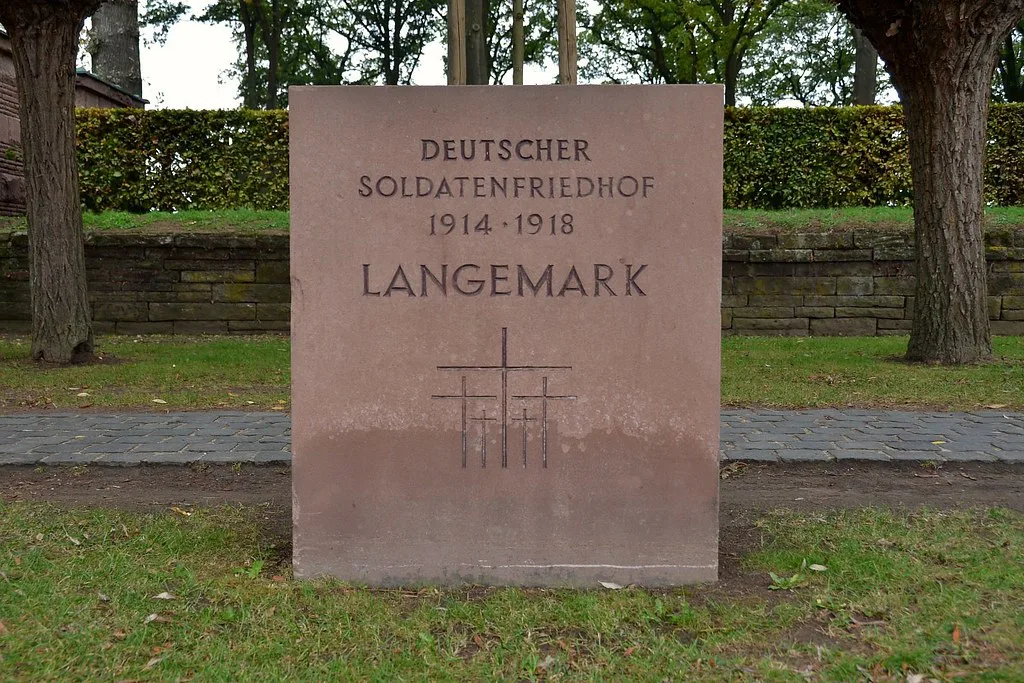
This is a German war grave, not a museum or a heritage attraction, and it is maintained by the Volksbund Deutsche Kriegsgräberfürsorge, the German War Graves Commission. It grew from a small group of graves made in 1915 and was dedicated in 1932, designed by Robert Tischler.
The site sits at the heart of the fighting around Ypres, and the ground itself carries the history of the First and Second Battles of Ypres. Langemark village was the scene of the first gas attacks by the German army in April 1915.
The comrades' grave at the entrance
The first thing you meet is a mass grave near the entrance, a single sunken rectangle rather than rows of individual stones. This comrades' grave holds 24,917 servicemen, among them the air ace Werner Voss, and it sets the tone for everything behind it.
Of that number, 7,977 remain unknown, which is why the grave reads as a communal field rather than a roll of names. Take a moment at the edge before walking on; the scale registers best when you look across it rather than down at it.
The oak trees and the adjoining graves
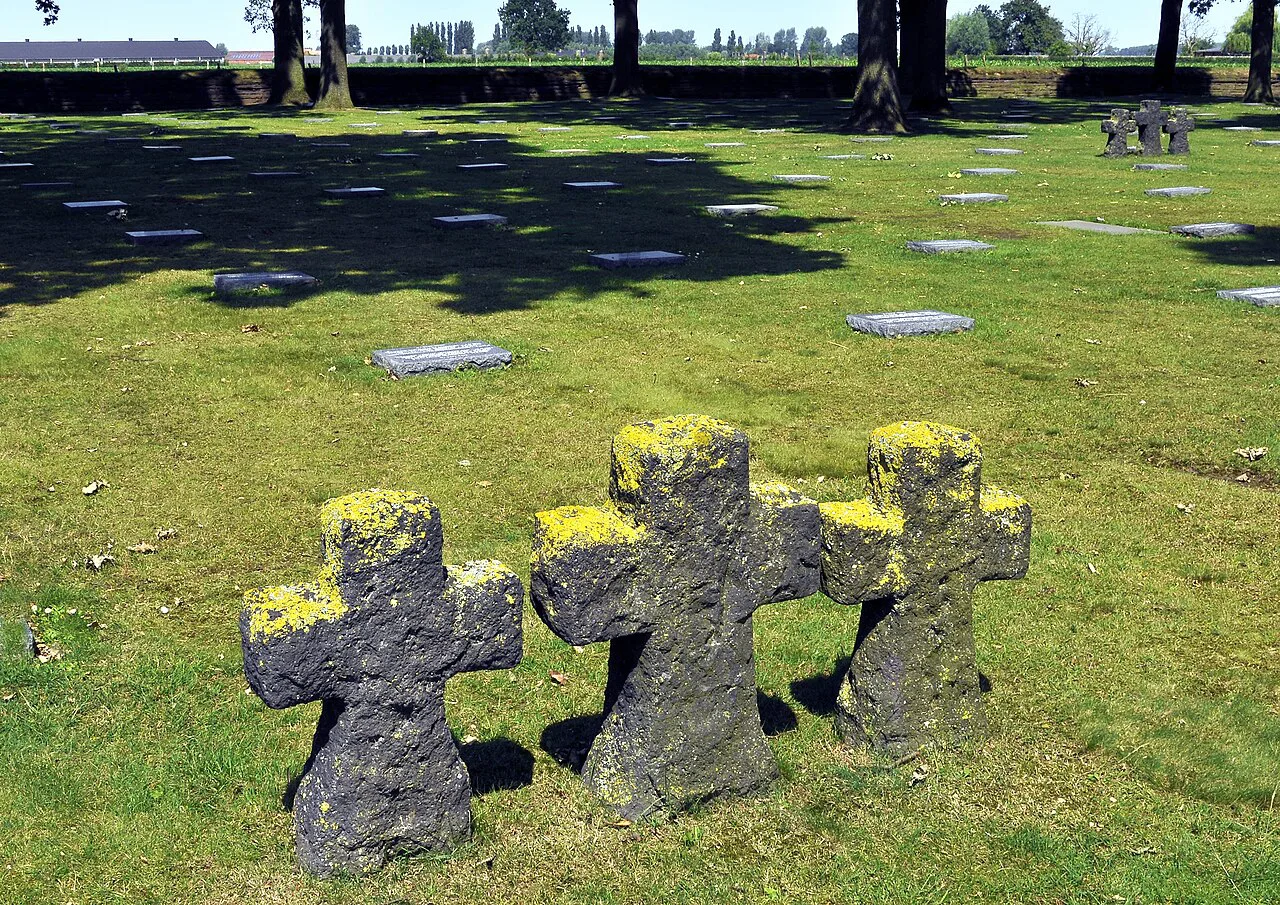
Between the oak trees beside the mass grave lie a further 10,143 soldiers, marked by low dark stones set almost flush with the grass. Two of them are British: Private Albert Carlill of the Loyal North Lancashire Regiment and Private Leonard Harry Lockley of the Seaforth Highlanders, both killed in the last weeks of the war in 1918.
Their names appear on a plaque to the left of the entrance, on the face of the first German memorial stone. It is a small detail and easy to walk past, so make it a deliberate stop if you want to find them.
The mourning figures at the rear
At the back of the cemetery stand four bronze mourning soldiers, a sculpture group by Professor Emil Krieger of Munich added in 1956. They face back across the graves and are said to stand guard over the fallen, which is why they read as the natural end point of a visit.
Walk to them last, then turn around for the view back over the whole field. It is the clearest single vantage point on the site and the place most visitors pause longest.
The student volunteers
A third part of the cemetery holds some 3,000 school students killed during the First Battle of Ypres in 1914. They are remembered separately from the mass grave and the oak-lined rows, and finding that section explains why Langemark is often described as a young men's cemetery.
The figure is worth holding onto, because it is often inflated in retellings. Only about fifteen per cent of the German soldiers involved in the Battle of Langemark were schoolboys or students.
The Langemark myth
The story goes that inexperienced German infantry sang as they charged allied positions near Langemark in October 1914, and that the song later became the German national anthem. The charge happened and the casualties were severe, checked by French infantry and British riflemen, but the singing is legend rather than record.
The legend was amplified after the war, and a monument to the volunteer army was even erected at the 1936 Berlin Olympics. Knowing that makes the cemetery easier to read: you are standing in a place that was deliberately mythologised as well as mourned.
How it differs from the Commonwealth cemeteries
Come here after Tyne Cot or another Commonwealth War Graves Commission site and the contrast is immediate. Instead of uniform pale headstones in perfect rows, Langemark gives you dark stone, oak trees, a single mass grave and a brooding sculpture group: a different architecture of remembrance, designed by Tischler for a different national tradition.
If you have time for only one German site, this is the one to choose; the other German military cemetery in the area, at Vladslo, is a quieter alternative further north. Pair either with the Ypres Salient's broader memorial landscape, including the Menin Gate (Menenpoort), Ypres, for the evening ceremony.
How long to allow and what to combine
Thirty to 45 minutes covers the entrance grave, the oak rows and the rear sculpture comfortably; an hour lets you read the plaque and sit with the place. The site is flat and compact, so there is no walking endurance required.
The cemetery sits well with the northern salient sites. The Sanctuary Wood Museum (Hill 62) keeps preserved trenches and is a short drive back towards Ieper, while the Passchendaele museum at Zonnebeke, in the Kasteeldomein van Zonnebeke, covers the later battles in depth.
Closer to Ieper, the Hooge Crater Museum, Ypres sits on the Menin Road and the ramparts cemetery Ypres and Hill 60, Ypres round off a full day in the salient. Build the day around a single direction of travel so the driving stays short.
Visiting respectfully
This is an active war grave, and the atmosphere is contemplative rather than interpretive: there is no visitor centre, no interactive display and no café. Keep voices low, stay on the paths and grass edges, and treat the stones as headstones rather than props.
The cemetery is maintained by the Volksbund, and it holds a register of the dead. If you are tracing a name, check the register and the Volksbund's own records before you travel, and remember the two British casualties recorded on the entrance plaque.
Is Langemark worth the detour?
Yes, if you want to understand the salient from the German side rather than only the Commonwealth one. The 30 to 45 minutes it takes to walk the mass grave, the oak rows and Krieger's mourning figures adds a perspective that the town-centre sites cannot give you.
Treat it as one stop on a northern loop out of Ieper along the N313, combined with a museum and one more cemetery. If you are planning the rest of the trip, the wider set of Ypres Attractions: 13 Visitor Guides and the things to do in Ypres will help you sequence the days.
Explore more Ypres guides
Frequently Asked Questions
How many soldiers are buried at Langemark German War Cemetery?
There are 44,294 burials. The comrades' grave near the entrance alone holds 24,917 servicemen, of whom 7,977 are unidentified, and a further 10,143 lie between the oak trees beside it. About 3,000 student volunteers killed in the First Battle of Ypres are buried in a separate part of the cemetery.
Can I find a named grave at Langemark?
The cemetery keeps a register of the dead, and the two British casualties buried here are recorded on a plaque to the left of the entrance. If you are tracing a specific German soldier, search the Volksbund's records before you travel, since not every grave is individually marked.
Why does Langemark look so different from Tyne Cot?
The two cemeteries were built to different national designs. Tyne Cot follows the Commonwealth War Graves Commission pattern of uniform pale headstones in rows, while Langemark was designed by Robert Tischler with dark stone, oak trees, a mass grave at the entrance and Emil Krieger's mourning figures at the rear.