
Belgian Lace: Bruges Bobbin Lace and How to Spot Handmade Work
Belgian lace means Flemish bobbin lace, and Bruges is its best-known home. See how the craft works, where to watch it and how to tell handmade lace.
On this page
Belgian lace is bobbin lace: thread wound on wooden bobbins, crossed and twisted over a pinned pattern on a sloping cushion, and Bruges (Brugge) is the city most visitors meet first in connection with it. The craft was a mass cottage industry across Flanders, and one of the old convent lace schools that taught it now runs the Bruges Lace Centre (Kantcentrum). This guide explains the mechanics of bobbin lace, the history behind Bruges' reputation, where the craft is preserved and taught in the city, and how to weigh up what is on sale.
What Belgian lace is: bobbins, pins and a sloping cushion
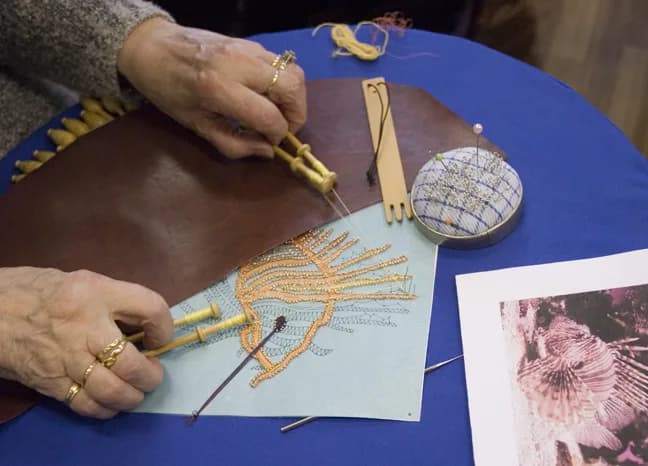
A lacemaker works at a lace pillow: a firm, sloping cushion that holds a pattern pinned to a strip of cloth down its centre. Hundreds of pins fix the pattern, and scores of wooden bobbins hang from the threads on either side. The maker crosses and twists pairs of bobbins in a fixed sequence, pricking each new pin into the pattern so the filmy fabric grows from the top downwards.
Belgium produced many distinct lace types, and Brussels lace earned a reputation for fine thread and skilled work from the 15th century onward, helped by good local flax. What unites the Flemish traditions is the method rather than one pattern: the same pillow-and-bobbins technique drives the dense, sculpted textures and the open, gauzy grounds that shoppers recognise.
Lace has plenty of competition in a Belgian city break, and travellers who enjoy craft heritage often pair it with the food side of the country. If your interests run to the kitchen rather than the workshop, the guide to Belgian chocolate covers the praline and cocoa-butter story in similar detail.
Why Bruges (Brugge) is the name most travellers meet first
Bruges is famous for lace, and it is the Flemish city where the trade's history and its present-day teaching are easiest to see together. Convent lace schools operated across Flanders, and one of the old convent lace schools, run by the Sisters of the Immaculate Conception, has been turned into a lace centre that now works to keep the handicraft alive for future generations.
What Belgian lace is: bobbins, pins and a sloping cushion. A lacemaker works at a lace pillow: a firm, sloping cushion that holds a pattern pinned to a strip of cloth down its centre.
Why Bruges (Brugge) is the name most travellers meet first. Bruges is famous for lace, and it is the Flemish city where the trade's history and its present-day teaching are easiest to see together.
How a lacemaker actually works. Watch a demonstration and the first thing you notice is the sound: bobbins clatter against each other as the maker works across the row.
The scale of the old industry is easy to underestimate. In the 1800s perhaps 150,000 Belgian women earned a living with bobbins and pillows, and by 1900 thousands of women in Bruges and other Flemish cities still supported themselves by making lace. By 1975 only a few hundred remained, mostly older women earning extra money, before a modest revival brought younger makers back.
That contraction explains what you will see in the shops. Most visitors who want a food souvenir instead of a textile one head for the city's chocolatiers, and the guide to the best Belgian chocolate sets out which Bruges makers are worth the detour.
How a lacemaker actually works
Watch a demonstration and the first thing you notice is the sound: bobbins clatter against each other as the maker works across the row. The pattern is pinned under a strip of cloth, so the design stays hidden while the lace emerges below the pins, building up from the pattern rather than being drawn or stitched. A maker may use dozens of bobbins at once on a wide piece, each one carrying a short length of thread.
The second thing you notice is the pace. A demonstration gives you a realistic idea of how long even a small motif takes, which is the most useful context for judging the price of a finished piece. It also shows you what machine lace does not reproduce: the tiny shifts in tension and the slight irregularity that come from hand-crossed threads.
Bruges rewards slow looking, and lace is one of several small indoor stops that fit between the Markt, the Burg and the canals. The same principle applies to the city's beer cafés, where a short tasting tells you more than a shelf of bottles. Chocolate works the same way: a chocolate workshop Bruges visitors can book introduces tempering and moulding in an hour or two.
Bruges' lace heritage: nuns, convent schools and the cottage trade
Historically, nuns ran lace schools to preserve the industry and to teach girls a trade that would bring in a little income. Most pupils came from the poorest local families, attending daily for lessons, and for some a bowl of soup at midday was the only meal. Belgium had more than 900 lace schools at one point, several of them in Bruges, and students could stay as long as they wished.
The work was not confined to the schoolroom. Many women finished their own chores and then worked outside in the sunshine, often in company, treating lace as a cottage industry rather than a factory job. Some pupils stayed on in the Beguinage as adults, and the Beguinage itself, a walled community for religious women who lived in community without taking vows, is part of the same Bruges story.
Handwork on that scale is a hard sell next to chocolate, which most travellers can taste before buying. If you prefer your souvenirs edible, Belgian pralines are the easier purchase, and the guide to Belgian pralines explains what separates a good shell from a mediocre one.
Bruges' lace centre and its heritage
The Bruges Lace Centre is a private cultural institute set up to preserve lacemaking for future generations. It grew out of one of the old convent lace schools, run by the Sisters of the Immaculate Conception, and manages a museum and a specialised library. It runs courses and lace workshops for children and adults, trains lace teachers and publishes KANT, an international magazine on lace. Its stated ambition is to become the knowledge centre of lace in Bruges and a reference institute in the world of lace.
Treat it as a short, focused visit built around the museum rather than a half-day. Look at the library material if you are seriously interested in patterns, and confirm directly with the centre what courses or workshops are running during your dates before you build a day around them.
Lace fits neatly into a one- to four-day Bruges break because it is small and indoor. Slot it into a morning between the Markt and the canals, or use it as shelter on a wet afternoon, and keep the rest of the day for the Groeningemuseum, the Belfort or a walk along the Graslei and Korenlei in Ghent if you are moving on.
Reading a piece of lace: handmade against machine
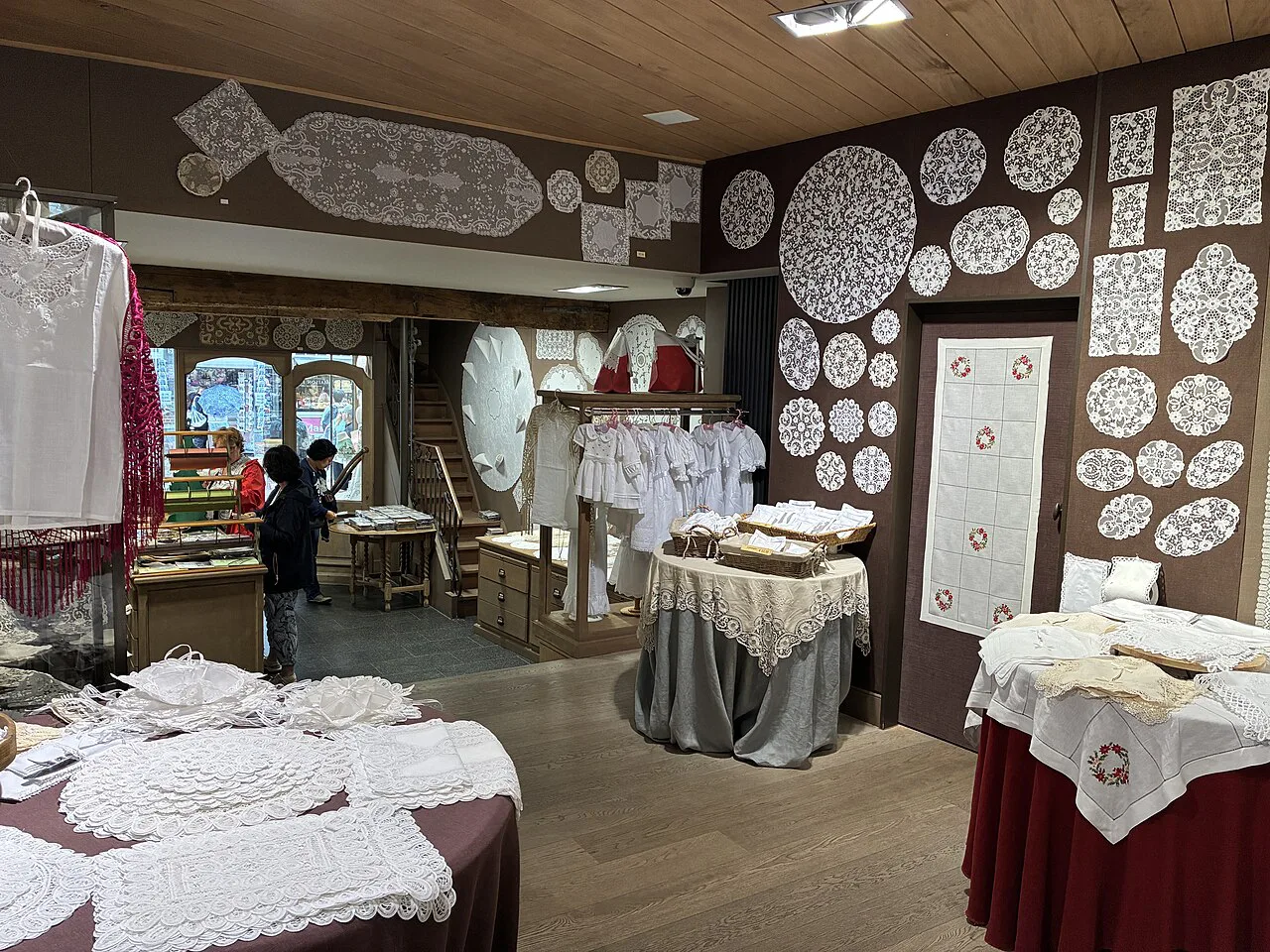
Handmade bobbin lace shows small variations: the tension shifts slightly across a motif, threads cross at marginally different angles, and the finish on the back differs from the front. Machine lace repeats itself exactly, with edges that are too even and a ground mesh that looks stamped rather than worked. Look closely at the crossings and the mesh for the irregularities a machine would not produce.
Price is a blunt test, but the useful check is time spent at the pillow rather than the tag. A wide piece in fine thread built up bobbin by bobbin over many hours is a different proposition from a machine-trimmed coaster, so ask what you are looking at and where it was made. A seller who can name the technique and the pattern type is a better signal than any label.
What to buy, and where the lines blur
Buy lace as a souvenir you will use rather than as an antique you hope will appreciate. Small pieces such as bookmarks, coasters, doilies and christening-style bonnets are the most practical purchases, and they let you compare workmanship between stalls without spending much. If you want something framed, choose a motif that shows off a range of stitches rather than one large expanse of plain mesh.
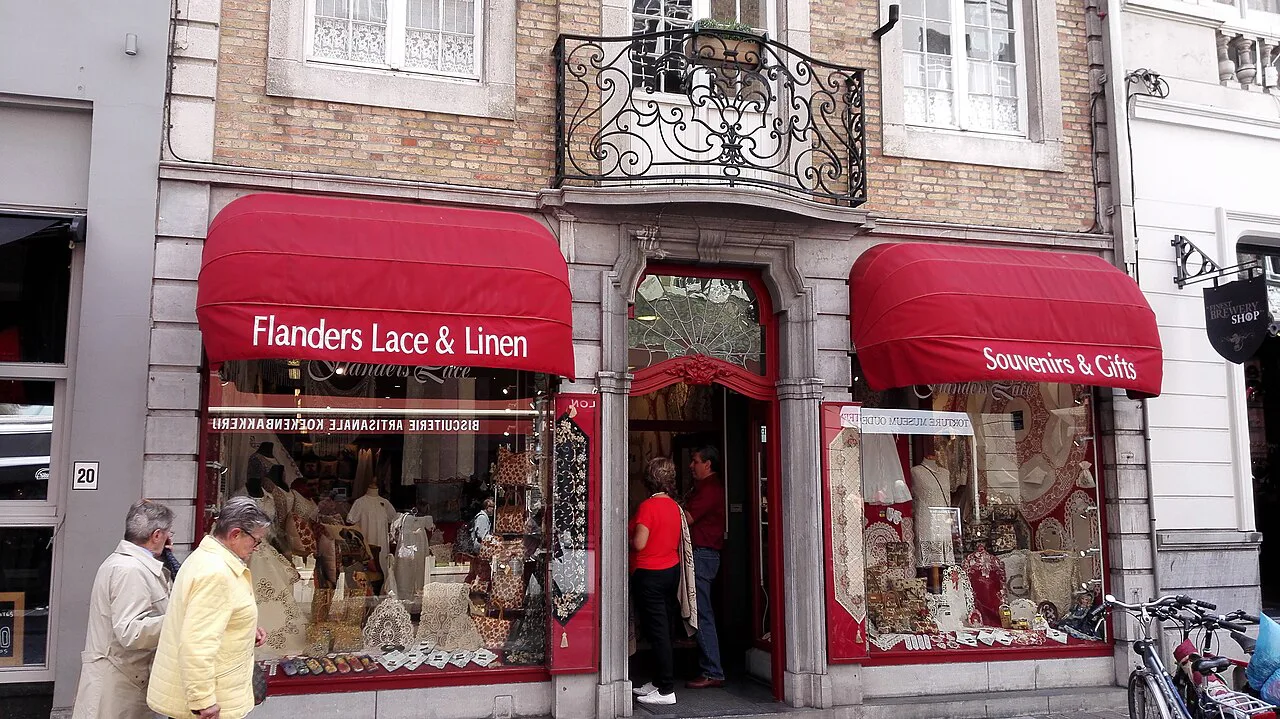
Remember that much of the lace on open sale is not handmade, and that is not a scandal: the revival is small and the old cottage industry is long gone. Ask in a shop which pieces are locally worked and which are machine-made, and accept that markets and general souvenir shops will mix both.
If you want a second craft-themed stop in Bruges, chocolate is the obvious pairing. The guide to The Chocolate Line in Bruges covers one of the city's best-known makers and is a practical way to plan a combined morning of lace and pralines.
Fitting lace into a one- to four-day Bruges city break
On a one-day visit, give lace about an hour: the Bruges Lace Centre, then a wander through the old town back towards the Markt. On a two-day break, put lace in the morning and give the afternoon to the Groeningemuseum or a canal boat. Three or four days lets you add a day in Ghent for the Graslei and the Belfort without rushing Bruges.
If you are travelling with someone who does not care about lace, split the visit: one of you takes the lace stop while the other covers the chocolate shops, then compare notes. The city's chocolate scene is deep enough to fill that hour, and the guide to chocolate museums in Belgium is a starting point for a wet day.
Is lace worth an hour of your Bruges trip?
Yes, if you want one small, specific thing to look at closely in a city that can blur into canals and chocolate shops. The Bruges Lace Centre is where the craft is preserved and taught, and an hour with it gives you the vocabulary to judge what is on sale elsewhere. Skip it if your Bruges days are already full and lace holds no interest, because no other sight in the city depends on it.
Whichever you choose, the pattern of a good Bruges break is the same: one anchor sight in the morning, one slower stop after lunch, and a walk along the water in between. Lace, chocolate or beer, the craft stops are the ones that give the city's squares their context.
Explore more Belgium guides
Sources
Useful notes for your next trip
Optional updates to our guides.
You might also like



Continue reading
More guides you'll find useful





