
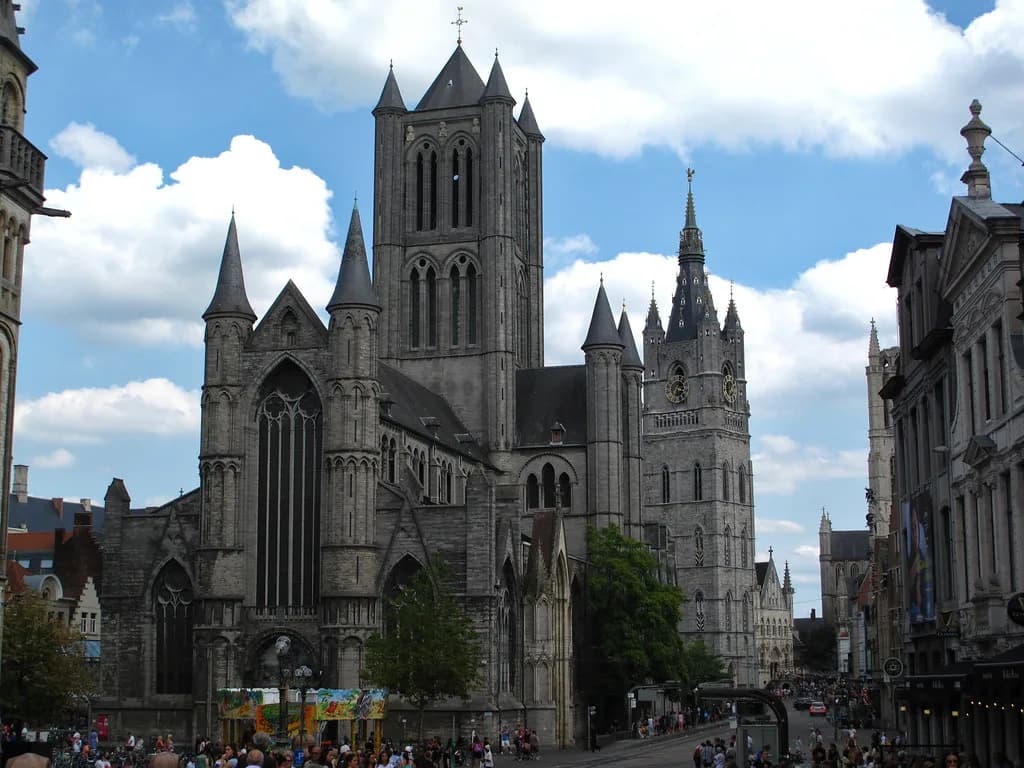
Saint Nicholas' Church (Sint-Niklaaskerk), Ghent
Saint Nicholas' Church (Sint-Niklaaskerk) is worth half an hour of any Ghent city break: it is the city's great merchants' church, set in the vicinity of the Korenmarkt and the old harbour along the Gras- en Korenlei. The building was given the function of a belfry by the city councillors as far back as the 13th century, and its interior holds a Baroque high altar, a set of 17th-century apostle statues and a 19th-century Cavaillé-Coll organ. This guide covers where it sits, what to look for inside and how to fit it into a walk through the centre.
A merchants' church at the heart of Ghent
Saint Nicholas' Church was, from the outset, the church of tradesmen and merchants working at the nearby Korenmarkt and at the port on the Graslei and Korenlei. The Visit Gent tourist office describes it as the first parish church in the Low Countries featuring emancipated urban architecture, which tells you how closely the building tracks the city's commercial confidence. Construction began in the early 13th century and ran through four phases, and the wealth of the merchant guilds paid for much of what you see.
The church was also given the function of a belfry by the city councillors as far back as the 13th century, when the city bells and city guards were based here. That history explains the tower's civic character, though the church is not Ghent's belfry today. If you want to climb the city's actual Belfort, that is a separate visit a few minutes away.
Where the church sits and how to reach it
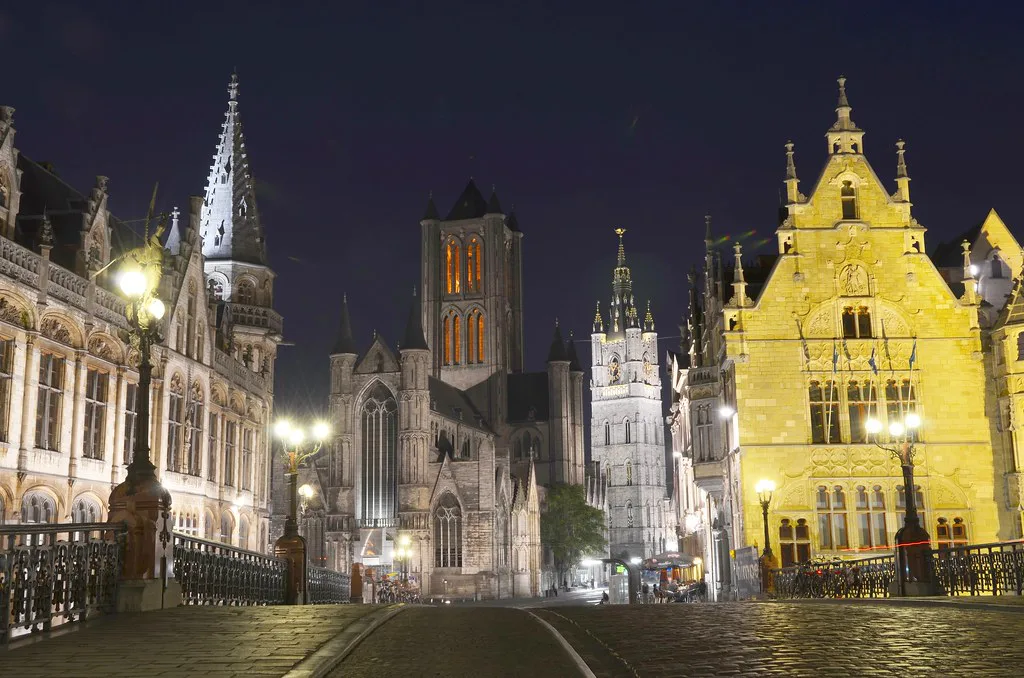
You will find the church in the vicinity of the Korenmarkt and the old harbour along the Gras- en Korenlei. That makes it a natural stop on a walk between the Korenmarkt and the water, and it sits within a few minutes of both the Belfry and Sint-Baafskathedraal. There is no need to plan a separate trip for it; you pass close to it on the main route through the centre.
Ghent's centre is compact and walkable, so the church is easiest reached on foot from anywhere between the Korenmarkt and the Leie.
The exterior: Scheldt Gothic and a tower with a civic past
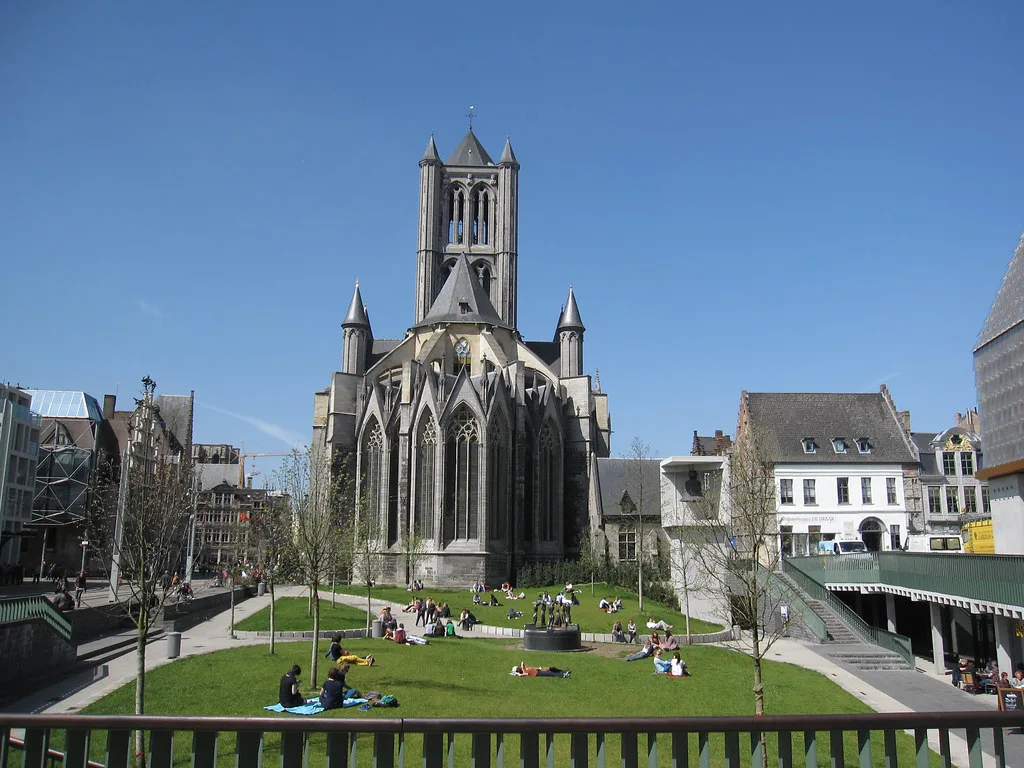
The exterior is the best place to start, because the church's distinctive Scheldt Gothic style is clearest from the square side. Look for the tall, slender tower and the way the stonework changes as you move around the building; after four phases of construction the choir was adapted to the international Gothic style at the beginning of the 14th century. The tower's civic role as a former belfry is a useful reminder that in Ghent, church and city government were never far apart.
Inside the nave: the Baroque high altar and De Liemaeker's altarpiece
Inside, the eye goes first to the high altar, which holds Nicolas De Liemaeker's painting of the appointment of Saint Nicholas as Bishop of Myra, painted around 1630-1632. De Liemaeker was a contemporary of Rubens and a sought-after master in Ghent's churches, and the work was enlarged in 1678 to fit into the new Baroque main altarpiece. The subject suits the setting: Saint Nicholas of Myra is the patron of sailors, merchants and bakers, the trades that paid for this church.
The interior was given Baroque cosmetic work in the 17th and 18th centuries, and the high altar is the clearest result of that phase. Take a moment to look at the painting's size and placement rather than just the image; the enlargement is a good example of how older art was adapted to new liturgical fashion. The church's guild chapels, each sponsored by a different trade, are scattered around the aisles and reward a slow circuit.
The apostle statues and the guild chapels
The twelve apostle statues date from the 17th century and were relocated during the restoration from the lower church. Look for Saint Peter with his book and key, Saint Andrew with the slanted Saint Andrew's Cross and Saint James the Great, each carrying the attribute that identifies him. They are a good way to read the church as a guild building: the chapels and their furnishings were funded by the trades that worked around the Korenmarkt.
The organs and Herman Blondeel's chancel windows
Above the western portal, on the rood screen, sits the Cavaillé-Coll organ installed in 1856, a French instrument praised in the local press the day after its inauguration. The organ itself is now awaiting thorough restoration, though its wind system has remained almost intact, so you see it rather than hear it. More modest in looks but not in musical power is the current swallow's-nest Flentrop organ suspended in the chancel, often used by students of the Ghent Academy of Music.
The three chancel windows are a design by the Ghent stained-glass artist Herman Blondeel and were continued after his death by Patrick Romain, then inaugurated on Sunday 4 July 2004. Their seven horizontal bands evoke the seven sacraments, with the three lower bands in colour for baptism, confirmation and marriage, and the four upper ones in black and white for confession, anointing of the sick, priesthood and the Eucharist. On a sunny day the light through these windows is the most memorable thing in the church.
The restoration and the unfinished question of the columns
A large part of the building's restoration is complete, and the church now shows how modern conservation works alongside historic fabric. The most visible result is the nave, where the columns stand in raw masonry form rather than with the polychrome finish they may once have had. Whether to repaint them is still debated, and that unfinished question gives the interior a slightly raw, honest character that many visitors find more interesting than a fully restored finish.
How long to allow and when to go
Allow around half an hour for Saint Nicholas' Church, or 45 minutes if you read the labels and walk the whole circuit. It is a working church, with half the building used for services and prayer and the other half for private initiatives, so keep your visit quiet and brief. A sunny day is best for the chancel windows, which are the highlight of the interior.
The church is a short walk from the Graslei and Korenlei, so the obvious trade-off is to see it on the way to or from the water rather than as a standalone stop. If you have time for only one religious interior in Ghent, Sint-Baafskathedraal holds the Ghent Altarpiece and will take longer. Saint Nicholas' is the quicker, quieter visit, and it pairs naturally with a walk along the old harbour.
Nearby: Korenmarkt, the Graslei and the Belfry
The Korenmarkt is the natural place to start or end a visit, and the old harbour on the Graslei and Korenlei is two minutes away. The Ghent Belfry (Belfort) and Sint-Baafskathedraal are both within a short walk, so you can see all three in an afternoon without planning transport. The Gravensteen castle is a little further but still walkable from the church.
If you want a wider set of Ghent visits to slot around the church, Ghent Attractions: 7 Visitor Guides span museums, the belfry and the Graslei, and all are within the same compact centre. The Design Museum Gent and the MSK sit further out but are easy to reach by tram from the Korenmarkt area.
Is Saint Nicholas' Church worth the stop?
Yes, if you are already walking between the Korenmarkt and the Graslei: half an hour buys you a merchants' church with a fine altarpiece, a set of apostle statues and striking chancel windows. It is not a substitute for Sint-Baafskathedraal or the Belfry, but it is an easy one of Ghent's religious interiors to fit into a short city break. Go on a sunny day for the chancel windows, and combine it with the old harbour.
Explore more Ghent guides
Frequently Asked Questions
Where exactly is Saint Nicholas' Church in Ghent?
It is in the vicinity of the Korenmarkt and the old harbour along the Gras- en Korenlei. The Belfry and Sint-Baafskathedraal are both a short walk away.
What should I look for inside Saint Nicholas' Church?
The high altar holds Nicolas De Liemaeker's painting of the appointment of Saint Nicholas as Bishop of Myra, painted around 1630-1632. Look for the 17th-century apostle statues, the Cavaillé-Coll organ above the western portal and Herman Blondeel's three chancel windows, inaugurated in 2004.
How long does a visit take?
Allow around half an hour, or 45 minutes if you read the labels and walk the whole circuit.