
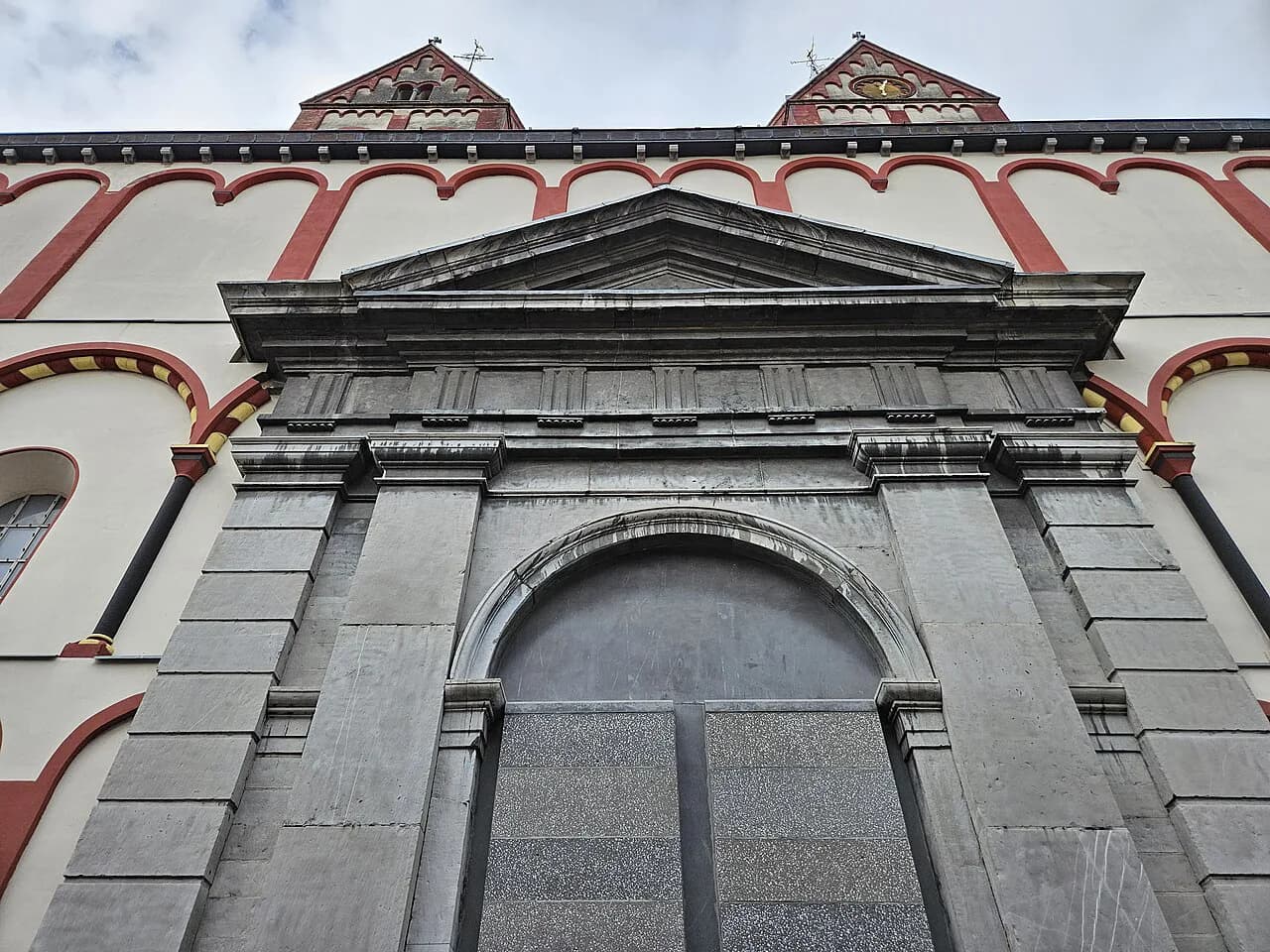
Collégiale Saint-Barthélemy, Liège: what to see and how long to allow

Allow around an hour for the Collégiale Saint-Barthélemy, the Romanesque collegiate church on place Saint-Barthélemy in the old heart of Liège. The font alone justifies the detour, and the building gives you the two bell towers and banded stonework that define the Meuse Romanesque style. This page covers where the church sits, what to look at inside, how long to give it and what pairs naturally with it on the same walk.
Why the church is worth an hour
Two things pull visitors here. The first is the baptismal font, an early Romanesque work in cast metal that the church presents as one of the Seven Wonders of Belgium. The second is the architecture: a west end built in the manner of the great Romanesque churches between the Rhine and the Meuse, with an imposing westbau and two elegant bell towers.
Saint-Barthélemy was the last of the seven collegiate churches founded in Liège between the eighth and eleventh centuries. That places it in the city's earliest religious landscape rather than among its later parish churches, which is why the surviving fabric matters as much as the objects inside.
Where it is: place Saint-Barthélemy
The church stands at 8 place Saint-Barthélemy in the 4000 Liège postcode, in the old quarter below the citadel slopes and a short walk from the Hors-Château street. The square is small and residential in feel, so the twin towers appear suddenly as you come down the hill rather than across a grand open space.
For orientation, treat place Saint-Lambert as your reference point in the commercial centre, then head uphill towards the Hors-Château quarter. The walk is short enough to combine the two in a single morning, and you pass the cathedral quarter on the way.
Approaching on foot from Hors-Château
Hors-Château is the old craft and artisan street that climbs from the river side towards the citadel, and it is the most rewarding approach. Come up it slowly, look back at the roofs, then turn off for the church square. The school of the same name sits at Hors-Château 31, so ignore the pupils and keep walking to the collegiate church itself.
If you are working through the city's main sights, the Collégiale Saint-Barthélemy slots neatly between the riverfront museums and the hillside streets. It is a short walk from the Grand Curtius and from the Montagne de Bueren stairway, so it works well as a mid-walk stop rather than a separate excursion.
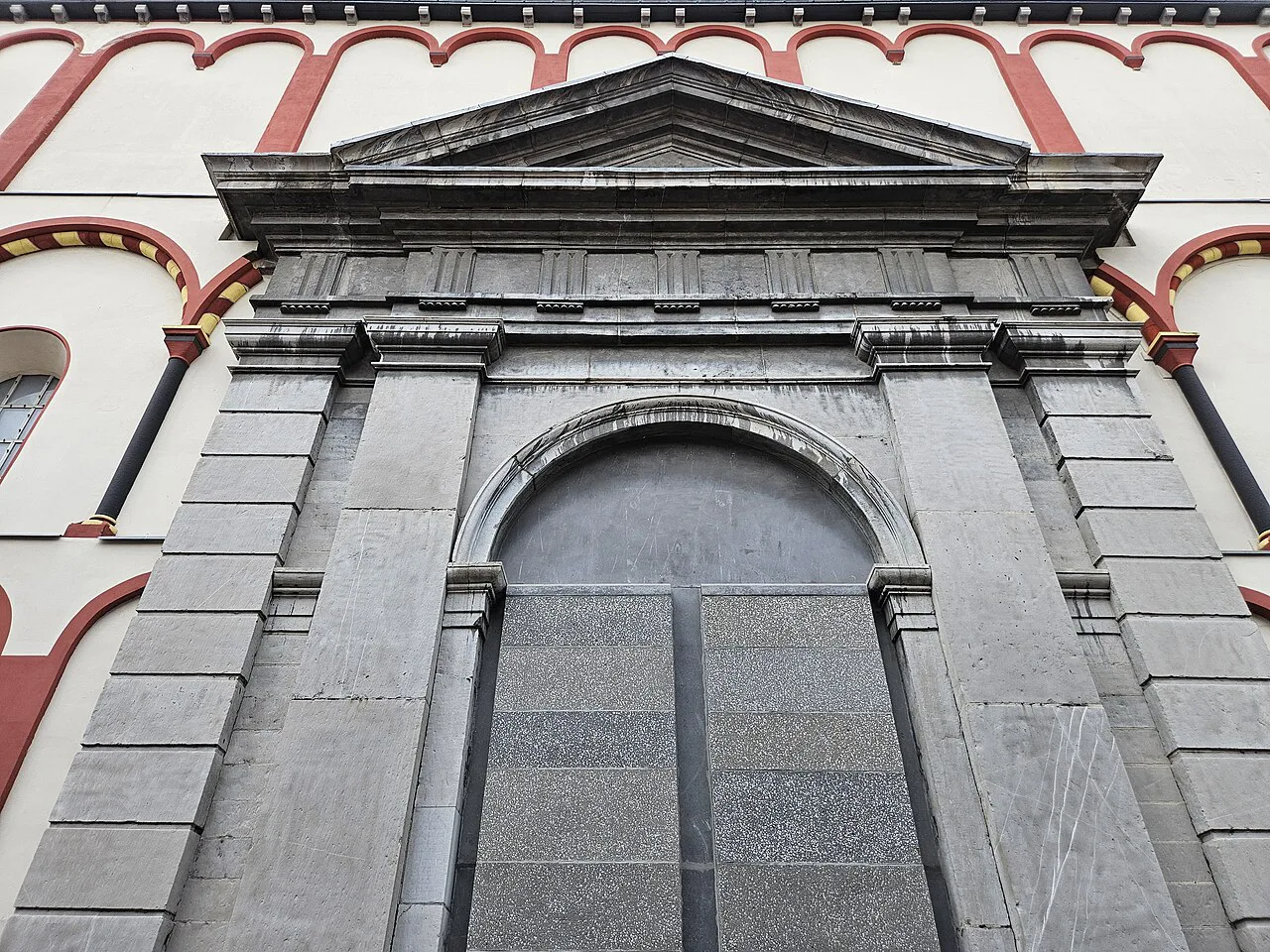

The building: westbau, twin towers and polychrome facades
Look first at the west end. The church describes its architecture as following the great German Romanesque churches of the region between the Rhine and the Meuse, characterised by an imposing westbau with two elegant bell towers and polychrome facades. In plain terms, a massive western block frames the entrance, the two towers rise above it, and the exterior walls use contrasting stone colours in bands.
The nave and aisles were rebuilt over more than a century: the church says a larger building gradually replaced the first collegiate church between 1040/50 and 1182. Under glass panels in the floor you can see remains of the earlier church, consecrated in 1015.
The baptismal font
The font is the reason many people come. The church calls it an early Romanesque work showing both technological mastery and a strong aesthetic pull, and it gives the piece an evident Byzantine influence with one or more unknown authors and some pieces missing. Read it as a survivor rather than a complete set piece, and look for the classical and eastern borrowings in the figures.
Because so much about the font's making is uncertain, the pleasure is in the detail rather than the label. Give it a good ten minutes, circle it slowly and note where the metalwork breaks off.
Stained glass, sculpture, paintings and organs
Beyond the font, the church's own visitor pages organise the interior around stained glass windows, sculptures, paintings and organs. Treat these as the second layer of the visit: the glass colours the nave, the sculpture and paintings sit against the Romanesque stone, and the organ case is part of the furnishing rather than a concert piece.
The carillon and recitals
The church also has a carillon, listed on its site alongside the organs. Occasional recitals and events are announced on the church's own agenda, including organ events under the Orgue à la Batte heading. Check the agenda page before you travel if music is a reason for your visit.
Guided tours and how visits work
The church offers guided visits, promoted on its site as the way to discover the secrets of Saint-Barthélemy with its guides. Practical information on access and visits is published on the same site, which is where you should look for the current pattern of opening.
If you want the tour rather than a self-guided look, the church advertises guided visits as the way to discover the building with its guides. Otherwise plan on walking in and reading the interior at your own pace.
How long to allow and when to slot it in
An hour inside covers the font, the west end, the glass and a slow turn around the nave. Add fifteen minutes outside for the towers and the square. If you are short of time, thirty minutes gets you the font and the architecture, which are the two reasons to come.
Place it in the morning if you are walking up from the centre, then continue to the hillside stairs or down to the river. La Boverie and its park make a calm afternoon counterpart on the other side of the water.
What else is nearby in the same quarter
The Musée de la Vie Wallonne and the Grand Curtius sit within easy reach, and both are substantial enough to fill the rest of a day. The Palais des Princes-Évêques on place Saint-Lambert is a good anchor for the return leg. Place Saint-Lambert itself is the transport and shopping heart of the city, useful when you are ready to move on.

Is Saint-Barthélemy worth the walk uphill?
Yes, if you want one Romanesque church done properly rather than five done quickly. The westbau and the font together make a compact, memorable stop, and the Hors-Château approach turns it into a good half-day loop through the older streets.
Explore more Liège guides
Frequently Asked Questions
Is the baptismal font of Saint-Barthélemy original?
It is an early Romanesque work held in the church and described by the church itself as having one or more unknown authors and some missing pieces. Treat it as an original survivor with losses rather than a complete or fully attributed piece.
Is there an entrance fee for the Collégiale Saint-Barthélemy?
The church publishes practical information on access and visits on its own site, which is the place to confirm current admission arrangements before you go. Guided visits are advertised separately.