
Leuven Town Hall (Stadhuis van Leuven): What to See
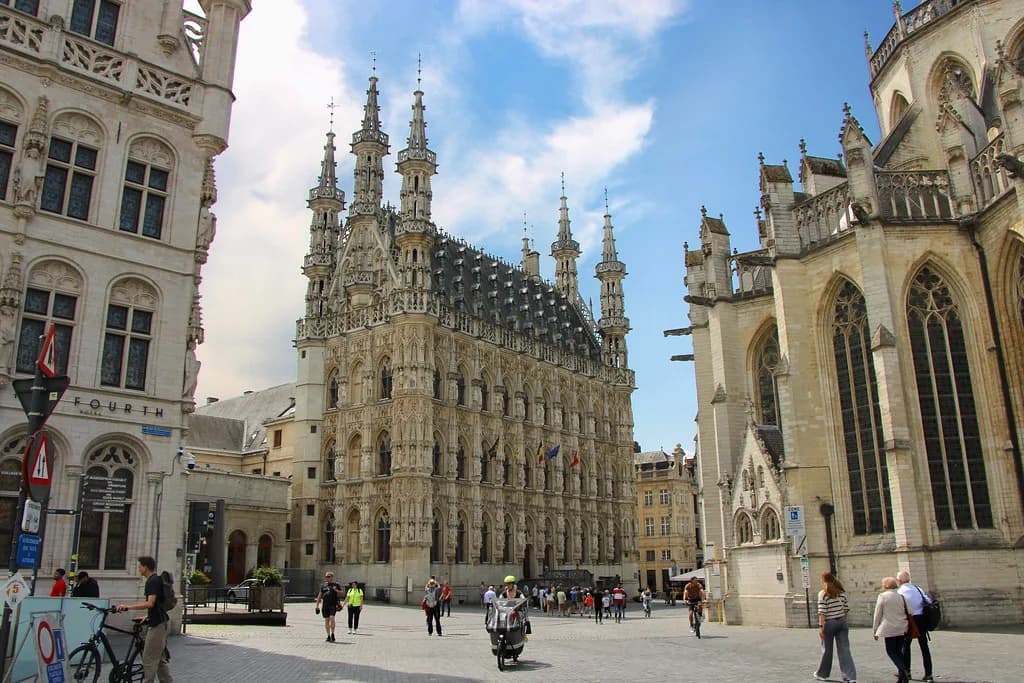
Leuven Town Hall, the Stadhuis van Leuven, is the building to stand in front of on the Grote Markt: a late-Gothic shell of pale stone with six octagonal turrets and 236 statues packed into its niches. Allow 20 to 30 minutes to read the facade properly, then fold it into a wider look at the square.
The exterior is the main event, and it rewards slow looking rather than a quick photo. This guide covers where the building sits, what to pick out on each storey, how the statues arrived centuries after the roof, and which sights are close enough to pair with it.
Where the Stadhuis stands on the Grote Markt
The town hall faces St Peter's Church across the Grote Markt, so the two buildings frame each other across the square. You reach it on foot from almost anywhere in the centre: Leuven is compact, and the walk from the Oude Markt takes a few minutes.
The present building is the third town hall in the city's history: an earlier hall stood on the Oude Markt, and a second was formed by unifying several buildings behind a single facade before the decision was taken in 1439 to raise one cohesive structure. Because the square is open and flat, the best view is from the far side, where you can take in the full roofline and all six turrets at once.
The facade explained: three storeys and six turrets
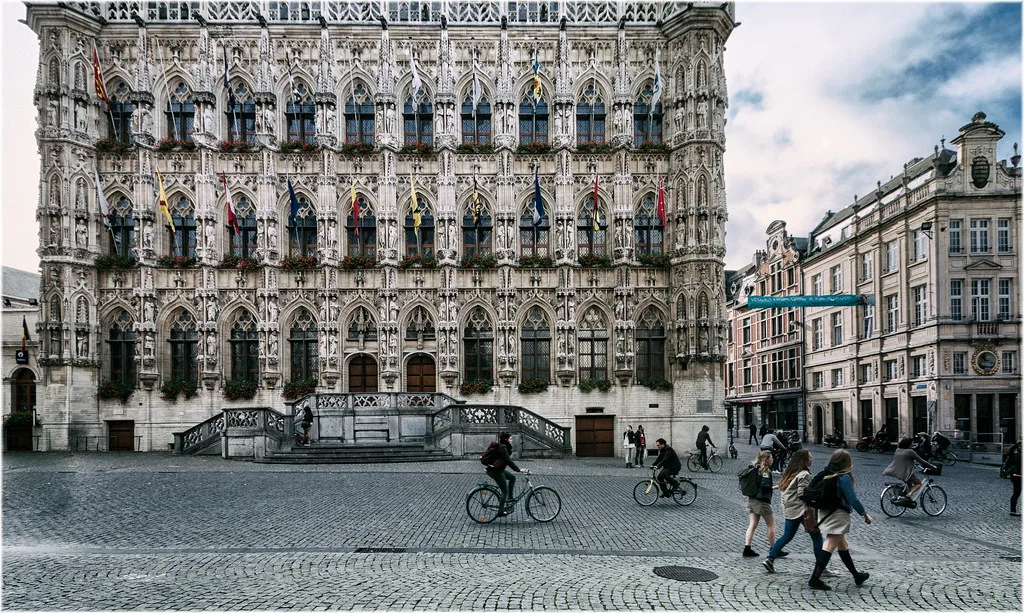
The building rises through three ornately carved storeys in the Brabantine late-Gothic style, with mullioned and transom windows set between paired niches and corbels. Look closely at the corbels: they carry finely sculpted biblical scenes, often on themes of guilt and punishment, placed there as a lesson for townsfolk and judges alike.
Six slender octagonal turrets crown the corners and gables, and the same paired-niche rhythm repeats up their spires. The architect Matthijs de Layens introduced the symmetrical design, added the high roof and the turrets, and dropped a planned belfry from the scheme, so there is no tower to climb here.
The 236 niches: dukes, artists and one empty place
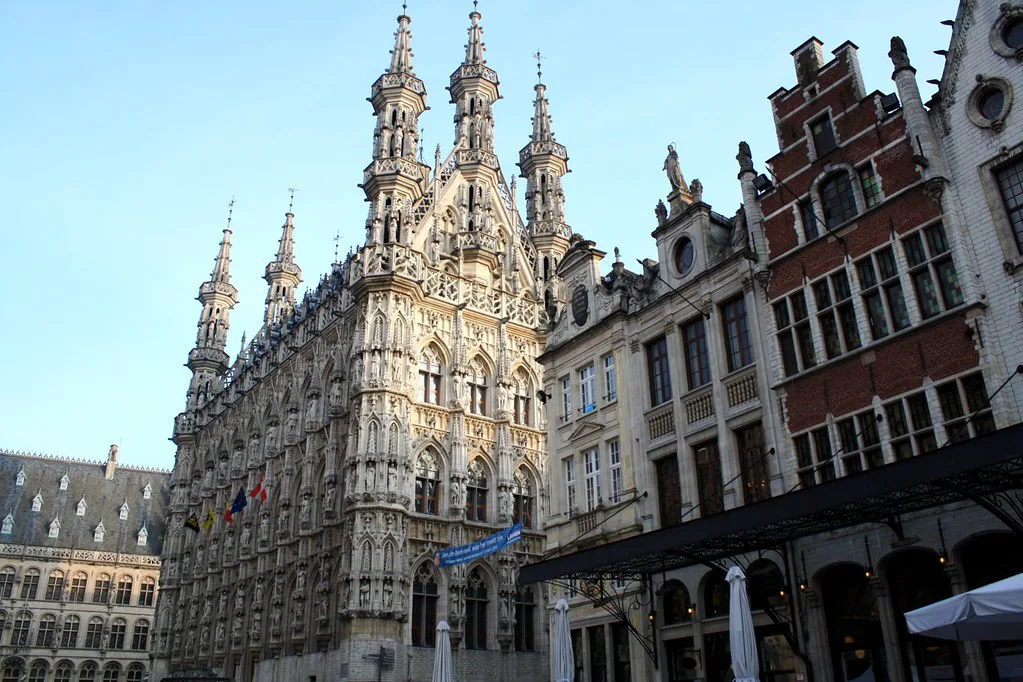
The niches hold 236 statues depicting counts, dukes, biblical figures, Flemish artists and university professors, all added after 1850. Walk the ground floor first for the historical figures at eye level, then step back to see how the rows continue up to the roofline.
One niche now stands empty. In November 2020, after the Black Lives Matter protests, the city council voted to remove the statue of King Leopold II from its place; it was moved to the basement of the town hall. Finding the gap among so many figures is a small puzzle worth setting yourself.
Four centuries from shell to statues
The current hall was decided on in 1439 and its main work was finished by 1469, with Matthijs de Layens taking charge from 1448 and giving the building its symmetrical late-Gothic form, but the 236 niches were left empty. Early attempts to fill them went badly: the first five statues were lost when the boat carrying them sank, replacements were stolen, a third set placed high up was brought down by a storm in 1477, and the city abandoned the project.
The push came from outside. Victor Hugo visited Leuven in 1852 and wrote an angry letter urging the council to fill the niches, and by 1880 all 236 had been occupied. The building survived both World Wars, with restoration work continuing until 1983, which is why the stonework and carving look as crisp as they do.
The interior and how to see inside
The Stadhuis is a working municipal building rather than a museum, so the visit is the exterior: the statue rows, the corbels and the six turrets. Plan the day around walking the facade rather than around going inside.
How long to allow and how to work the square
Give the town hall 20 to 30 minutes if you want to trace the statue rows and corbels, or ten minutes for a circuit and photos. Pair it immediately with St Peter's Church opposite, which puts two of the city's principal monuments in one stop.
The Grote Markt is calmer early in the day, before the square fills with visitors and groups. From there, the Oude Markt is a short walk south-west and makes an easy next stop for a drink and a look at its long terrace frontage.
Nearby: Oude Markt, Ladeuzeplein and the beguinage
Beyond the Grote Markt, Ladeuzeplein Leuven is a broad square a few minutes' walk east, with the university library as its centrepiece and the M Museum Leuven (M Leuven) close by for a contrast of old and new. Both fit neatly into the same half-day as the Stadhuis.
For a quieter counterpoint, the Groot Begijnhof Leuven is a walled cluster of streets and courtyards roughly 15 minutes on foot from the square. The Botanical Garden Leuven (Kruidtuin) and Sint-Geertruikerk sit on the same side of town, so you can string them together without doubling back.
Is the town hall worth the detour?
Yes, and the facade alone justifies the stop: half an hour spent reading the statues and corbels is time well used. Build the visit around St Peter's Church opposite and the Oude Markt a few minutes away, and you have a solid morning in the centre of Leuven.
Explore more Leuven guides
Frequently Asked Questions
Is Leuven Dutch-speaking or French-speaking?
Leuven lies in Flanders, and the local name of the town hall is the Dutch Stadhuis van Leuven. French and English are widely understood in the centre and around the university.
What is Leuven famous for?
Leuven is best known for its university, its Gothic town hall on the Grote Markt, the long terrace frontage of the Oude Markt and the walled beguinage.
Can you go inside Leuven Town Hall?
The Stadhuis is a working municipal building rather than a museum, and public access is not guaranteed. Treat the exterior as the main event and do not plan your day around an interior visit unless you have confirmed otherwise.