
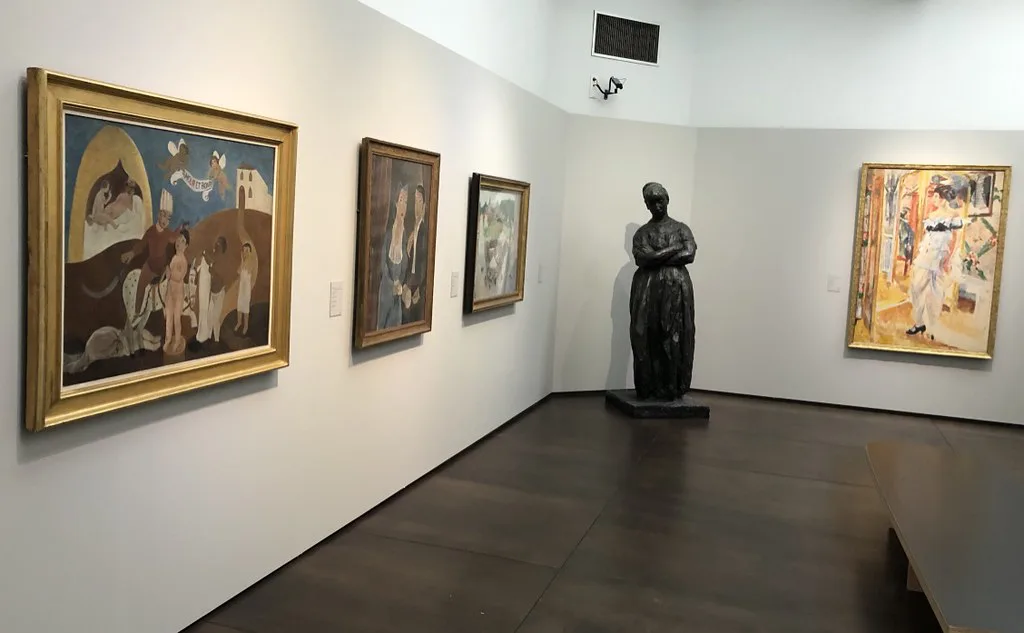
Groeningemuseum: Bruges's Flemish Art Museum on the Dijver
The Groeningemuseum is Bruges's essential art museum: a compact gallery of roughly ten rooms on one floor whose reputation rests on a small group of Flemish Primitive panels rather than on sheer scale. Its anchor is Jan van Eyck's Madonna with Canon Joris van der Paele, and the museum sits on the Dijver in the southern half of the historic centre. This guide covers what is inside, how the rooms run, what tickets cost and the museum's four-year closure from January 2027.
Plan around a single fact: the museum closes from 11 January 2027 for a total renovation lasting four years, and the core of the collection moves to the new kunsthal BRUSK from March 2027. Anyone visiting in late 2026 or after should check the Musea Brugge website before fixing a day.
What the Groeningemuseum is and why it earns a slot in your Bruges days
The collection traces Belgian painting from the 15th century to the 20th, with the Flemish Primitives as the headline and later Renaissance, baroque, 18th- and 19th-century Bruges neoclassical and Flemish expressionist work filling out the story. It is a chronological walk rather than a labyrinth, so you can move from van Eyck to Magritte without doubling back.
Set your expectations carefully. This is not a hall of van Eycks: a few works are by van Eyck's circle or later hands, and the pleasure comes from close looking at a handful of panels rather than from volume. If you want an hour of intense, detailed painting in a calm setting, it delivers; if you want a blockbuster, spend your time elsewhere.
It also suits a mixed group. The gallery is small enough that a companion with little interest in early Netherlandish art can be through it in under an hour, while an enthusiast lingers over the glazes and the symbolism tucked into the corners of each panel.
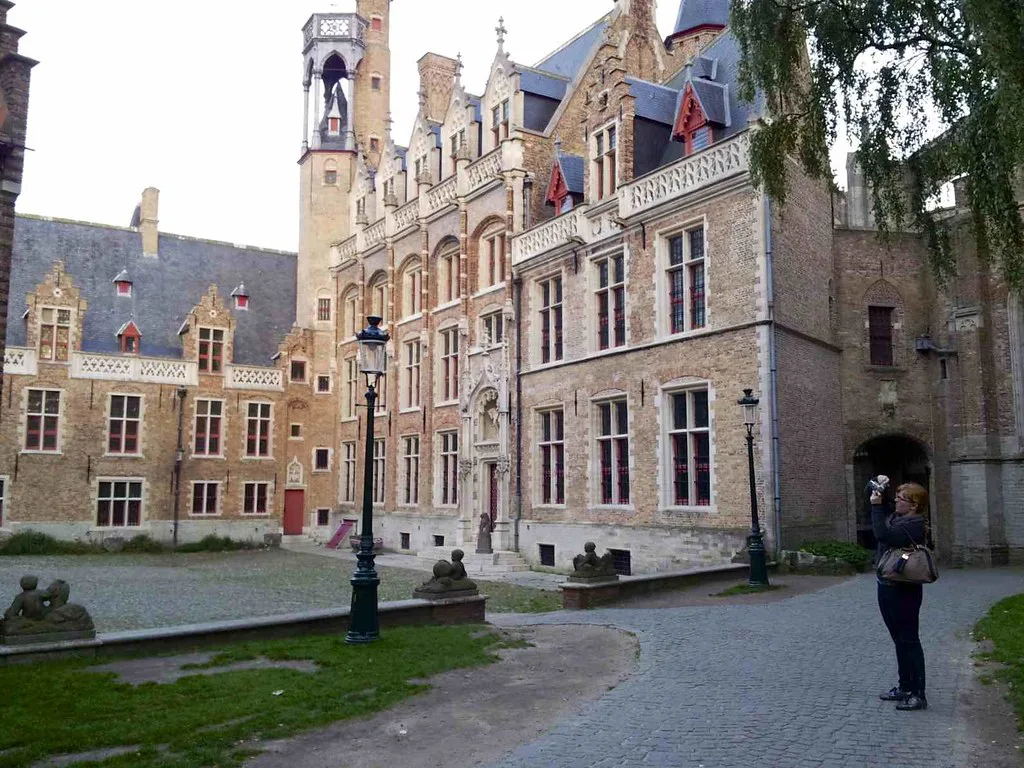
Where it is: Dijver 12, a short walk from the Markt and the Belfort
The museum sits at Dijver 12, 8000 Brugge, on the canal of the same name in the southern half of the historic centre. From the Markt and the Belfort it is a walk of roughly ten minutes past the Burg and down along the water; from the station, bus services stop at Brugge Dijver, close to the entrance.
Drivers should aim for Parking Pandreitje, the nearest car park, then walk the last few minutes. The approach along the Dijver is one of the prettiest in the city, with the canal, the quayside trees and the museum façades reflected in the water, so build in a few minutes for the walk itself.
The Dijver quayside is also where the canal-side Bruges most people picture begins, and the Rozenhoedkaai viewpoint is a short stroll north. Pairing the museum with a walk between the two makes a natural half-day.
What to see inside: Jan van Eyck's Madonna with Canon Joris van der Paele
The room everyone comes for holds van Eyck's Madonna with Canon Joris van der Paele, painted in 1436 and widely treated as the museum's greatest single treasure. Mary sits in a red dress with the Christ child, St George stands to one side, and the canon kneels in white, all rendered with the microscopic detail that made van Eyck's oil technique famous.
Look for the setting: rather than a golden heaven, the scene is staged in what reads as a Bruges interior, and the canon's face is unflattered and specific. Give it five or ten minutes rather than a glance, because the point of the panel is the texture of fabric, metal and skin at close range.
The museum also holds van Eyck's portrait of his wife Margareta, one of the earliest individual portraits of an ordinary person rather than a ruler or Saint. Beside it, Rogier van der Weyden's portrait of Philip the Good shows the duke who moved his court to Bruges in 1425 and turned the city into a cultural capital.
Hans Memling's Moreel Triptych and the Flemish Primitives
Hans Memling's Moreel Triptych is the second pillar of the collection, a multi-panel altarpiece that rewards a slow circuit from wing to wing. The visitbruges listing names it alongside the van Eyck as the museum's defining pair, which tells you where to spend your best attention.
Beyond those two, the Flemish Primitive rooms include Hugo van der Goes's Death of the Virgin, Jan Provoost's Death and the Miser and Gerard David's Baptism of Christ, plus a Last Judgment attributed to the circle of Hieronymus Bosch. The gallery also notes that several are workshop pieces or copies, so read the labels rather than assuming every panel is an autograph masterpiece.
The style takes a moment to warm to: stiff poses, devotional subjects and cool, precise surfaces can feel remote next to Italian Renaissance warmth. In person the obsessive detail does the work, and the faces are stranger and more lifelike than any reproduction suggests.
Beyond the Primitives: Renaissance, baroque and Flemish expressionism
The chronological hang continues past the 15th century into Renaissance and baroque masters, then into Bruges neoclassical work of the 18th and 19th centuries and finally the Flemish expressionists. That later stretch is what stops the museum feeling like a single-room shrine to one period, and it gives the visit a shape: old Bruges, then modern Belgium.
Surrealism appears too, with René Magritte's The Assault among the modern pieces. If your taste runs to the 20th century, work backwards through the rooms instead of starting at the entrance, and you will reach the Primitives with your concentration still fresh.
How the collection is laid out and how long to allow
The galleries run to about ten medium-sized rooms on a single floor, arranged chronologically from the 15th to the 20th century. There are no long wings to navigate, which makes the museum easy on tired legs and simple to leave when you have had enough.
Allow an hour for a focused pass and up to ninety minutes if you read labels and linger in the van Eyck and Memling rooms. That fits neatly into a morning that also takes in the Gruuthusemuseum next door, which covers three key periods of Bruges history and sits at Dijver 17C, a few steps along the same canal.
A QR code in the museum links to an audio guide, useful if you want context without reading every panel. The building has a museum shop, a garden open to visitors and free toilets, and step-free access is limited, with entrance and paths accessible only with help.
Tickets: what you pay and which pass makes sense
Standard admission applies to adults and to visitors aged 65 and over, with admission for 18- to 25-year-olds and for 13- to 17-year-olds, and free entry for children up to 12. A combined ticket with the Historium is available, and group rates can differ.
The Musea Brugge Card gives 72 hours of access to the Groeningemuseum and every other open Musea Brugge site, bought at the ticket desk or online, and museumPASSmusées gives a year of entry to more than 200 Belgian museums. Both cover your admission rather than costing nothing at the door, so do the sums against how many museums you will actually enter.
The Groeningemuseum and the Historium are near neighbours, so the combination ticket only pays off if you had already planned to visit both. Between museum stops, the Burg is a short walk away, where the Basilica of the Holy Blood (Heilig-Bloedbasiliek), Bruges sits within the historic centre.
The four-year closure from 11 January 2027
The Groeningemuseum closes from 11 January for a total renovation that is scheduled to last four years. From March the core of the collection moves to kunsthal BRUSK, the new exhibition hall opening with monumental rooms built for major shows.
For anyone visiting in the final months of 2026 this is the last chance to see the panels in their usual Dijver setting before the closure, so plan the museum into your trip rather than leaving it to a spare afternoon. After the move, check what BRUSK is showing before you travel, since a temporary display will differ from the full chronological hang.
Nearby: the other Dijver museums and the canalside
The Dijver packs three museums into one short stretch: the Groeningemuseum at number 12, the Gruuthusemuseum at 17C and the Museum Sint-Janshospitaal on Mariastraat, one of the oldest surviving hospital buildings in Europe. Doing two of the three in a morning is realistic and keeps you off your feet for less time than a city-wide museum crawl.
Afterwards, walk the quays between the Dijver and the Rozenhoedkaai (Quai du Rosaire), the bend that appears on most Bruges postcards. It is free, it takes minutes, and it works best before the day-trippers thicken around mid-morning.
Beer drinkers can round off the morning with a tour at De Halve Maan Brewery, Bruges, which sits a short walk south-west of the Dijver. It is a working brewery with a visitor route, and it pairs naturally with an art-heavy morning on the canal.
Should the Groeningemuseum be on your Bruges list?
Yes, if you will trade breadth for depth. An hour here buys close contact with van Eyck's Madonna and Memling's Moreel Triptych in a quiet, walkable gallery, and the Dijver setting makes it easy to fold into a morning with the Gruuthusemuseum or the Sint-Janshospitaal. Skip it if your group wants spectacle and scale.
Book it into the first half of a 2026 trip, before the doors shut on 11 January 2027, and follow the move to kunsthal BRUSK for visits after March 2027.
Explore more Bruges guides
Frequently Asked Questions
Is the Groeningemuseum worth visiting for non-specialists?
Yes, in a compact way. The gallery is about ten rooms on one floor, so an hour gives you the van Eyck Madonna, the Memling Moreel Triptych and a sweep through later Belgian painting without museum fatigue. If nobody in your group enjoys close looking at old panels, the Historium or a canal walk may suit you better.
How much time should I set aside for the Groeningemuseum?
Allow about an hour for a focused visit and up to ninety minutes if you read labels and use the audio guide. The collection is chronological and on a single floor, so there is no long route to walk and you can leave whenever you have had enough.
Where does the collection go while the building is renovated?
The Groeningemuseum closes from 11 January 2027 for a four-year renovation, and the core of the collection is shown at kunsthal BRUSK from March 2027. Check what BRUSK is exhibiting before you travel, because a temporary display will not match the full chronological hang.