
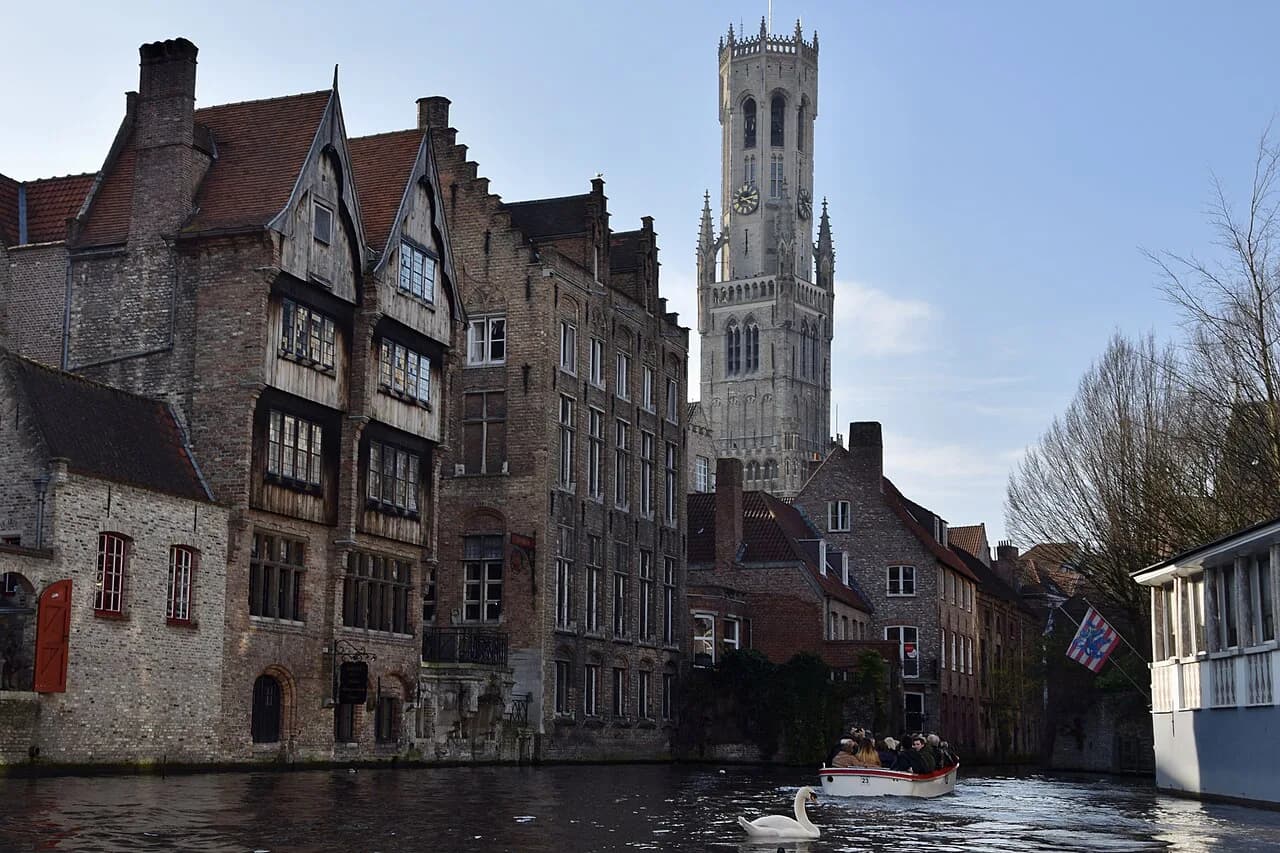
Rozenhoedkaai (Quai du Rosaire): Bruges' Most Photographed Quay

The Rozenhoedkaai is free and always open: it is a public quay and street on the Dijver in central Bruges (Brugge), not an attraction with a ticket desk. Visit Bruges lists it among the city's squares, streets and waterside spots, which is the right way to plan it, as a stop of a few minutes folded into a walk rather than a destination in its own right.
This page covers where the quay sits, the view you get from it, what is visible on both banks, how long to allow and which nearby sights fit around it. It is one of the stops in our Bruges Attractions: 7 Visitor Guides, which covers the city's main paid sights alongside free viewpoints like this one.
What and where the Rozenhoedkaai is
The Rozenhoedkaai, or Quai du Rosaire, is a short waterside street on the Dijver in the heart of Bruges, addressed simply as Rozenhoedkaai, 8000 Brugge. The name refers to the rosary: prayer beads were once sold here, and the spot is now the city's best-known photograph.
Treat it as a street rather than a sight. There is no entrance, no gate and no closing time, so it fits into a walk between the Markt and the museums quarter without any booking or planning. Visit Bruges catalogues it as an outdoor place and street, which is exactly how it behaves on the ground.
Older accounts hold that the quay served as a mooring place for ships in the late Middle Ages, with salt traders unloading here. That origin is presented as belief rather than record, so take it as colourful background while you look at the water rather than as settled history.

The view: canal, bridges and the Belfry
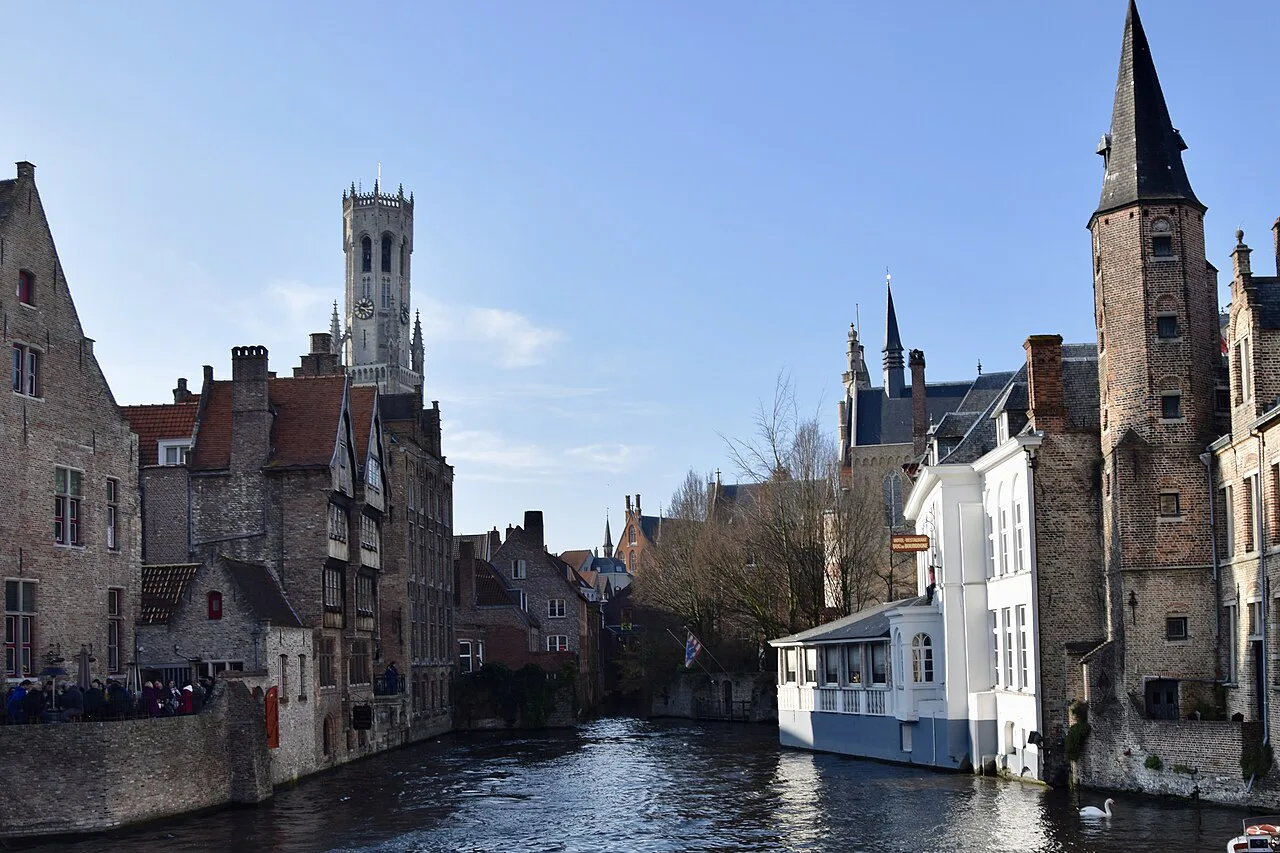
The classic composition looks along the Dijver, with the canal bending away, low bridges crossing it and the brick gables of the old centre closing the view. Visit Bruges calls the Rozenhoedkaai one of the most beautiful views in the city; it is the shot that sells Bruges on postcards, and the reason a short stretch of paving draws a steady queue of cameras.
The quay delivers in dull conditions as well as bright ones. Visit Bruges describes the romantic pull of the spot as working in summer and winter, morning and evening, in sun or rain, which is a fair warning that you cannot count on having it to yourself at any hour.
For planning, the honest advice is to arrive early in the day if you want the paving clearer, and to accept that the light you get is the light you get. The view is photogenic in any season, so there is no wrong month to stand here, only busier and quieter moments.

What to look at on both banks
Look across the water as well as along it. The Meebrug, a fourteenth-century bridge, and the Peerdenbrug, a seventeenth-century one, both cross this stretch, and Visit Bruges points visitors to them as part of the same waterside scene rather than as separate excursions.
On the opposite bank, the Passage Bourgondisch Cruyce is the narrow passage that appears in so many photographs taken from the quay. Visit Bruges singles it out as somewhere to linger once you have taken the obvious picture, and it is free to walk through.
The quay sits on the Dijver, the canal that also threads past the city's art museum and a cluster of waterside sights. Walking a few hundred metres along it in either direction gives you more bridges, more gables and a quieter stretch of water without leaving the centre.
Getting there from the Markt and Burg
On foot is the sensible way. From the Markt, walk south past the Belfry and the cloth hall towards the water; from the Burg, take Wollestraat down towards the Dijver. Either approach brings you to the quay within a short walk of the main squares.
If you are arriving by bus, the nearest stop is Brugge Dijver, a short walk from the water. The city's main station, Station Brugge, is the reference point for rail arrivals, and from there the centre is a continuing walk or a short onward connection rather than an immediate step onto the quay.
Cyclists will find the quay itself better walked than ridden: it is a narrow paved edge beside water, and the pleasure is in standing still. Lock the bike nearby and cover the last stretch on foot.
How long to allow
Fifteen to thirty minutes covers the view, the photographs and a look along both banks. That budget assumes you are content to stand, shoot and move on; anyone hoping to wait out a crowd should add time, because the quay is a thoroughfare and people pass through continuously.
The quay works best as a hinge in a longer walk rather than a standalone outing. Slot it between the Markt and the museums quarter, or use it as the pause before or after a canal boat trip from the same stretch of water.
Canal boats from the quay area
Boat trips run on this part of the Dijver, and Visit Bruges treats a canal cruise as close to essential for a first visit, describing the waterways as the arteries of the city. The boat page is listed at Huidenvettersplein 13, a short walk from the Rozenhoedkaai, so you can see the water from the quay and then get onto it.
Boats are the one part of this area that needs arranging rather than simply turning up to enjoy. Fares, departure times and season are set by the operators, so check them at the quay or through the tourist office on the day you plan to sail instead of budgeting from an old figure.
Nearby sights within a few minutes' walk
The Burg is the first stop, with the basilica of the Holy Blood Bruges on its corner and the Stadhuis across the square. Both are within a few minutes of the water, and the basilica's chapel and relic make a natural pairing with the quay's religious name.
The Markt, with the Belfort at its head, is the other anchor, and the Historium Bruges on the square is a straightforward stop if you want a fixed-hours indoor visit near the quay. Continue south past the water and you reach the Groeningemuseum Bruges, home to the city's Flemish Primitives and a natural next step for anyone following the Jan van Eyck trail.
Two more sights round out a half-day on this side of town. The church of our Lady Bruges, with its tall brick tower, and the brewery De Halve Maan sit within a comfortable walk, giving you a church and a working brewhouse to bookend the quay's free view.
If you would rather build a full day around the centre, our things to do in Bruges guide sets the quay alongside the city's other free and paid stops. The quay is the easy part: it is free, it does not close and it takes as long as your camera roll demands.
Should the Rozenhoedkaai be on your Bruges shortlist?
Yes, as a stop rather than a destination. The Rozenhoedkaai is free, open at any hour and a short walk from the Markt, so it earns its place on a one- to three-day Bruges itinerary as the photograph you take on the way to somewhere else.
Build it into a loop: the Markt first, then the quay, then the Burg and the Dijver museums, with a canal boat if the water has tempted you. Allow half a day for that circuit and you will have seen the centre's essential view without ever buying a ticket for it.
Explore more Bruges guides
Frequently Asked Questions
Is the Rozenhoedkaai free to visit?
Yes. The Rozenhoedkaai is a public quay and street on the Dijver in central Bruges, not a ticketed attraction, so there is no entrance charge and no gate to pass through.
Why is the Rozenhoedkaai so popular for photos?
It offers a single frame of the canal, low bridges and the brick gables of the old centre, which is why it has become the most photographed view in the city. Visit Bruges describes it as one of the most beautiful views in Bruges, and it draws photographers through summer and winter, morning and evening.