
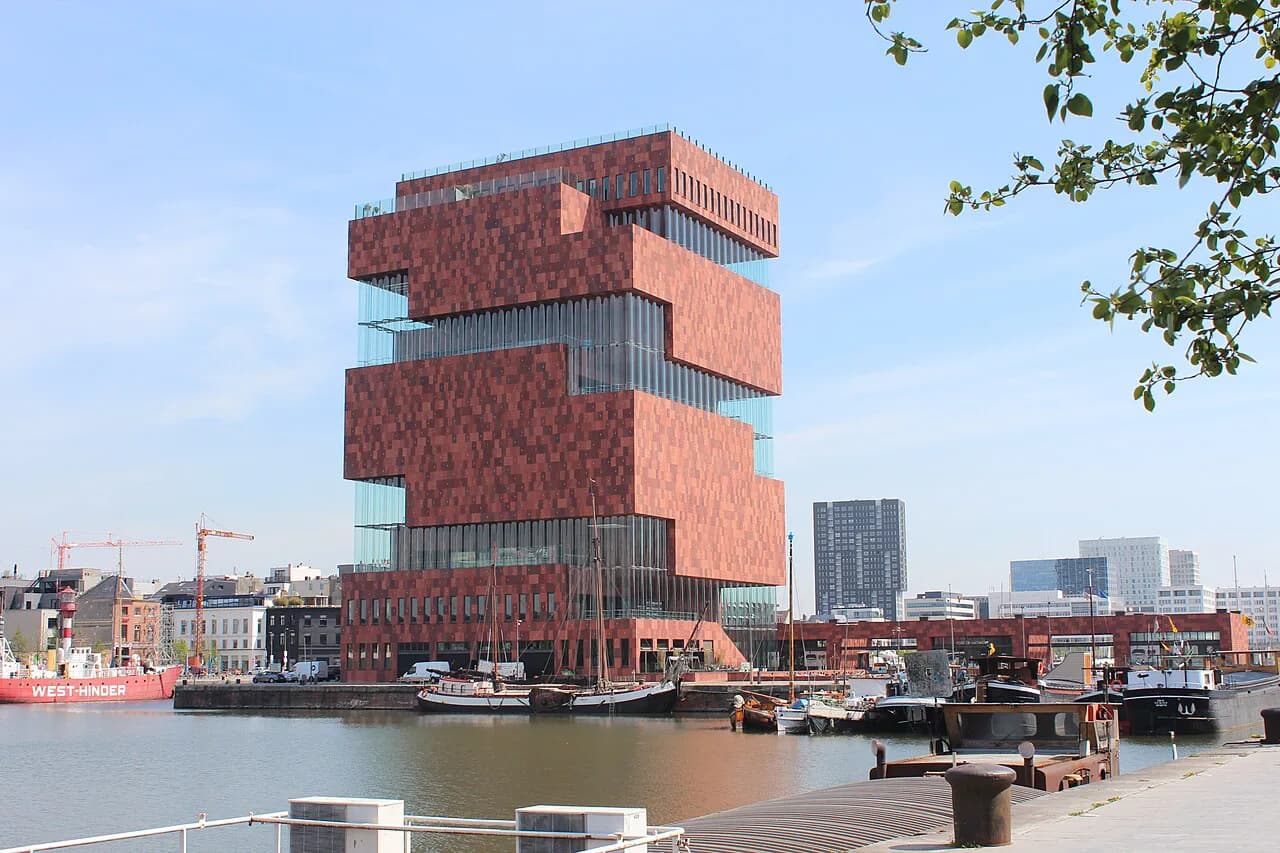
MAS Antwerp: What to See at the Museum aan de Stroom

MAS Antwerp is worth a half day: the Museum aan de Stroom is a red tower of stacked exhibition floors on the Eilandje, and the climb up its escalator route ends at a rooftop view over the docks and the city. Budget about two hours for the paid displays and the same again for the free levels, then walk the surrounding quays. This guide covers the building's setting on Hanzestedenplaats, what each floor holds, which temporary exhibitions are worth timing a trip around, and what sits within a few minutes' walk.
What the MAS is and why it stands out on the Antwerp waterfront
The MAS is a museum of the city and its relationship with the river and the world beyond it, housed in a deliberately striking contemporary building rather than a historic one. Its red stone facade and stacked volumes make it the landmark of the Eilandje, the old dockland north of the historic centre, and the museum's own positioning stresses encounters between Antwerp, the port and other cultures. Come for the building and the view as much as the collections: this is one of the few Antwerp museums where the architecture is part of the visit.
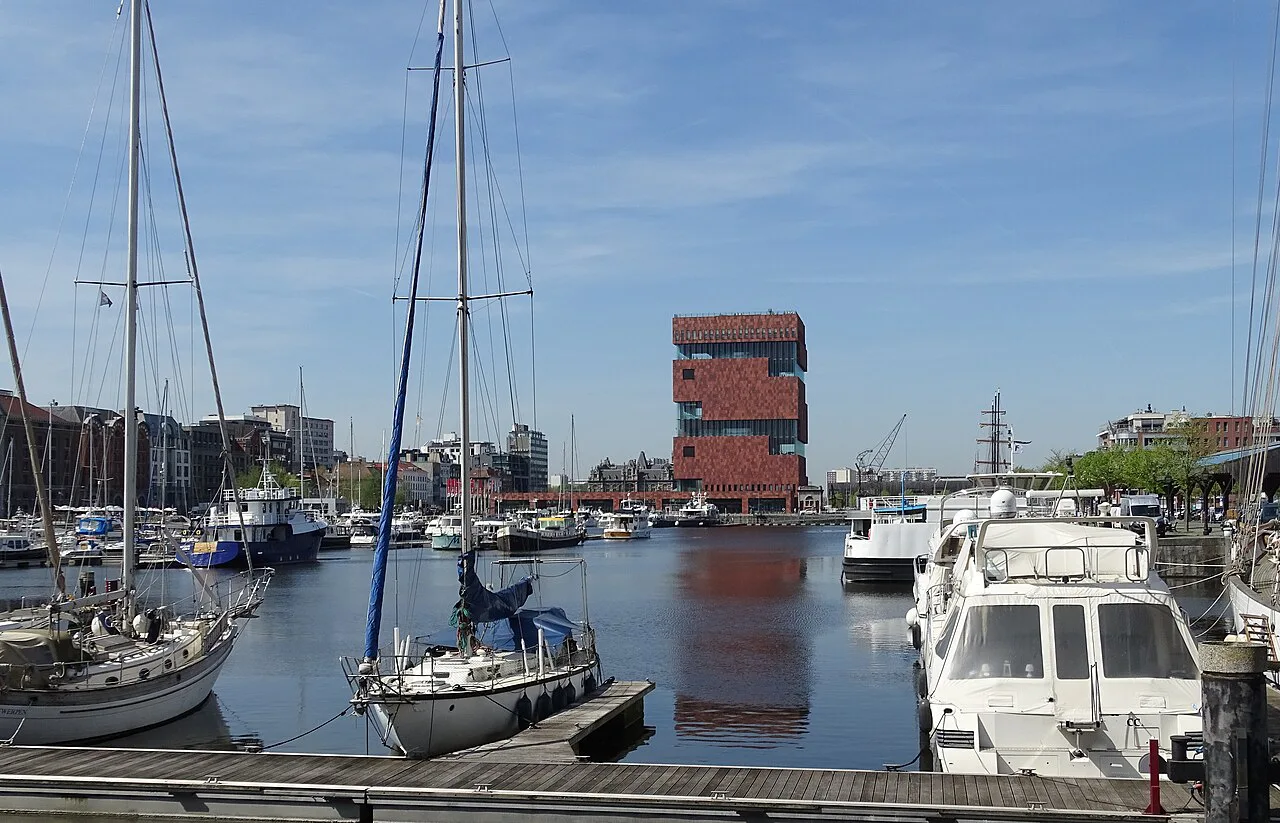
The setting sells it. The Eilandje was a working harbour district, and the museum sits among docks, quays and converted warehouses, so a visit slots naturally into a walk along the water rather than a trip into a museum quarter. The tourist office treats it as the headline attraction of the neighbourhood, which is a fair summary of how it functions for a short break.
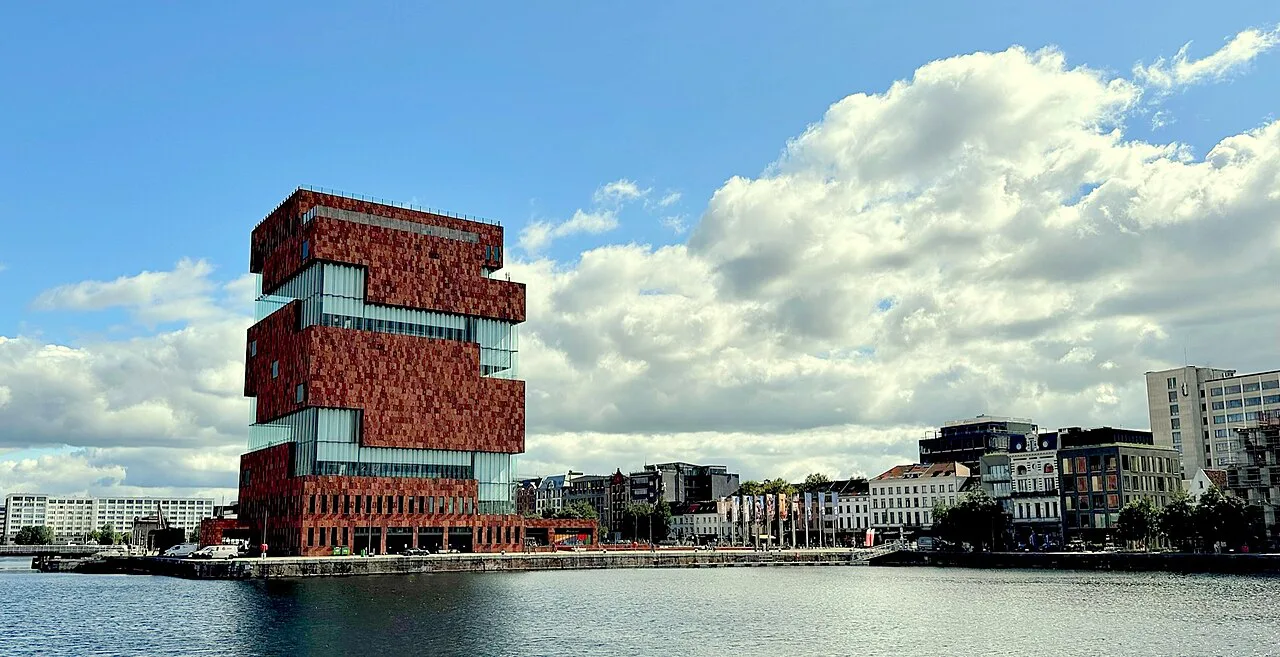

Where the MAS is: Hanzestedenplaats 1 on the Eilandje
The address is Hanzestedenplaats 1, 2000 Antwerpen, on the Eilandje about a twenty-minute walk north of the cathedral and the Grote Markt. From the historic centre, head towards the MAS via the old docks; the tower is visible long before you reach it, so navigation is easy. Allow a slow half hour if you want to take in the waterfront on the way rather than walking directly.
Trams and buses serve the Eilandje, but routes and stops change, so plan the last leg on the day with the local transport planner rather than relying on a fixed line number. If you are already exploring the centre, walking is the better choice: it keeps the docks in view and avoids a transfer for a trip that takes little longer on foot.

What is on show inside, floor by floor
The permanent displays are thematic rather than chronological. Antwerpen à la carte traces the city's history through food, an angle that suits the museum's approach of telling urban history through ordinary life. Fracht, on the sixth floor, covers the port, the people who worked it and the goods that passed through, from the Viking era to container shipping, and does not shy away from the costs of economic growth.
Two further exhibitions widen the range. Stadt im Krieg covers Antwerp between 1940 and 1945, using personal stories and objects to make military violence and mass persecution concrete. Kunst aus Amerika presents the Paul & Dora Janssen-Arts collection, which explores the relationship between life and death in the cultures of the Americas before European conquest. Jemand zu Hause? is the family-oriented display, a playful set of characters asking what home means.
Not everything costs money. On the museum's own listing, the Schaudepot displays are marked free entry: Lebendige Sammlung, lebendige Traditionen, in which eight Antwerpers present an object tied to a tradition they still practise, and a display of eleven dolls from Maria Nijs's collection of dolls made in Europe between 1830 and 1930, shown with a portrait of her painted by her father. A free photography exhibition on martial arts in Antwerp runs along the escalators in the Boulevard, and free stories from schoolchildren taking part in the De Wondere Pluim writing competition can be heard in the Kijkdepot.
The Boulevard escalators, roof and free displays
The Boulevard is the museum's internal street: a route of escalators climbing through the building, with free displays along the way and the roof at the top. Treat it as the backbone of the visit rather than a corridor. Each level opens onto a different view and a different piece of the collection, so even travellers who skip the paid floors get a genuine sense of the place.
The climb is also the reason to come on a clear day. Go up first to see how the city and docks lie, then work back down through the floors you want to see properly. The museum's own short-tour suggestion pitches the escalator route and roof as a compact cultural stop when time is tight, which is a sensible plan for a one- or two-day Antwerp visit.
Current exhibitions worth timing a visit around
Martial Arts is the exhibition to build a trip around if the subject appeals. The museum lists it from Friday 3 April 2026 to Sunday 29 November 2026, open 10:00 to 17:00, and it examines kickboxing, karate, capoeira, kung fu and Nguni stick-fighting through their beauty, philosophy and traditions. If you are in Antwerp outside that window, check the museum's programme for what replaces it before committing an afternoon.
Beyond that, the permanent-themed displays give the museum its shape, and the sixth-floor port exhibition is the one most visitors remember. Older shows such as World city, World Port and Exodus have closed and are listed only as history on the museum's site, so do not plan around them.
How long to allow and how to pace a visit
Two hours covers the main themed floors at a steady pace, and three to four hours covers everything including the free Schaudepot displays and a proper stop on the roof. Families should weight the time towards the Boulevard and Jemand zu Hause?, which are built for a younger pace. If you only have an hour, take the escalators to the top, look out, and come down through one floor of your choice.
Sequence matters more than speed. Start at the top of the escalator route for orientation, then descend into the port display, the city-and-food gallery and whatever temporary show is running. Leave the ground level and the shop for the end, when you are ready to step back out onto the docks.
Pair the museum with the Eilandje rather than rushing back to the centre: the quays, docks and converted warehouses around Hanzestedenplaats reward a slow loop of thirty to forty-five minutes after your visit. That combination fills an afternoon comfortably without a second museum.
Tickets, tours and booking
Tickets are sold through the museum's own booking channel, and guided options include a full MAS tour, a quick tour of the Boulevard and an architecture walk, plus tours for visitors who do not speak Dutch. Prices, opening days and tour times vary, so confirm them on the museum's site when you book; the free-entry labels on the Schaudepot and Boulevard displays are stated directly on the museum's listing.
Book ahead for the architecture and guided tours if those are the reason you are going. General admission is more forgiving, and booking in advance is the safest way to secure a place.
What to see nearby on the Eilandje
The Eilandje holds two other museums within walking distance that round out a dockland day. The Red Star Line Museum, Antwerp tells the story of the shipping line that carried emigrants from these docks to North America, and it sits close enough to combine with the MAS in a single afternoon.
In the other direction, back towards the centre, the Plantin-Moretus Museum is the city's printing-house treasure and a UNESCO-listed site, roughly half an hour on foot from the MAS. It makes a natural pairing if you are building a day around museums rather than docks.
If you want the fine-art counterweight, the KMSKA holds Antwerp's old masters and modern collection south of the centre, though it is a separate trip rather than a walk from the Eilandje. Use the Antwerp Attractions: 4 Visitor Guides overview to see how the city's main sights fit together across a short break.
Should the MAS be on your Antwerp shortlist?
Yes, if you want one museum that explains Antwerp to you: the port, the food, the war years and the city's place in the world, all in a building that is itself the attraction. The free Boulevard and roof mean even a tight schedule gets something out of the visit.
Skip it if your priority is old masters or printing history; in that case the KMSKA or the Plantin-Moretus Museum will serve you better. Otherwise put the MAS on the first afternoon, walk the Eilandje afterwards, and leave the centre for the next morning.